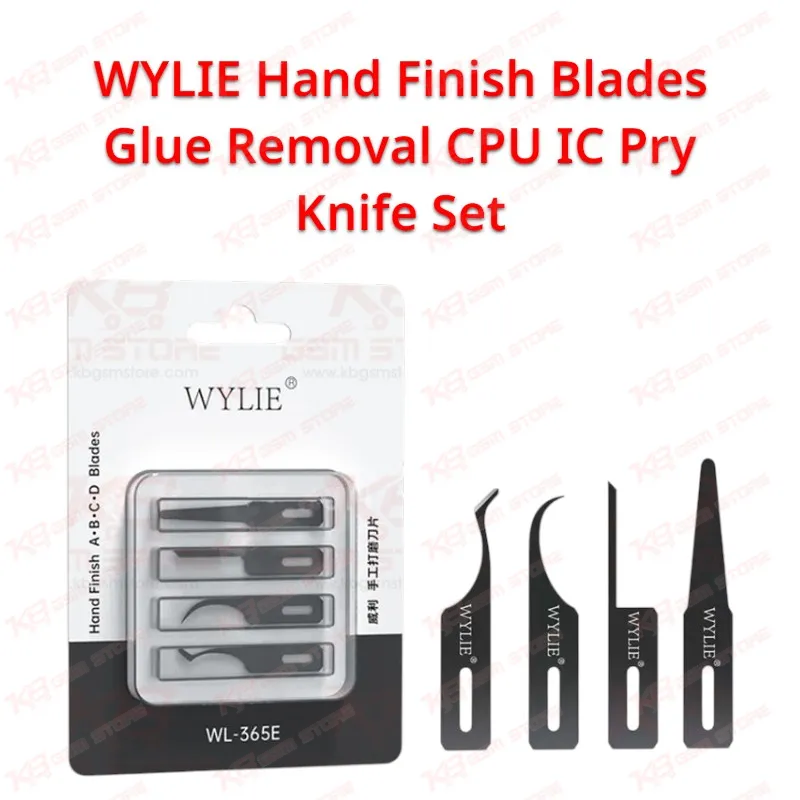
Every technician who has tried to pry a CPU or PMIC off a motherboard with a generic blade knows the risk: one slip and you have lifted pads or a cracked chip instead of a clean removal. The WYLIE WL-365E 4-in-1 Hand Finish Blade Set exists to remove that guesswork. Instead of one all-purpose blade, WYLIE ships four separate blades, each ground for a distinct stage of the glue removal process, so the tool you pick up matches the job you are actually doing rather than forcing one edge to compromise across every task. The first blade separates the CPU and NAND flash package, giving you a controlled starting point when a board needs the processor lifted for reballing or replacement. The second targets the glue layer directly underneath IC and CPU chips on the motherboard, cutting through the adhesive bond without transferring shock into the pads below it. The third is built for side glue removal, the thin bead of adhesive that runs along the perimeter of a chip and often gets skipped with wider blades, leaving resistance that leads to a forced, uneven lift. The fourth blade handles underfill black glue, the dense epoxy fill used under CPUs on many modern boards, cutting through it cleanly instead of dragging or tearing the surrounding solder mask. All four blades share the same high-hardness construction, keeping their edges sharp through repeated sessions instead of dulling and rounding off after a handful of boards, which is a common complaint with cheaper degumming knives. Stainless steel construction also means the blades resist corrosion from flux residue and cleaning solvents that sit on a repair bench day after day. In practice, this set fits directly into the glue removal and CPU tiering stage of board-level repair: after hot air separates a chip enough to work with, these blades take over for the fine, close-contact cutting that determines whether the pads underneath survive intact. That matters directly for reballing work, where a damaged pad means a failed reflow no matter how good the reballing stencil or solder paste is afterward. It also matters for dead-after-flash and no-power diagnostics, where a suspect IC needs to come off cleanly enough to test or replace without collateral damage to neighboring components. Technicians working ISP, eMMC, and UFS repair benches will recognize the same need: removal quality upstream directly affects whether the chip can be reattached and read correctly downstream. Because the blades are separated by function rather than combined into one compromise edge, workshops running high volumes of CPU and IC-level repairs see fewer damaged boards and less rework compared to using a single universal scraper for every glue type. The set is compact enough to sit in a tool roll or drawer alongside hot air stations, microscopes, and reballing kits, and it pairs naturally with PCB fixtures and precision tweezers already on a technician's bench. For shops handling Qualcomm, MediaTek, Samsung, HiSilicon, or Apple platform boards, glue composition and thickness vary, and having four distinct blade profiles available means you are not stuck adapting one edge across inconsistent adhesive types. The result is a tool built around how CPU and IC glue removal actually happens on a busy repair bench, not a single blade asked to do four different jobs.