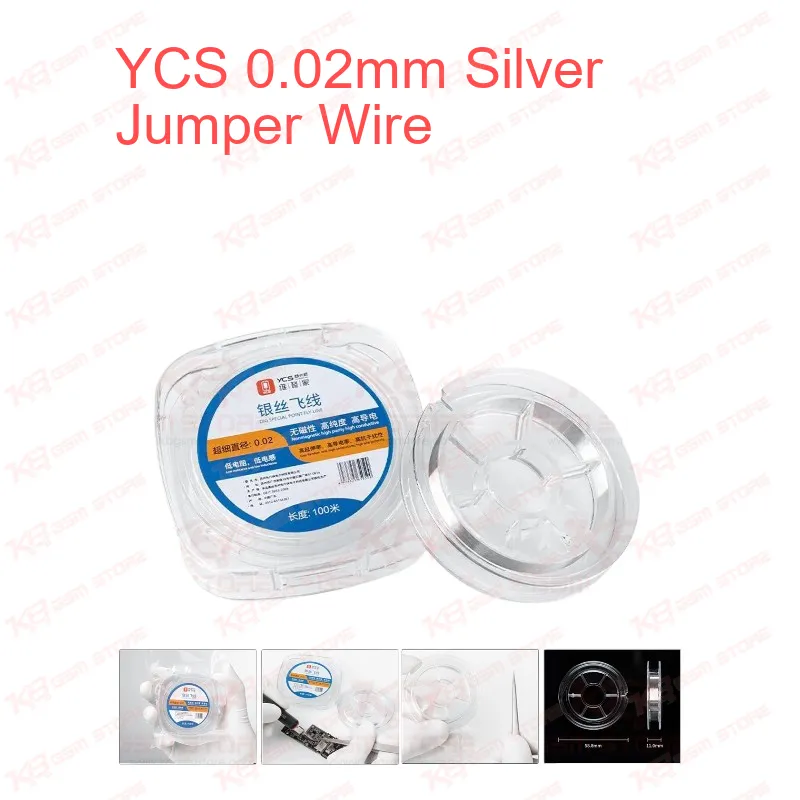
A single lifted pad under a charging IC or a torn trace beside the CPU can turn a simple charging issue into a dead phone on your bench, and the YCS 0.02mm Silver Jumper Wire gives you the precision link you need to bring that circuit back. YCS built this ultra-fine flying wire for mobile phone motherboard, PCB, and CPU pad repair, and at just 0.02mm in diameter it fits between tightly packed components where thicker wire blocks your view and bridges neighbouring points. The 100-meter spool covers hundreds of jobs, so one roll keeps a busy repair shop running jumper work for months. The silver wire offers strong electrical and thermal conductivity with low solder resistance, so solder flows onto it quickly and grips the pad without you holding the iron on a sensitive area for too long. That matters near heat-sensitive ICs, because every extra second of heat raises the risk of lifting another pad or damaging underfill. The wire comes bare with no enamel coating, so you never scrape paint or burn insulation before soldering; you tin the end and attach it directly. A bare wire can short against a neighbouring component if you route it carelessly, so experienced technicians keep it low on the board, steer it away from exposed pads, and seal it with UV solder mask once the connection tests correct. Good toughness and elongation let the wire bend around capacitors and shield frames without snapping, and the breakpoint-free length means you never discover a hidden break halfway through a long run. Its non-magnetic nature stops it from clinging to steel tweezers, and its corrosion resistance keeps a finished jumper stable long after the customer collects the phone. On a Pakistani repair bench, the YCS 0.02mm Silver Jumper Wire handles the faults you see every day: a no-charging fault after water damage, a network issue from a broken RF line, a display problem caused by a missing line at the FPC connector, a hang on logo or boot loop issue traced to a damaged pad after CPU reballing, or a missing fingerprint line that needs a long, thin jumper. You reach for it after IC removal when a pad lifts, during board-level fault finding when you bypass a corroded via, and after reballing when a pad comes away with the old solder. The wire sits at the final stage of the hardware fault workflow, after diagnosis and before testing, so it performs best alongside a complete rework setup. A temperature-controlled soldering station with a fine conical or knife tip gives you the control a 0.02mm diameter demands, a stereo microscope shows you exactly where the wire meets the pad, and a PCB holder keeps the motherboard steady during long runs. Hot air stations and reballing kits prepare the board before jumper work, and a multimeter in continuity or diode mode confirms the new line before you power the phone through a test box or DC supply. Technicians moving from basic charging port repair to CPU-area and baseband work usually upgrade from thicker or enamelled copper wire to this ultra-fine silver option, because fine-pitch iPhone and Android motherboards leave no room for anything heavier. The wire suits beginners building a first micro-soldering kit and senior service centre technicians who run dozens of jumpers a week, and the 100m length makes it a cost-effective consumable for repair shops in Lahore, Karachi, Islamabad, and every city where board-level repair keeps growing. Keep a spool beside your microscope and you always have a reliable answer when a trace breaks and the customer still wants a working phone.