Skip to product information
1 of 4
Brand: YCS

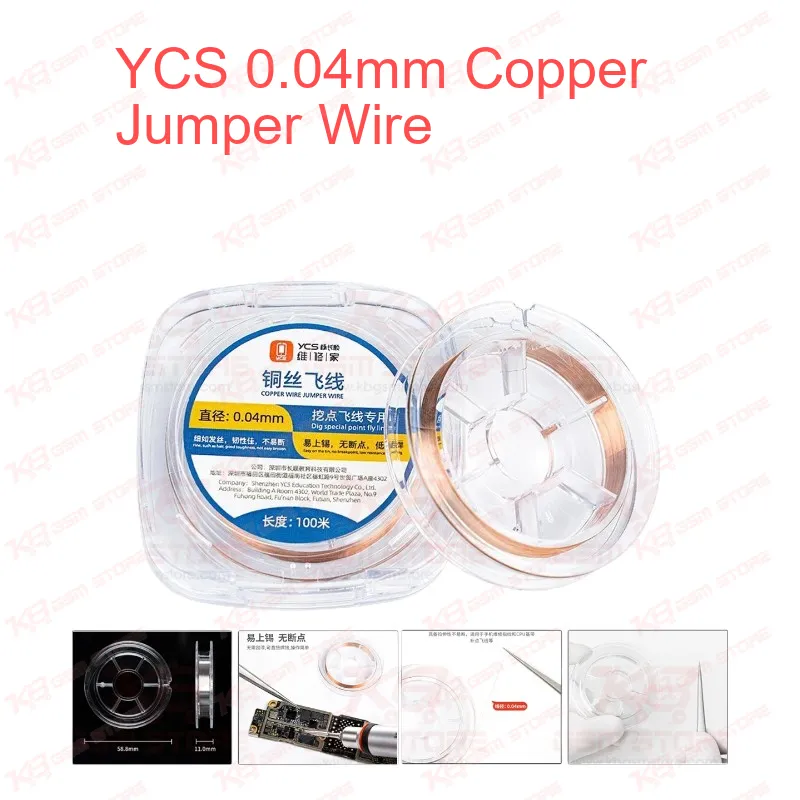
YCS 0.04mm Copper Jumper Wire

YCS 0.04mm Copper Jumper Wire

Regular price Rs.700.00 PKR
Regular price Rs.900.00 PKR Sale price Rs.700.00 PKR
Sale Sold out
Shipping calculated at checkout.
Quantity

The 0.04mm Copper Jumper Wire is an ultra-fine enameled copper wire built for micro soldering work on mobile phone motherboards. Technicians use it to jumper broken tracks, repair damaged flex cable pads, and restore continuity on tightly packed PCB points where a standard wire is too thick to fit. The enamel coating burns off directly under soldering iron heat, so there is no need to strip or scrape the wire before use. Its 0.04mm diameter makes it suitable for fine-pitch IC pads, board-level jumpers, and tight component gaps on modern smartphone boards, making it a regular item on the GSM repair bench.

SKU:MST-SOLDERING-ACCESSORIES-581

⚖️ Weight: 0.03 kg

  • Safe & Secure Payment
  • Fast Delivery
  • WhatsApp Support
View full details

Description

On a modern smartphone motherboard, track spacing has gotten tighter every year, and a technician doing board level kaam needs a wire fine enough to sit between pads without bridging the next point. The 0.04mm Copper Jumper Wire is made for exactly that job. It is a common item in any GSM workshop that handles dead phone repair, hardware fault diagnosis, and PCB level fixes where a broken track has to be reconnected point to point rather than replaced.A thicker jumper wire works fine on older or larger boards, but on current generation phones the pads sit close enough that a 0.1mm or 0.15mm wire simply will not lay flat without touching a neighboring point. At 0.04mm this wire can be routed between fine pitch IC legs, along narrow board traces, and into cramped connector areas without the risk of a short. This is the same reason experienced technicians keep a fine gauge wire like this one separate from their general purpose jumper stock — it is reserved for the jobs a normal wire cannot handle.The wire carries a thin enamel coating rather than bare copper. This matters on the bench because it means the wire will not short against adjacent components while it is being routed and positioned. Once it is placed and heat is applied with a soldering iron, the enamel burns away at the contact point, so the technician does not need to scrape or strip the wire first. This self-fluxing behavior is standard for fine gauge copper jumper wire used in mobile repair and saves a step during time sensitive board work.This wire sits at the PCB repair and micro soldering stage of the mobile repair workflow, after diagnostics have already identified a broken track, a lifted pad, or a damaged flex connector point as the fault. It is not a diagnostic tool and it is not a substitute for a proper reballing or IC replacement — it is used once the technician has already traced the fault and needs to physically restore the electrical path. Common scenarios include a phone stuck in a boot loop after a board level short, a charging issue traced back to a broken trace near the charging IC, or a display problem caused by a damaged connector pad. In each case the wire bridges the gap left by the original track.Because the wire is this thin, it is usually held with tweezers rather than fingers, positioned under a microscope or magnifier, and tacked down with a fine tip soldering iron at low temperature. Technicians typically keep a small length pulled out at a time rather than unspooling more than needed, since 0.04mm wire kinks easily if handled roughly. It pairs naturally with a microscope, a fine tip iron, and flux, and is often used alongside reballing and rework stations during the same repair session.For a shop doing regular board level repair, having a dedicated fine gauge wire on hand avoids the workaround of splitting a thicker wire or using scavenged strands from other cables, both of which are inconsistent and slow down the job. A dedicated 0.04mm spool gives predictable results job after job, which matters when a customer is waiting on a same day dead phone or hang on logo repair.

Key Features

  • 0.04mm diameter for fine-pitch board level work
  • Enamel coated for direct soldering without stripping
  • Suitable for tight IC pad and connector spacing
  • Reduces risk of shorting against adjacent pads
  • Works with standard soldering iron and flux
  • Ideal for microscope-assisted micro soldering
  • Useful for reconnecting broken PCB traces
  • Compact spool, easy to store on the repair bench

Specifications

Brand Entity YCS
Product Entity Copper Jumper Wire (0.04mm)
Technology Entity Micro Soldering, PCB Repair
Compatible Device Entities Universal Mobile Phone Motherboards
Repair Process Entity Board Level Repair, Track Jumpering, Rework
Industry Entity Mobile Repair Industry, GSM Technician Tools

Compatible Devices


Universal — not device-specific. Suitable for all mobile phone, tablet, and general PCB motherboards where fine-pitch jumper repair is required.

Common Repair Uses


Broken PCB track repair, damaged flex cable pad restoration, IC pad jumpering, charging port trace repair, board-level short circuit fixes, dead phone and boot loop board repair, fine-pitch connector point restoration.

FAQ

What is the product name?
The product name is 0.04mm Copper Jumper Wire.
What is the brand of this product?
The brand of this product is YCS.
What is this product used for?
This product is used for repairing broken PCB tracks and jumpering board level connection points during mobile phone repair.
Which devices are compatible with this product?
This wire is universal and not device-specific, suitable for any mobile phone or tablet motherboard requiring fine jumper repair.
Who should use this product?
This product is suitable for mobile repair technicians, repair shops, service centers, and professional PCB repair users.
Does this wire need to be stripped before soldering?
No, the enamel coating burns off under soldering iron heat, so the wire can be soldered directly without stripping.
Is 0.04mm wire suitable for fine-pitch IC pad repair?
Yes, its thin diameter allows it to be routed between closely spaced pads and fine-pitch IC legs without bridging adjacent points.