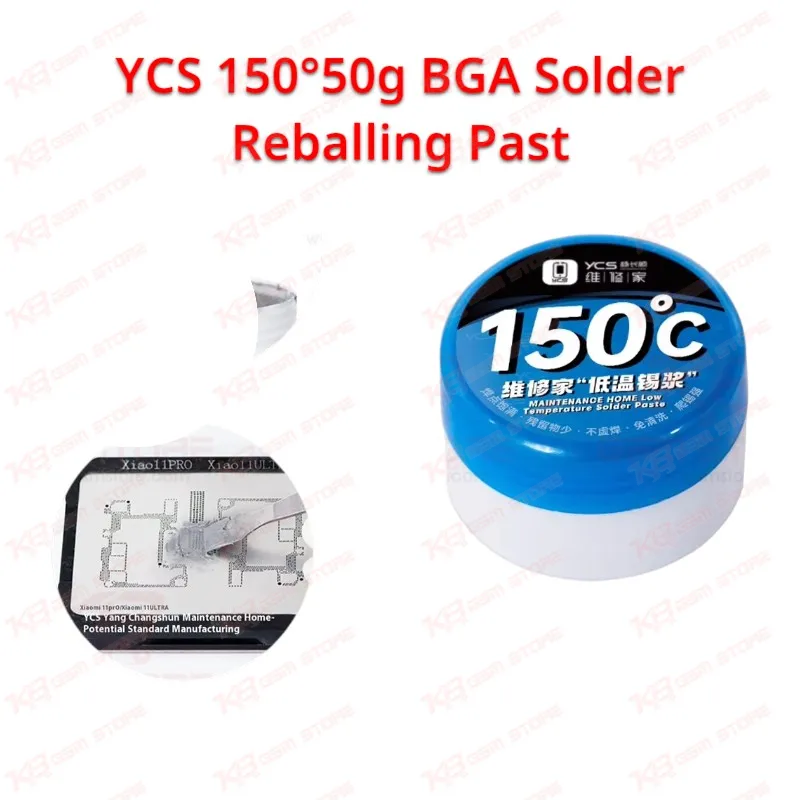
Low-temperature reballing often decides whether a CPU job ends with a working phone or a cooked board, and the YCS 150°50g BGA Solder Reballing Past gives you a controlled middle point between 138°C and 183°C pastes on your repair bench. YCS formulates this 150°C tin paste for BGA, IC, CPU, and PCB precision soldering, so one jar covers most of the reballing jobs a busy Pakistani repair shop handles in a week. When a dead phone lands on your counter with a suspected CPU or memory joint failure, the paste you load into the stencil decides whether the new balls sit straight or roll away during heating. A 150°C melting point lets you lift and reball a chip without pushing the surrounding components, plastic connectors, and display FPC sockets through the full heat of a medium-temperature job. That difference matters most on modern motherboards, where a camera connector or a tiny capacitor sits only millimeters away from the IC you need to rework. The paste itself carries the qualities technicians check first when they open a new jar. YCS keeps the texture uniform and fine, with strong wettability that pulls solder cleanly onto pads and chip balls. The viscosity stays stable during work, so the paste holds its shape inside stencil holes without collapsing or shifting, and your chip stays in position while the solder melts. Anti-oxidation performance protects the paste during repeated jar opening, and finished joints come out bright and full instead of dull or grainy. Strong activity also cuts down the poor joints and false soldering that bring a phone back to your counter a week later with the same hardware fault. In a typical reballing workflow, you remove the faulty or suspect IC with your hot air station, clean the old solder from the chip and board pads with wick and flux, and lock the chip into a reballing stencil from your reballing kit. You spread a thin layer of the YCS 150°50g BGA Solder Reballing Past across the stencil with a blade, scrape away the excess, and heat evenly until every hole forms a round, shiny ball. After cooling, you lift the stencil, inspect the balls under a microscope, clean the residue, and refit the chip on a board held firmly in a PCB holder. A steady hand and controlled airflow give the best result, and this paste rewards both by forming balls without bridging or splashing onto neighbouring pads. This paste earns its place in boot loop issue repairs, hang on logo faults caused by weak memory or CPU joints, and dead after flash cases where the software side checks out but the board still refuses to boot. You also reach for it during charging issue repairs that need a PMIC or charging IC change, network issue repairs involving RF or baseband ICs, and display problem repairs where a display IC needs fresh joints. Once you trace a fault to a cracked or dry BGA joint with your multimeter and test boxes, a clean reball with a reliable paste often brings the board back without replacing the whole motherboard. The 50g jar keeps enough paste for many reballing jobs without stocking an oversized tub that dries out on the shelf. Keep the lid tightly closed after each use and store the jar away from heat sources so the paste keeps its consistency from the first job to the last. Pair it with a quality flux, fresh desoldering wick, a fine-tip soldering station, and the right stencils for the chips you handle most, and your BGA rework setup covers the full cycle from chip removal to final refit. If you plan to take on more CPU and stacked-board work, a digital hot air station with stable airflow control makes a logical upgrade alongside this paste, since even heating matters as much as paste quality. For shop owners searching the YCS solder paste price in Pakistan, this 150°C option gives you a practical everyday reballing paste that balances safe working temperature with strong, reliable joints across a wide range of mobile motherboard repairs.