


Brand:
YCS
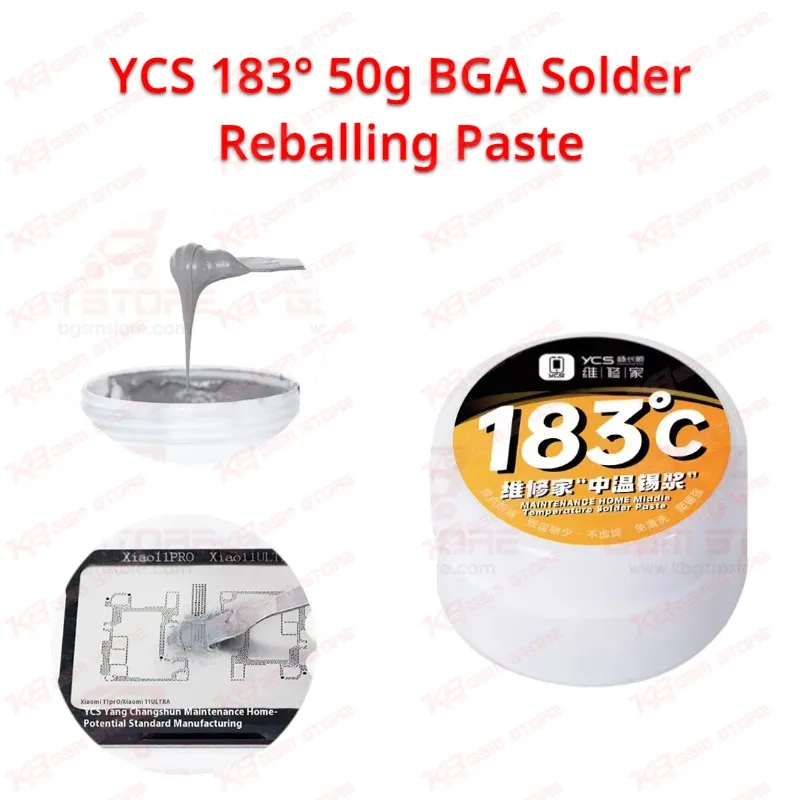
YCS 183° 50g BGA Solder Reballing Paste
YCS 183° 50g BGA Solder Reballing Paste
Regular price
Rs.1,250.00 PKR
Regular price
Sale price
Rs.1,250.00 PKR
Shipping calculated at checkout.
Quantity
Couldn't load pickup availability
The YCS 183° 50g BGA Solder Reballing Paste gives your repair bench a medium temperature option for CPU, storage chip, and power IC reballing. Its 183°C working point sits between YCS low temperature grades (138°C and 150°C) and high temperature grades (199°C and 215°C), so you control heat without cooking nearby components. The smooth, viscous body holds solder in each stencil hole, resists slump and shift, and leaves bright, full joints with strong wetting. The compact 50g jar fits any workstation drawer and handles daily IC replacement work on dead phones, charging faults, and network issues in Pakistani repair shops.
SKU:MST-SOLDERING-ACCESSORIES-728
⚖️ Weight: 0.05 kg
- Safe & Secure Payment
- Fast Delivery
- WhatsApp Support


Description
FAQ
What is the product name?
The product name is YCS 183° 50g BGA Solder Reballing Paste.
What is the brand of this product?
The brand of this product is YCS.
What is the model of this product?
The model of this product is YCS 183°C medium temperature solder paste, 50g.
What is this product used for?
This product is used for BGA chip reballing, IC replacement, and precision PCB soldering on mobile phone motherboards.
Which devices are compatible with this product?
This product is compatible with mobile phone motherboards and BGA, IC, and CPU packages, and it is not device-specific.
Who should use this product?
This product is suitable for mobile repair technicians, repair shops, service centers, and professional users.
Which YCS grade should I choose: 138°C, 183°C, or 199°C?
Choose 138°C or 150°C for heat-sensitive layered boards, 183°C for most everyday CPU and IC reballing, and 199°C or 215°C when you need a higher-strength joint and your board can take the extra heat.
Can I use 183°C paste on a chip that came off a board with lead-free solder?
Yes, but remove all old lead-free solder from the chip and pads with wick and flux first, because lead-free alloys melt at a higher temperature and leftover residue gives uneven balls and weak joints.