


Brand:
YCS
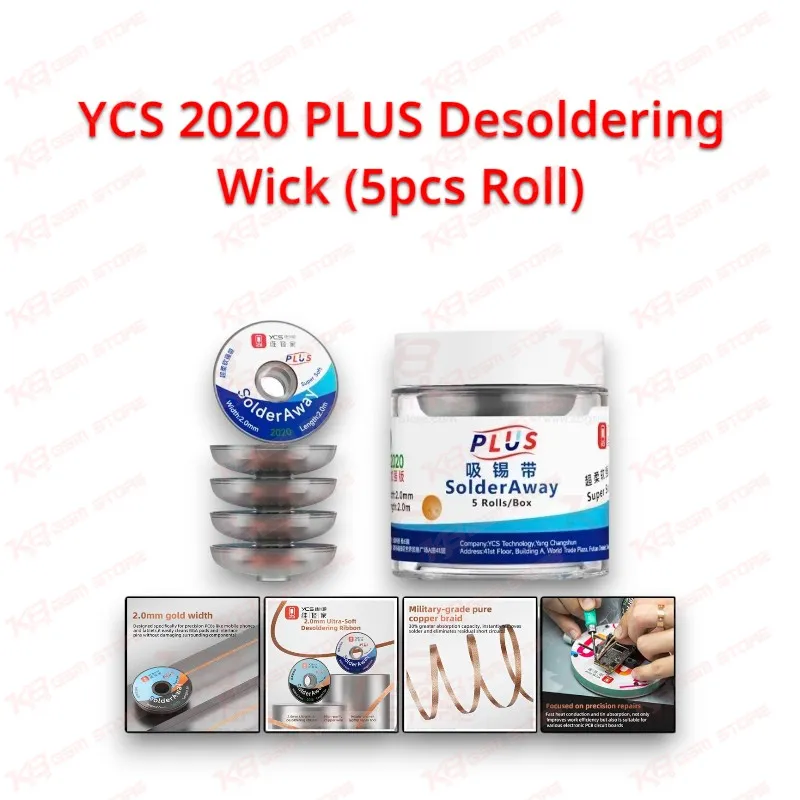
YCS 2020 PLUS Desoldering Wick (5pcs Roll)
YCS 2020 PLUS Desoldering Wick (5pcs Roll)
Regular price
Rs.1,650.00 PKR
Regular price
Sale price
Rs.1,650.00 PKR
Shipping calculated at checkout.
Quantity
Couldn't load pickup availability
The YCS 2020 PLUS Desoldering Wick (5pcs Roll) gives you a 2.0 mm pure copper braid loaded with rosin flux for fast, clean solder removal on mobile phone motherboards. Each roll carries 2.0 m of braid, and the 5-roll pack keeps a fresh spool ready on your repair bench. You get quick solder pickup on charging IC pads, PMIC footprints, connector pins, and CPU or eMMC pad areas before reballing. The fine copper weave pulls heat into the joint quickly, so you spend less time on each pad and protect nearby components. A practical, budget-friendly consumable for repair shops and technicians across Pakistan.
SKU:MST-SOLDERING-ACCESSORIES-679
⚖️ Weight: 0.01 kg
- Safe & Secure Payment
- Fast Delivery
- WhatsApp Support


Description
FAQ
What is the product name?
The product name is YCS 2020 PLUS Desoldering Wick (5pcs Roll).
What is the brand of this product?
The brand of this product is YCS.
What is the model of this product?
The model of this product is 2020 PLUS.
What is this product used for?
This product is used for removing solder from pads, pins, and joints on mobile phone motherboards and other PCBs.
Which devices are compatible with this product?
This product is compatible with mobile phone motherboards and general PCBs, and it works with any standard soldering iron or soldering station. It is universal and not device-specific.
Who should use this product?
This product is suitable for mobile repair technicians, repair shops, service centers, and professional users.
Can the YCS 2020 PLUS desoldering wick remove lead-free solder from phone boards?
Yes. The copper braid absorbs any solder once your iron melts it, including lead-free alloys. Lead-free solder needs more heat, so use a properly set station and add a little extra flux on old or oxidized pads for a cleaner pull.
Which desoldering wick width works best for CPU and eMMC pad cleaning before reballing?
A 2.0 mm wick like the YCS 2020 PLUS suits most CPU, eMMC, and IC pad areas because it gives you control over small pad rows. For wide ground areas or shield frames, a 3.5 mm wick such as the YCS 3520 covers more surface per pass.