


Brand:
YCS
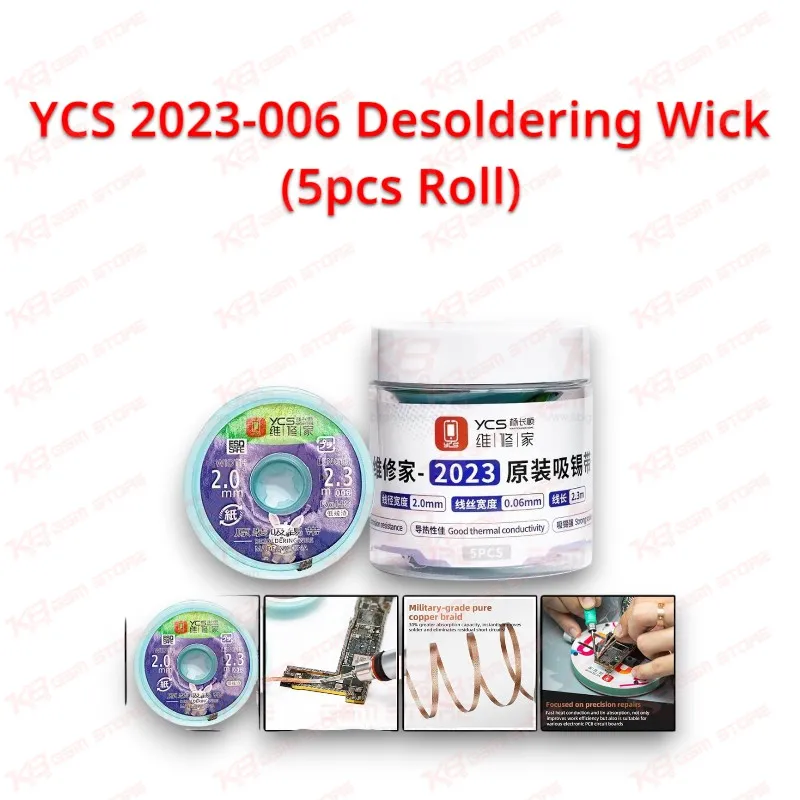
YCS 2023-006 Desoldering Wick (5pcs Roll)
YCS 2023-006 Desoldering Wick (5pcs Roll)
Regular price
Rs.1,500.00 PKR
Regular price
Sale price
Rs.1,500.00 PKR
Shipping calculated at checkout.
Quantity
Couldn't load pickup availability
The YCS 2023-006 Desoldering Wick (5pcs Roll) gives your repair bench a dependable copper braid for removing old solder from mobile phone boards. Each roll is 2.0mm wide and 1.5m long. YCS weaves it from fine 0.06mm pure copper strands and fills the braid with rosin flux. It picks up solder quickly from charging connector pads, PMIC footprints, and CPU or eMMC lands after IC removal. The 2.0mm width fits the tight pad layouts on modern Android and iPhone logic boards. The five-roll pack keeps fresh wick ready for daily jobs in a busy Pakistani repair shop.
SKU:MST-SOLDERING-ACCESSORIES-681
⚖️ Weight: 0.01 kg
- Safe & Secure Payment
- Fast Delivery
- WhatsApp Support


Description
FAQ
What is the product name?
The product name is YCS 2023-006 Desoldering Wick (5pcs Roll).
What is the brand of this product?
The brand of this product is YCS.
What is the model of this product?
The model of this product is 2023-006.
What is this product used for?
This product is used for removing solder from PCB pads, IC footprints, and connector pads during mobile phone board repair.
Which devices are compatible with this product?
This product is compatible with any PCB rework job; it is universal and not device-specific, and it suits smartphone and tablet logic boards.
Who should use this product?
This product is suitable for mobile repair technicians, repair shops, service centers, and professional users.
What are the width, length, and strand size of the YCS 2023-006 wick?
Each roll is 2.0mm wide and 1.5m long, woven from 0.06mm pure copper strands, which suits small mobile IC footprints.
Can I use the YCS 2023-006 desoldering wick to clean BGA pads before reballing?
Yes. After you remove the CPU, eMMC, or UFS chip with hot air, add flux, lay the braid flat, and stroke across the pads to leave them flat and ready for a reballing stencil.