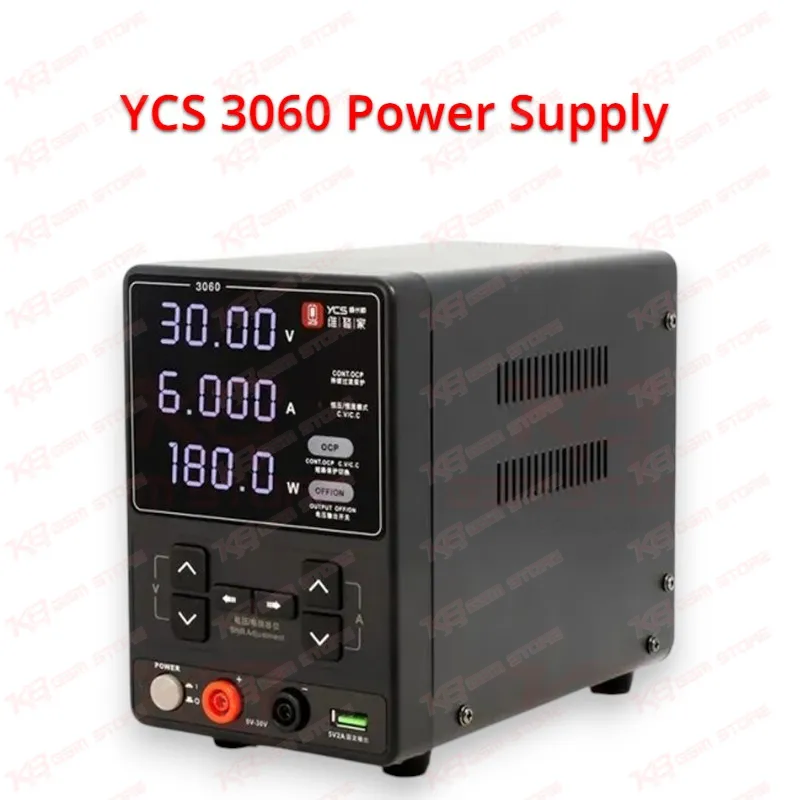
Every board-level technician knows that a good bench supply tells you more about a dead phone in thirty seconds than a full hour of guesswork, and the YCS 3060 Power Supply puts exactly that kind of reading on your repair bench. This YCS unit delivers adjustable DC output up to 30V and 6A with a total capacity of 180W, so you get enough headroom for a small smartphone logic board, a heavy tablet board, and general electronics bench work from the same box. The digital display shows your voltage and current settings clearly, and that matters because the whole value of a repair power supply lives in the current reading. When a customer drops a phone on your counter with no power, no vibration, and no charging response, you remove the battery, clip your leads to the battery connector, set the voltage close to that model’s battery voltage, and press the power key. The current reading tells the story: zero draw points you toward the power key line, the battery connector, or a broken path to the PMIC, a fixed high draw before you press anything points to a short on a main rail, and a draw that climbs and then drops back usually means the board starts the boot sequence and fails somewhere in the middle. That same behaviour helps you with boot loop issues and phones that hang on logo, because you watch the current pattern repeat and judge whether you face a software fault worth flashing or a hardware fault that needs board work. Short circuit hunting forms the second big job for the YCS 3060 Power Supply. Once your multimeter confirms a shorted rail in diode mode or resistance mode, you set a safe current limit, inject a low voltage into that rail, and let the faulty capacitor or IC heat up. Pair it with rosin smoke, freeze spray, or a thermal camera and the bad component shows itself within seconds, which saves you from lifting good parts with your hot air station. The adjustable current limit protects you during this step, because you decide how much current the shorted rail receives instead of dumping a full battery into it. YCS builds two protection modes into this unit, and that gives you a safety layer for both the phone on your bench and the supply itself when a test lead slips or a rail collapses unexpectedly. Ultra-low ripple keeps the output clean and steady, so the display reflects what the board actually pulls rather than noise from the supply, and you can trust small changes in current when you compare a healthy board against a faulty one. The output control lets you switch the output on and off from the panel, so you set your values first and only then send power into the board, a habit that saves many expensive boards in a busy shop. You also get both front and rear output terminals, which helps when you keep the supply on a shelf above your bench and run fixed cables from the back to your PCB holder, while the front terminals stay free for quick jobs at the counter. The universal 110V–220V input range suits local mains conditions, and because Pakistani shops often run on UPS or inverter backup during load shedding, a supply that handles a wide input range gives you one less thing to worry about. Charging issue diagnosis becomes far simpler too. You feed voltage at the battery terminals or the charging port and watch whether the board accepts current, which tells you quickly whether the charging IC, the port flex, or the battery itself causes the problem. The burn-in feature that YCS lists for this model lets you run a board under steady power for a longer test, useful after you change an IC or reball a chip and want to confirm the repair holds before you close the phone and hand it back. For training institutes and new technicians, this bench supply also works as a learning tool, because students see in real numbers how a healthy board behaves at standby, at power key press, and during boot, and that understanding forms the base of every serious hardware repair skill. In your full repair workflow, the YCS 3060 Power Supply sits at the diagnostics stage, right before soldering and rework. A typical job starts here with the current reading, moves to a digital multimeter for rail checks, then to a stereo microscope for inspecting corrosion, cracked solder balls, or burnt components, and finally to your soldering station and hot air station for the actual part replacement. Keep a sturdy PCB holder next to it so you can clamp the board flat while your leads stay connected, and keep a test box or flash tool ready for cases where the current pattern points toward a software fault rather than a hardware one. If you later want direct USB and Type-C output with an extra short circuit suppressor, the YCS 3061 VCO model gives you that upgrade path inside the same family, while the YCS 3060 stays the straightforward, dependable choice for shops that work mainly with test leads and clips. The 180W capacity also covers more than phones, so you can power Bluetooth speaker boards, power bank boards, LED drivers, and other low-voltage electronics that walk into a typical Pakistani repair shop alongside the phone work. Whether you handle ten dead phones a day or run a full service center with multiple benches, a reliable bench power supply decides how fast you find faults and how few boards you damage along the way, and this model gives you exactly the controls you need without extra menus or complicated setup.