


Brand:
YCS
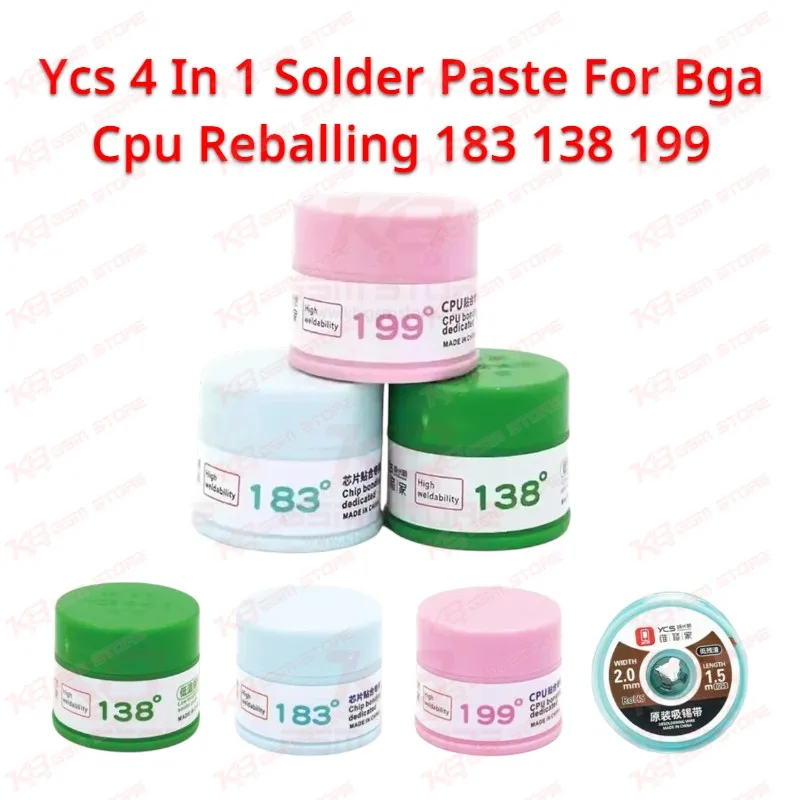
Ycs 4 In 1 Solder Paste For Bga Cpu Reballing 183 138 199
Ycs 4 In 1 Solder Paste For Bga Cpu Reballing 183 138 199
Regular price
Rs.3,500.00 PKR
Regular price
Sale price
Rs.3,500.00 PKR
Shipping calculated at checkout.
Quantity
Couldn't load pickup availability
The Ycs 4 In 1 Solder Paste For Bga Cpu Reballing 183 138 199 puts three melting-point grades on your repair bench in one set, so you match the tin to the board instead of forcing one paste onto every job. Use the 138°C grade for heat-sensitive boards, the 183°C grade for everyday CPU and IC reballing, and the 199°C grade when joints must hold firm while you rework nearby parts. The low-residue formula forms clean, round balls through the stencil and cuts cleanup time. You get a practical consumable for dead phone repair, charging issues, network faults, and CPU reballing in busy Pakistani repair shops.
SKU:MST-SOLDERING-ACCESSORIES-732
⚖️ Weight: 0.2 kg
- Safe & Secure Payment
- Fast Delivery
- WhatsApp Support


Description
FAQ
What is the product name?
The product name is Ycs 4 In 1 Solder Paste For Bga Cpu Reballing 183 138 199.
What is the brand of this product?
The brand of this product is YCS.
What is the model of this product?
The model of this product is YCS 4 in 1 Solder Paste 183/138/199.
What is this product used for?
This product is used for BGA chip reballing, CPU reworking, and PCB soldering on mobile phone boards.
Which devices are compatible with this product?
This product is compatible with mobile phone logic boards and BGA chips, including CPUs, memory chips, and PMICs, as a universal consumable.
Who should use this product?
This product is suitable for mobile repair technicians, repair shops, service centers, and professional users.
Which solder paste temperature should I use for iPhone sandwich board reballing?
Use the 138°C low-melt grade when you need to separate or rework layered boards without disturbing the factory solder on the other layer.
What is the difference between 138°C and 183°C solder paste for BGA reballing?
The 138°C grade melts at a lower temperature and protects heat-sensitive parts, while the 183°C grade melts at the standard eutectic point and suits everyday CPU and IC reballing.