


Brand:
YCS
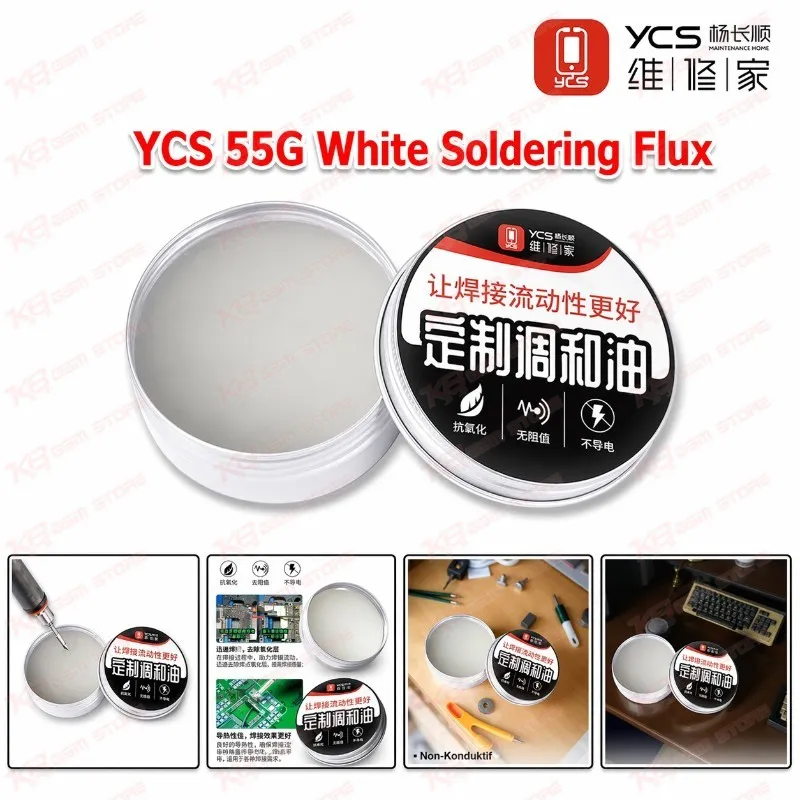
YCS 55G White Soldering Flux
YCS 55G White Soldering Flux
Regular price
Rs.550.00 PKR
Regular price
Sale price
Rs.550.00 PKR
Shipping calculated at checkout.
Quantity
Couldn't load pickup availability
YCS 55G White Soldering Flux is a rosin-based flux paste built for daily mobile phone board repair. It lowers solder surface tension so the alloy spreads evenly, wets pads properly, and forms bright, solid joints instead of dry or cold ones. The white paste stays easy to see under a microscope, works with lead-free solder, and stays non-conductive on dense smartphone motherboards. Use it for IC removal, BGA reballing, jumper work, charging port repair, and pad cleaning. The 55g tin gives a busy repair shop a long-lasting supply for every soldering and rework job on the bench.
SKU:MST-SOLDERING-ACCESSORIES-654
⚖️ Weight: 0.05 kg
- Safe & Secure Payment
- Fast Delivery
- WhatsApp Support


Description
FAQ
What is the product name?
The product name is YCS 55G White Soldering Flux.
What is the brand of this product?
The brand of this product is YCS.
What is the model of this product?
The model of this product is YCS 55G White.
What is this product used for?
This product is used for soldering, desoldering, IC rework, BGA reballing, and pad cleaning on mobile phone and electronic PCBs.
Which devices are compatible with this product?
This product is compatible with all mobile phone and tablet PCBs, including Android and iPhone boards, as it is a universal soldering consumable.
Who should use this product?
This product is suitable for mobile repair technicians, repair shops, service centers, and professional users.
Does YCS 55G White Soldering Flux work with lead-free solder?
Yes. This YCS rosin flux paste works with lead-free solder, which most modern smartphone boards and repair solder wires use.
Is this flux safe to use near small components on a dense motherboard?
Yes. YCS lists this rosin flux as non-conductive, so it suits tightly packed smartphone boards. Cleaning the area with isopropyl alcohol after heavy rework still gives the best inspection results.
Can I use this flux for BGA reballing?
Yes. The paste holds solder balls in place on the chip and helps them form uniform shapes during reheating.