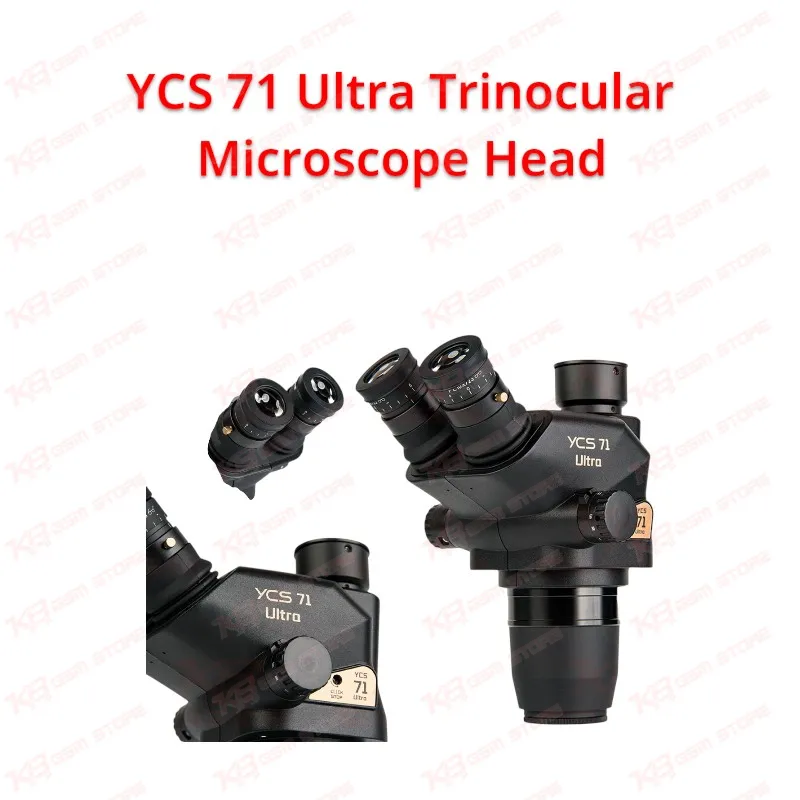
Every board-level job on a Pakistani repair bench comes down to one thing: what you can actually see. A dead phone with a shorted rail, a cracked joint under a PMIC, a lifted pad after an IC swap, or a hairline crack in a display connector all hide below the reach of a loupe. The YCS 71 Ultra Trinocular Microscope Head gives you the optical core of a professional repair microscope in one unit: the zoom body, the 45° binocular viewing tubes, and a trinocular camera port. You mount it on the stand or swing arm you already own, add your own light and camera, and your bench gets a sharp stereo view that runs from a full board overview down to the smallest passive components on a modern phone.
Inside the body, YCS uses a Greenough stereo optical system with a 10° convergence angle and a 0.67X–4.5X continuous zoom objective. That 6.7:1 zoom ratio, paired with the standard PL10X/23mm eyepieces, delivers 6.7X–45X total magnification. The Greenough layout keeps a deep, flat-field image across the view, which matters the moment you lift a shield with hot air or check a row of BGA balls after reballing. You see the whole component in focus instead of chasing sharpness with the focus knob every few seconds, and true stereo depth shows you whether a joint sits flat or rides high on the pad.
The feature most technicians notice first is the magnification control. The 71 Ultra adds lockable minimum and maximum zoom stops plus a fixed-frame magnification mechanism, so you return to the exact same zoom level every time. Set a low stop for a quick board scan on a phone with a boot loop issue, set a high stop for running a jumper wire on a broken trace, and flick between them without losing your place. On a busy day with ten charging issue jobs in the queue, that repeatability saves real minutes per board and keeps your measurements and solder judgment consistent from phone to phone.
Working distance decides how comfortably your tools fit under the lens. The standard setup gives you 110mm, enough room for a fine soldering iron tip, curved tweezers, and a hot air nozzle at a sensible angle. When a job needs more clearance, the head accepts optional auxiliary objectives: a 0.5X lens opens the distance to 177mm for larger nozzles and preheater work, a 0.7X lens gives 120mm, and a 2X lens drops to 26mm for close inspection. With optional PL15X/16mm or PL20X/12mm eyepieces and the right auxiliary objective, you can stretch the overall range from 2X up to 225X, so the head grows with your repair work instead of limiting it.
Long sessions on a hang on logo case or a CPU underfill job punish your neck and eyes, and this head addresses both. The high-eyepoint PL10X/23mm eyepieces give a wide field of view, and each one adjusts across ±5 diopters to suit your eyesight. Interpupillary distance covers 52mm to 76mm, the viewing tubes sit at a relaxed 45° tilt, and the head rotates a full 360° on its mount. The push-pull lever routes light between the eyepieces and the camera port, so you switch from bench viewing to screen viewing in one motion without touching your setup.
The trinocular port turns the head into a recording and teaching tool. YCS rates the beam split at 20/80 between the binocular and trinocular paths, and the port takes optional focusable C-mount adapters at 0.35X, 0.5X, 0.65X, and 1X. With the right adapter, most HDMI 4K microscope cameras fit, and you can run the whole job on a monitor. Shop owners use this to show customers the corroded area on a water-damaged board before quoting, record before-and-after shots of a network issue repair, train apprentices on a shared screen, or film repair content for the shop’s social pages.
This listing covers the YCS 71 Ultra Trinocular Microscope Head on its own, so plan the rest of the setup before you order. You need a compatible stand, such as a YCS swing arm or a YCS base with holder, an LED ring light such as a 144 LED unit, and a C-mount CTV adapter if you want a camera. Technicians upgrading from an older binocular microscope often keep their current stand and lighting and swap only the head, which brings modern zoom locks and a camera port to the bench at a lower price in Pakistan than a full new kit. The natural upgrade path from here is a 4K microscope camera such as the YCS X80, which turns the trinocular port into a live HD view.
On the workflow map, the head sits at the centre of every hardware stage. You use it for diagnosis when you inspect a dead phone for burnt components, for soldering and rework when you remove and replace charging, audio, or power ICs, and for final testing when you check every joint before the board goes back in the frame. It works hand in hand with your Hot Air Station, Soldering Station, Reballing Kit, PCB Holder, and Multimeter, and it gives you the clear view you need on eMMC and UFS removal for chip-off work. For any shop moving deeper into board-level repair, this head is the piece that makes the rest of the bench precise.