


Brand:
YCS
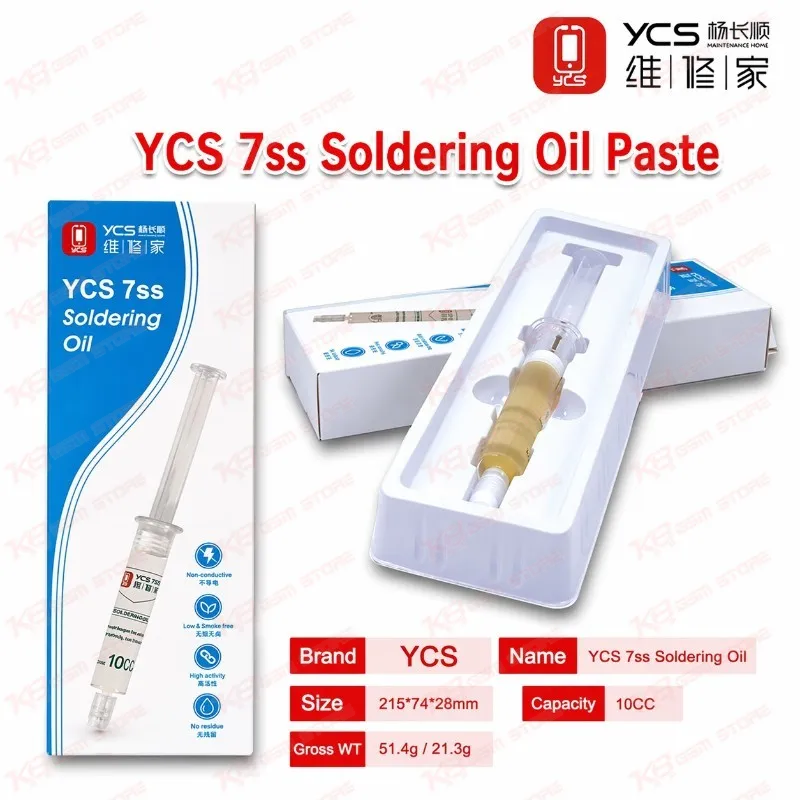
YCS 7ss Soldering Oil Paste
YCS 7ss Soldering Oil Paste
Regular price
Rs.800.00 PKR
Regular price
Sale price
Rs.800.00 PKR
Shipping calculated at checkout.
Quantity
Couldn't load pickup availability
The YCS 7ss Soldering Oil Paste is a lead-free, halogen-free flux oil in a compact 10cc pack, built for precision mobile phone board repair. It helps solder flow smoothly across pads, makes tinning faster, and keeps fine-pitch pins insulated against short circuits during IC and BGA work. Use it for charging IC replacement, CPU reballing, jumper wire repair, and ISP point soldering on dead phones. Low smoke output keeps your microscope view clear while you work. A dependable everyday consumable for every repair shop, service center, and hardware technician in Pakistan.
SKU:MST-SOLDERING-ACCESSORIES-658
⚖️ Weight: 0.03 kg
- Safe & Secure Payment
- Fast Delivery
- WhatsApp Support


Description
FAQ
What is the product name?
The product name is YCS 7ss Soldering Oil Paste.
What is the brand of this product?
The brand of this product is YCS.
What is the model of this product?
The model of this product is 7SS.
What is this product used for?
This product is used for precision soldering, tinning, IC replacement, and BGA reballing on mobile phone and PC circuit boards.
Which devices are compatible with this product?
This product is compatible with mobile phone logic boards, computer and PC circuit boards, BGA chips, ICs, and CPUs — it is a universal consumable, not device-specific.
Who should use this product?
This product is suitable for mobile repair technicians, repair shops, service centers, and professional users.
Is YCS 7SS flux suitable for lead-free solder work?
Yes. YCS makes the 7SS as a lead-free, halogen-free flux oil, so it matches the lead-free solder used on most modern phone motherboards.
Can YCS 7SS soldering oil cause short circuits between IC pins?
YCS designs the 7SS formula with solder insulation to prevent short circuits on fine-pitch chips. Good practice still calls for cleaning the board after rework.
Can I use YCS 7SS soldering oil for CPU and BGA reballing?
Yes. YCS lists BGA and CPU chip soldering among its main applications, and the oil holds solder balls in place on the stencil during reflow.