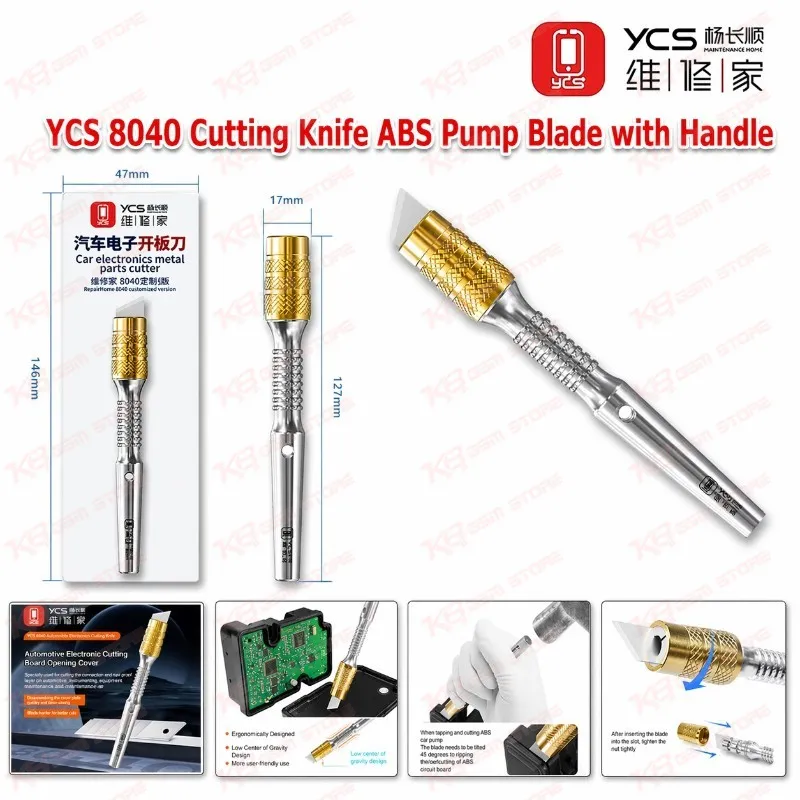
An ABS warning light that refuses to clear often traces back to cracked solder joints or a failed driver inside the control unit, and in that job the hardest part is not the soldering. The hardest part is getting the sealed housing open without wrecking the board underneath, and the YCS 8040 Cutting Knife ABS Pump Blade with Handle exists for exactly that step. Manufacturers bond and seal ABS pump control module lids to keep out moisture and vibration. A screwdriver pry usually cracks the plastic lip, and a rotary cutoff wheel heats and melts the housing while it throws debris onto the PCB. A dedicated cutting blade lets you work the seam by hand, pass after pass, so you decide how deep the edge travels and stop before it touches the electronics. YCS builds the 8040 as a blade-and-handle combination, so you get a firm grip and steady leverage along the edge of the cover instead of pinching a loose razor between your fingers. That matters when you are leaning over a heavy hydraulic unit clamped on the bench. Many electronics technicians in Pakistan are expanding from mobile phone board repair into automotive module work, and this tool fills a gap that standard phone opening knives cannot cover. ABS module covers use far thicker plastic and stronger sealing compound than any phone back glass or display frame. The workflow stays familiar. You remove the unit from the vehicle and mount it securely. You score the seal line with light, controlled strokes and deepen the cut gradually. Then you lift the lid and move into the same board-level diagnosis you already practise on mobile motherboards. Once the cover comes off, your regular bench equipment takes over. You use a microscope to inspect connector pins and bond wires, and a multimeter to trace open circuits and check MOSFET drivers. A soldering station reflows tired joints on the power connector, and a hot air station handles any component that needs replacement. Many common ABS failures are exactly these hardware faults: dry joints on the connector pins, failed pump motor driver transistors, or bond wire breaks that only show up when the unit gets hot or cold. You cannot fix any of them, or bring a dead unit back, until the housing is open. A clean cut also helps you close the unit properly afterwards. A straight, even seam seals back with sealant far more reliably than a lid that prying has chipped and cracked, and a well-sealed housing keeps water and road dust away from the board once the car goes back on the road. The alternatives are sending the module to a remanufacturing service, or buying a replacement unit that then needs coding to the vehicle. Repairing the original module in your own workshop keeps the job profitable and the turnaround short, and a dedicated opening blade is the cheapest piece of that setup. Treat the YCS 8040 as part of a broader PCB repair kit rather than a standalone purchase. Pair it with PCB holders to keep the opened board stable, with flux and solder from our soldering range, and with a reliable soldering station for reflow work, and you have a complete module repair bench. Work patiently with this blade. Let the edge do the cutting, keep strokes shallow near corners and mounting posts, and check depth often so you never reach the circuit board or the internal bond wires. Keep the blade away from your free hand while cutting, and store it covered when the job is done. YCS already has a strong presence on Pakistani repair benches through its CPU degumming knives and screen glue removal tools, and the 8040 brings the same hands-on, precision-cutting focus to automotive electronics. Order the YCS 8040 from KB GSM Store and add a purpose-built ABS module opening tool to your workshop for safer, cleaner, and more repeatable housing cuts on every unit that reaches your bench.