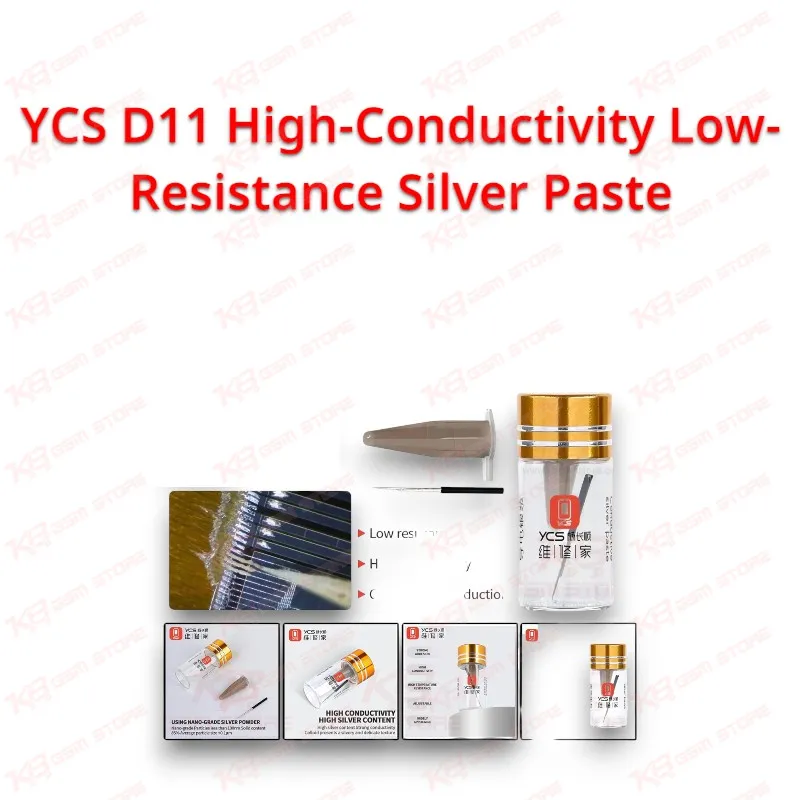
When a trace lifts off a logic board or a flex line breaks under the microscope, solder alone often cannot bridge the gap, and that is exactly where the YCS D11 High-Conductivity Low-Resistance Silver Paste earns its place on your repair bench. YCS formulates this conductive silver paste with nano-grade silver powder, holding an average particle size below 0.1µm and a solid content of 85%, so the colloid spreads into a smooth, silver-white film that carries current with very low resistance. For a technician handling a dead phone with a broken line, a display problem caused by a damaged flex, or a charging issue traced back to a lifted pad, that fine particle structure matters because it lets you lay a thin, continuous conductive path across gaps that a soldering iron tip cannot reach without risking neighbouring components. The paste bonds firmly to the surface, withstands heat once it sets, and gives you a stable electrical connection that holds up during normal device operation. In a typical PCB repair workflow, you start by isolating the fault with a multimeter in continuity or diode mode, confirm the broken path, and then clean the area with isopropyl alcohol so the paste grips bare copper or exposed contact points instead of flux residue or dirt. Under a stereo microscope, you scrape back the solder mask carefully, use the included probe to pick up a tiny amount of paste, and draw it along the damaged route from one good point to the next. Because the colloid stays smooth and controllable, you can build a clean line without spreading excess material onto adjacent tracks, which keeps you clear of fresh short circuits. Once the line sets, you check resistance again with your meter before reassembly, and only then move on to power-on testing with a DC power supply or test box. Screen and LCD repair work forms another major use case for the YCS D11 paste. Water damage commonly leaves an iPhone or Android display with green, yellow, or white lines when the fine conductive tracks on the panel edge or flex cable break down, and technicians use this silver paste to patch those broken lines and restore the signal path. The same approach works for FPC connectors with a corroded or torn finger, where you need conduction rather than a full solder joint that could melt the flex. On the motherboard side, the paste helps when you rebuild a ripped pad after IC removal, bridge a damaged via, or reconnect a cut track during jumper work on network issue or hardware fault cases. Battery connector contacts and small component pads fall within its range too, as long as you treat it as a conductive bridge and not a structural mount. You get the most value from this paste when you pair it with the right supporting tools from the KB GSM Store catalog: a quality microscope for line-level visibility, a stable PCB holder to keep the board steady while you draw the trace, a precise soldering station for surrounding joints, a hot air station for controlled component removal before pad restoration, and a reballing kit when the job moves to BGA work after the pads come back. A multimeter remains essential for verifying every line you build, before and after the paste sets. Repair shops across Lahore, Karachi, Islamabad, and smaller cities keep conductive silver paste in the drawer because it saves boards that would otherwise go to the scrap pile, turning a "board dead, no repair" verdict into a billable job. For training institutes, it serves as practical teaching material for trace repair and line patching before students handle customer devices. Keep the container sealed and away from heat between jobs, and apply thin layers instead of thick blobs, since a thinner line gives you better control and a cleaner finish. Each pack includes the silver paste and a probe applicator, so you can start working straight away. If your daily work involves dead phone revival, display line faults, FPC damage, or pad rebuilding, this conductive paste gives you a dependable, low-resistance option that fits directly into your existing microsoldering setup.