


Brand:
YCS
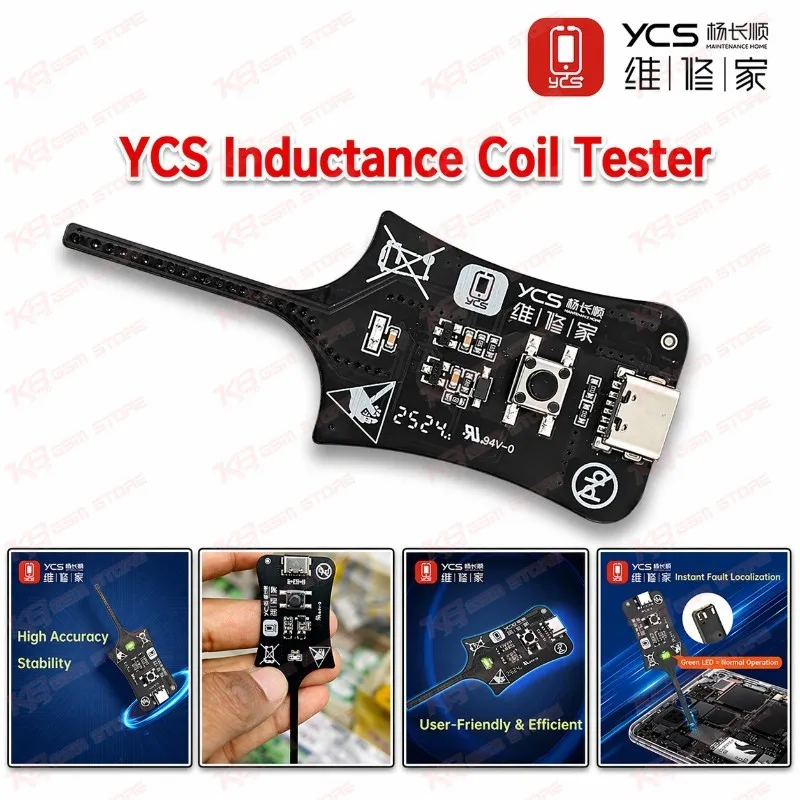
YCS Inductance Coil Tester
YCS Inductance Coil Tester
Regular price
Rs.800.00 PKR
Regular price
Sale price
Rs.800.00 PKR
Shipping calculated at checkout.
Quantity
Couldn't load pickup availability
The YCS Inductance Coil Tester helps you find faulty SMD inductors and coils directly on mobile phone motherboards without removing a single component. It works on electromagnetic induction: a green LED lights up when a coil responds normally, and no light points to an open, shorted, or damaged coil. Technicians use it to trace dead phone, no power, charging issue, and backlight faults around the PMIC and charging circuits in seconds. The compact Y-001 body needs no calibration or software, so it suits busy repair counters, service centers, and training institutes across Pakistan that want fast, reliable board-level diagnosis.
SKU:MST-SOLDERING-ACCESSORIES-661
⚖️ Weight: 0.09 kg
- Safe & Secure Payment
- Fast Delivery
- WhatsApp Support


Description
FAQ
What is the product name?
The product name is YCS Inductance Coil Tester.
What is the brand of this product?
The brand of this product is YCS.
What is the model of this product?
The model of this product is Y-001.
What is this product used for?
This product is used for detecting faulty inductors and coils on mobile phone motherboards and other PCBs using electromagnetic induction.
Which devices are compatible with this product?
This product is compatible with SMD inductors on smartphone, tablet, BGA, and computer motherboards; it is universal and not tied to any phone brand.
Who should use this product?
This product is suitable for mobile repair technicians, repair shops, service centers, and professional users.
Does the YCS Inductance Coil Tester show the inductance value in microhenries?
No. It gives a pass or fail indication through the green LED. For exact µH values, use an LCR meter alongside it.
Can I test inductors without removing them from the motherboard?
Yes. You test coils on the board by placing the probe on the inductor, which lets you locate the faulty part before using hot air.
Can I use this tester on car ignition coils?
No. It targets low-voltage electronic components such as SMD inductors on phone and computer boards.