Skip to product information
1 of 6
Brand: YCS

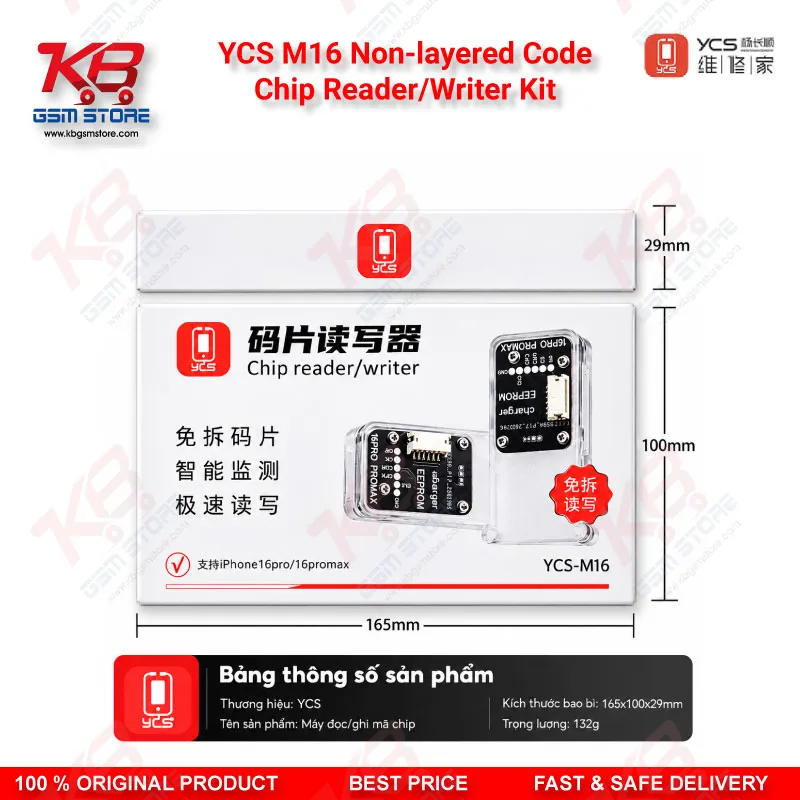
YCS M16 Non-layered Code Chip Reader/Writer Kit for iPhone

YCS M16 Non-layered Code Chip Reader/Writer Kit for iPhone

Regular price Rs.5,500.00 PKR
Regular price Sale price Rs.5,500.00 PKR
Sale Sold out
Shipping calculated at checkout.
Quantity

YCS M16 Layer-Free iPhone Code Chip Programmer in Pakistan
The YCS M16 Non-layered Code Chip Reader/Writer Kit lets you read, back up, and rewrite iPhone charging code chip data without splitting the sandwich motherboard. You skip the risky layering and reballing job, connect to the chip through matched jumper points, and pull a clean dump in minutes. It targets the iPhone 15 and 16 series charging issue where the phone stops charging or refuses a USB-C connection because the code chip data got corrupted. For a busy repair bench in Lahore, Karachi, or Islamabad, this kit turns a half-day board separation job into a quick, low-risk data fix that keeps the original logic board intact and your customer’s phone safe.

SKU:MST-FLASHING-DEVICE-28

⚖️ Weight: 0.02 kg

  • Safe & Secure Payment
  • Fast Delivery
  • WhatsApp Support
View full details

Every technician who works on newer iPhones knows the pain of a stacked logic board, because a simple charging issue on an iPhone 15 Pro Max or iPhone 16 Pro Max often hides behind a code chip sitting between two soldered layers, and the old way meant heating the sandwich apart, cleaning the interposer, reading the chip, and then reballing the whole board back together while praying nothing lifts a pad, and the YCS M16 Non-layered Code Chip Reader/Writer Kit removes that entire risk from your workflow by giving you direct read and write access to the code chip without separating the board at all. YCS builds this kit around its Mr. Yang (M.Y) EEPROM read/write platform, which focuses on the iPhone 15 and 16 series, and the job it solves on your bench is very specific: the phone powers up, the display works, the battery is healthy, yet it shows no charging response or drops the USB-C connection because the data inside the charging code chip got lost or corrupted after a liquid damage job, a failed board swap, or a careless repair by someone before you. Instead of replacing parts blindly or calling the board a hardware fault, you read the chip, check the dump, and write good data back, which brings the charging path back to life in most data-loss cases. The workflow stays simple enough for a shop technician who already handles iPhone EEPROM programmers, since you open the phone, expose the test points the kit maps for you, connect the matching numbered points with jumper wire, power the reader through its supplied cable, and run the read operation first so you always keep a backup of the original data before you touch anything. That backup step matters more than most people think, because a code chip carries data tied to that specific board, and when you save the original dump you protect yourself from turning a recoverable charging fault into a dead board that the customer blames on your shop. Beyond the USB-C charging chip, the YCS M.Y platform reads and writes the baseband logic EEPROM on the iPhone 15 Pro Max and iPhone 16 Pro Max, so you get a second use case on the same bench whenever a board comes in with logic-side EEPROM data trouble, and the same kit covers the USB-C chip found on iPad boards, which widens the jobs you can take from walk-in customers and dealer referrals. The real value shows up in your daily numbers, because a layered board job ties up your hot air station, your preheater, your stencil, and your best technician for hours, while a non-layered read and write job takes a fraction of that time and leaves no heat damage on the CPU, the NAND, or the delicate RF section around the interposer, so you finish more phones per day and you send fewer boards back with new faults. Think about the jobs this kit fits best: an iPhone 16 Pro that stopped charging after a cheap cable short, an iPhone 15 Pro Max that refuses wired charging after a board repair at another shop, or a phone that charges only with one cable direction because of corrupted chip data, since each of these points straight to the code chip, and each one turns into a clean, billable repair instead of a risky board separation. Treat the kit as one part of a complete iPhone data repair corner on your bench, because you still need a good microscope to locate the test points clearly, a fine-tip soldering station and thin jumper wire for reliable connections, a quality multimeter to confirm the charging line before and after the write, and a stable PCB holder so the board never shifts while the wires sit on the points. When a job truly needs board separation for a physical fault such as a cracked interposer or a burnt component under the stack, you still move to your layered test fixtures and reballing stencils, so this tool does not replace hardware repair but it saves you from opening the stack when the fault lives in the data. Shops that already run programmers for Android flashing and eMMC work will find the logic familiar, since you read, save, compare, and write, and the main difference lies in the precise physical connection on a tiny iPhone board, which is why steady hands and clean solder points decide your success rate more than any software setting. For new technicians, the kit also works as a practical training tool, because it teaches the difference between a true hardware fault and a data fault, and that diagnostic habit alone saves you money on parts you never needed to replace. If you price iPhone repairs competitively in the Pakistan market, a non-layered approach lets you quote a lower charge to the customer while still keeping a healthy margin, since your labor time and material cost drop sharply compared with a full sandwich board job. When your shop grows and you start taking higher-volume iPhone board work, the natural upgrade path leads to a full multi-function iPhone programmer that adds Face ID, battery, and display data repair to the same bench, but for the specific charging code chip problem on the iPhone 15 and 16 series, this kit gives you exactly what the job demands without paying for features you will rarely use. Keep your test points clean, use fresh flux, always save the original dump first, and verify charging with a multimeter or USB tester after every write, and the YCS M16 Non-layered Code Chip Reader/Writer Kit will earn its place as one of the most profitable small tools on your iPhone repair bench.

Key Features

  • Reads and writes iPhone charging code chip data without separating the sandwich motherboard
  • Built for the iPhone 15 and iPhone 16 series charging and USB-C connection faults
  • Reads and writes the baseband logic EEPROM on iPhone 15 Pro Max and iPhone 16 Pro Max
  • Supports the USB-C chip on iPhone and iPad boards for wider repair coverage
  • Connects through matched numbered points with jumper wire, so you avoid chip removal and reballing
  • Saves the original chip dump before writing, so you always keep a recovery backup
  • Removes heat exposure on the CPU, NAND, and interposer area compared with a layered repair
  • Cuts repair time on data-related charging faults, so your bench handles more iPhones per day

Specifications

Brand Entity YCS (Mr. Yang / M.Y series)
Product Entity YCS M16 Non-layered Code Chip Reader/Writer Kit
Technology Entity Layer-free EEPROM / code chip read and write via jumper wire connection
Compatible Device Entities iPhone 15 series, iPhone 16 series, iPhone 15 Pro Max, iPhone 16 Pro Max, iPad USB-C boards
Repair Process Entity Charging code chip data backup, read, write, and recovery without motherboard layering
Industry Entity Mobile phone repair, iPhone board-level repair, PCB repair

Compatible Devices

  • iPhone 15 series (charging code chip read/write)
  • iPhone 16 series (charging code chip read/write)
  • iPhone 15 Pro Max and iPhone 16 Pro Max (baseband logic EEPROM read/write)
  • iPhone and iPad boards with a USB-C chip (USB-C chip read/write)

Common Repair Uses

  • iPhone not charging after liquid damage or a cable short when the code chip data is corrupted
  • USB-C connection failure on iPhone 15 and 16 series caused by chip data loss
  • Charging fault after a board swap or a previous repair at another shop
  • Backing up original code chip data before any board-level work
  • Baseband logic EEPROM data repair on iPhone 15 Pro Max and iPhone 16 Pro Max
  • USB-C chip data repair on iPad boards

FAQ

What is the product name?
The product name is YCS M16 Non-layered Code Chip Reader/Writer Kit.
What is the brand of this product?
The brand of this product is YCS.
What is the model of this product?
The model of this product is M16.
What is this product used for?
This product is used for reading, backing up, and writing iPhone charging code chip data without separating the layered motherboard.
Which devices are compatible with this product?
This product is compatible with the iPhone 15 and iPhone 16 series for charging code chip work, the iPhone 15 Pro Max and iPhone 16 Pro Max for baseband logic EEPROM work, and iPhone and iPad boards with a USB-C chip.
Who should use this product?
This product is suitable for mobile repair technicians, repair shops, service centers, and professional users.
Do I need to separate the iPhone 16 Pro Max sandwich board to read the charging code chip?
No. You connect to the chip through mapped test points with jumper wire, so the board stays in one piece and you avoid heating, interposer cleaning, and reballing.
Can this kit fix every iPhone charging problem?
No. It fixes charging and USB-C connection faults caused by lost or corrupted chip data. A burnt component, a damaged charging line, or a cracked interposer still needs normal hardware repair, so confirm the fault with a multimeter before you write.