


Brand:
YCS
YCS Plant Tin ARC Mat IC Reball Pad
YCS Plant Tin ARC Mat IC Reball Pad
Regular price
Rs.1,200.00 PKR
Regular price
Sale price
Rs.1,200.00 PKR
Shipping calculated at checkout.
Quantity
Couldn't load pickup availability
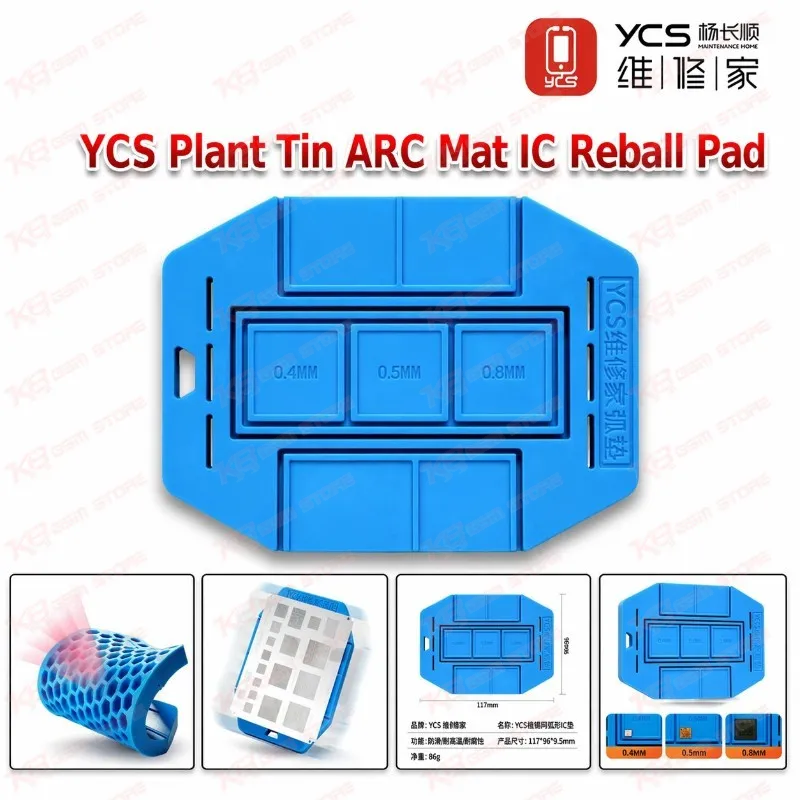
The YCS Plant Tin ARC Mat IC Reball Pad gives you a stable, magnetic base for BGA reballing on CPU, NAND, eMMC and power ICs. Its soft high-temperature silicone body holds the chip in one of three recessed slots, while the magnetic base pulls your steel stencil flat so it cannot lift, slide or bulge under hot air. Hollow heat-dissipation holes on the back help the stencil cool evenly, giving you clean, evenly sized solder balls. If you handle chip-level work on dead phones, boot loop sets or hang on logo boards, this compact pad belongs next to your hot air station.
SKU:MST-SOLDERING-ACCESSORIES-660
⚖️ Weight: 0.09 kg
- Safe & Secure Payment
- Fast Delivery
- WhatsApp Support


Description
FAQ
What is the product name?
The product name is YCS Plant Tin ARC Mat IC Reball Pad.
What is the brand of this product?
The brand of this product is YCS.
What is the model of this product?
The model of this product is YCS Plant Tin ARC Mat (ARC Pad).
What is this product used for?
This product is used for holding ICs and steel stencils steady during BGA reballing and tin planting.
Which devices are compatible with this product?
This product is compatible with BGA mobile phone chips such as CPU, NAND, eMMC and PMIC ICs that fit its slots; it is universal, not device-specific.
Who should use this product?
This product is suitable for mobile repair technicians, repair shops, service centers, and professional users.
Which slot depths does the YCS ARC reball pad offer?
The blue version has 0.4 mm, 0.5 mm and 0.8 mm slots, and the orange version has 0.3 mm, 0.45 mm and 0.77 mm slots, letting you match the slot to the chip thickness.
Will the stencil stay in place under hot air on this pad?
Yes. The magnetic base pulls a steel stencil flat against the chip so it does not shift or bulge, and the silicone handles heat up to around 500°C.