Skip to product information
1 of 4
Brand: YCS

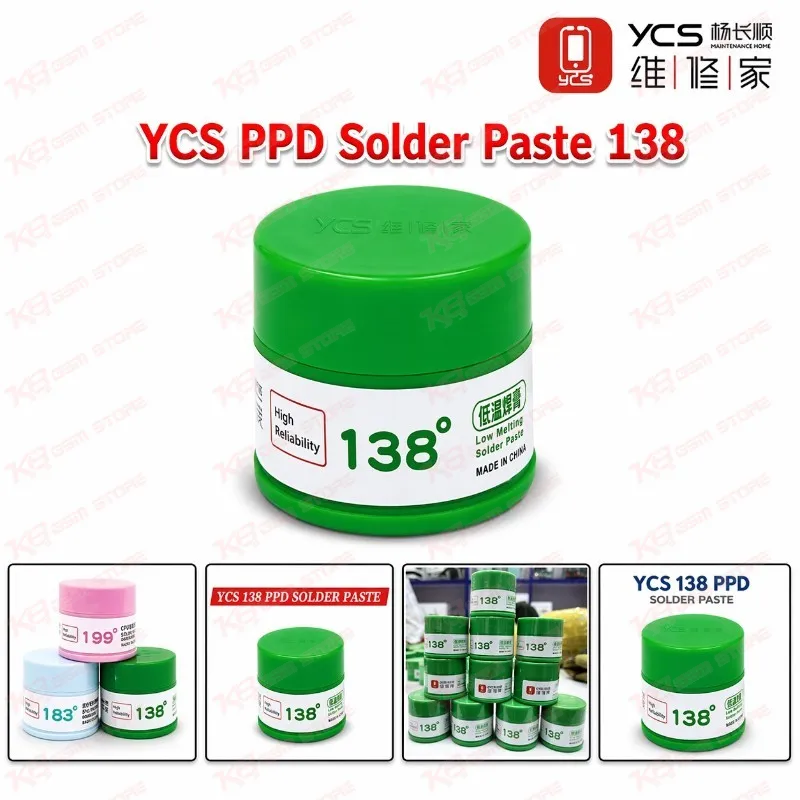
YCS PPD Solder Paste 138

YCS PPD Solder Paste 138

Regular price Rs.1,300.00 PKR
Regular price Sale price Rs.1,300.00 PKR
Sale Sold out
Shipping calculated at checkout.
Quantity

YCS PPD Solder Paste 138 is a low-temperature solder paste with a 138°C melting point, built for BGA reballing, CPU rework, and IC replacement on mobile phone motherboards. The lower melting point protects nearby components, connectors, and multilayer PCB traces from heat damage during reflow. Its stable, viscous consistency resists slump and keeps chips in position, while strong flux activity forms bright, full joints that reduce cold joints and false welds. The 50g container suits busy repair shops and service centres across Pakistan that handle dead phone, boot loop, and charging issue repairs daily.

SKU:MST-SOLDERING-ACCESSORIES-656

⚖️ Weight: 0.05 kg

  • Safe & Secure Payment
  • Fast Delivery
  • WhatsApp Support
View full details

Description

YCS PPD Solder Paste 138 gives your repair bench a low-melt option for the jobs where full-temperature heat puts a board at risk. Every technician in Pakistan knows the moment: a phone comes in with a hardware fault, the culprit sits under a BGA chip, and the neighbouring components, flex connectors, and plastic parts will not survive a long blast of hot air. This 50g YCS paste melts at 138°C, so you can reflow joints and plant fresh balls at a noticeably lower temperature than standard 183°C paste demands. That lower heat window protects nearby ICs, underfill, and multilayer PCB traces while you work, which matters most on thin modern motherboards where a single lifted pad turns a simple IC change into a jumper job. Technicians call this type of product PPD paste, and it sits at the heart of BGA reballing, CPU work, and general SMD rework on mobile phone boards. The paste holds a stable, viscous consistency that resists slump and keeps chip components from drifting before the solder melts, so your stencil prints stay clean and your balls form round and even. Its strong flux activity and anti-oxidation formula help it wet pads properly and create bright, full joints, which cuts down on cold joints and false welds that later return as a dead phone or an intermittent fault on the customer's next visit. In a typical reballing workflow, you lift the chip with a hot air station, clean old solder off the pads with a soldering station and wick, secure the chip or board in a PCB holder, apply YCS PPD Solder Paste 138 through a stencil from your reballing kit, and reflow at low temperature until every ball forms evenly. A microscope lets you confirm ball shape and spot bridges before the chip goes back on the board. This low-temperature approach suits stacked or sandwich-style motherboards, where you need to separate or rejoin board layers without overheating the components on the other side. It also helps when you replant a chip close to heat-sensitive parts such as camera connectors, display connectors, or tiny passive components that shift easily under high heat. Repair situations that lead you to this paste include a phone stuck in a boot loop or hang on logo due to a cracked BGA joint, a charging issue traced to a PMIC or charging IC, a network issue from an RF or baseband chip, and no-power faults where a CPU or memory chip needs rework. Storage chip work fits here too: when you reball an eMMC or UFS chip before reading or writing it through eMMC programmers, UFS adapters, or ISP pinout tools, clean and even balls make the difference between a stable connection and repeated read errors. After the job, a test box and a multimeter help you confirm current draw and continuity before you hand the phone back. The 50g container gives a busy workshop enough material for many jobs, and the compact size fits neatly into a tool drawer or reballing kit. Keep the lid tightly closed after every use so the flux does not dry out, stir the paste before application if it has sat unused for a while, and apply only the amount the stencil needs to avoid excess residue. Clean flux residue from the board after reflow with a suitable PCB cleaner so it does not attract moisture or dust over time. Pair this paste with the higher-temperature versions in the YCS range when a job calls for stronger mechanical joints, and keep the 138°C option ready for heat-sensitive situations. For technicians who open iPhone, Samsung, Oppo, Vivo, Infinix, and Tecno boards every day, a dependable low-melt paste saves rework time and reduces the risk of turning a repairable phone into a board-level loss. KB GSM Store stocks YCS PPD Solder Paste 138 for repair shops, service centres, and training institutes across Pakistan, including Lahore, Karachi, and Islamabad, so you can restock your bench without hunting through the market.

Key Features

  • Low 138°C melting point reduces heat stress on nearby components and PCB layers
  • Stable viscosity resists slump and stops chips from drifting before reflow
  • Strong flux activity wets pads well and forms bright, full solder joints
  • Anti-oxidation formula helps prevent cold joints and false welds
  • Smooth consistency prints cleanly through fine-pitch reballing stencils
  • Suited to BGA, CPU, and IC reballing on mobile phone motherboards
  • Compact 50g container sized for daily workshop use
  • Part of the YCS range alongside 183°C and 199°C pastes for different heat requirements

Specifications

Brand Entity YCS
Product Entity YCS PPD Solder Paste 138 (50g)
Technology Entity Low-temperature solder paste, 138°C melting point
Compatible Device Entities Mobile phone motherboards, BGA ICs, CPUs, PMICs, eMMC/UFS chips
Repair Process Entity BGA reballing, IC replacement, CPU rework, SMD rework, PCB layer soldering
Industry Entity Mobile phone repair, PCB repair, board-level microsoldering

Compatible Devices

  • Universal — not device-specific; works on mobile phone motherboards regardless of brand
  • BGA chips including CPUs, PMICs, charging ICs, RF/baseband ICs, and memory chips
  • eMMC and UFS storage chips during reballing before programming or data work
  • SMD components on general electronic PCBs

Common Repair Uses

  • BGA chip reballing with a stencil and hot air station
  • CPU and memory chip rework on dead phone or no-power faults
  • PMIC and charging IC replacement for charging issue repairs
  • RF and baseband IC rework for network issue faults
  • Low-heat soldering on stacked or sandwich-style motherboards
  • Replanting chips near heat-sensitive connectors and small passive components
  • eMMC/UFS chip reballing before connection to programmers or adapters

FAQ

What is the product name?
The product name is YCS PPD Solder Paste 138.
What is the brand of this product?
The brand of this product is YCS.
What is the model of this product?
The model of this product is PPD 138 (YCS 138°C solder paste).
What is this product used for?
This product is used for BGA reballing, CPU rework, IC replacement, and low-temperature SMD soldering on mobile phone motherboards.
Which devices are compatible with this product?
This product is compatible with mobile phone PCBs of all brands, as it works at the board and chip level rather than with a specific phone model.
Who should use this product?
This product is suitable for mobile repair technicians, repair shops, service centres, and professional users.
What is the melting point of YCS PPD Solder Paste 138?
It melts at 138°C, which is lower than standard 183°C paste and lets you reflow with less heat on the board.
When should I choose 138°C paste instead of 183°C paste?
Choose the 138°C paste when the chip sits near heat-sensitive parts or on stacked board layers; switch to 183°C or 199°C YCS paste when the job needs stronger mechanical joints at higher reflow heat.
Can I use this paste to reball eMMC and UFS chips?
Yes, it works for reballing storage chips before you connect them to eMMC programmers or UFS adapters, as long as you use the correct stencil for the chip package.