Skip to product information
1 of 4

YCS Silver Flying Line Jumper Wire 0.01mm

YCS Silver Flying Line Jumper Wire 0.01mm

Regular price Rs.1,300.00 PKR
Regular price Sale price Rs.1,300.00 PKR
Sale Sold out
Shipping calculated at checkout.
Quantity

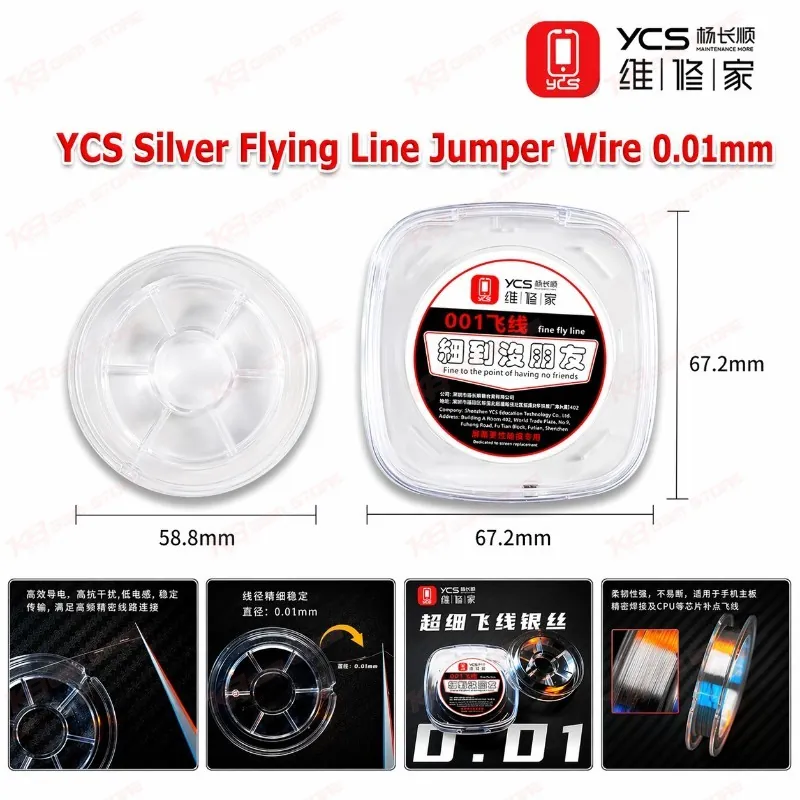
The YCS Silver Flying Line Jumper Wire 0.01mm is an ultra-fine silver repair wire built for precision motherboard and PCB soldering work. Supplied in a 100-meter roll, this jumper wire suits technicians handling delicate pad bridging, CPU-level jumps, and fine trace repairs on modern smartphones and other compact electronic boards. Its thin gauge allows clean routing under shields and across tightly packed board layouts without disturbing surrounding components. The silver construction supports strong conductivity and easy tinning, letting technicians solder connections directly without scraping or additional prep work. A dependable addition to any GSM repair bench where accuracy and board-level control matter most.

SKU:MST-SOLDERING-ACCESSORIES-526

⚖️ Weight: 0.09 kg

  • Safe & Secure Payment
  • Fast Delivery
  • WhatsApp Support
View full details

Description

Repairing a motherboard at component level demands a wire that disappears into the board rather than fighting against it, and the YCS Silver Flying Line Jumper Wire 0.01mm answers that need with a gauge fine enough for the tightest pad-to-pad connections found on current smartphone logic boards. Technicians working on charging port failures, camera line breaks, fingerprint sensor faults, or CPU-side pad damage reach for flying wire precisely because standard hookup wire cannot fit the spacing or hold the board's thermal profile during rework, and at 0.01mm this spool sits at the finer end of that spectrum, suited to work where visibility and steady hands under a microscope decide the outcome. The silver material gives the wire strong electrical conductivity for low-voltage signal and power paths, which matters directly on data lines, sensor connections, and short power bridges where resistance losses would otherwise show up as an intermittent fault after the repair looks complete. Tinning takes hold cleanly on contact with solder, so a technician can strip a short length, tack it to iron temperature, and lay it across a broken trace or a lifted pad without the frustration of scraping insulation or fighting oxidation that slows down cheaper wire on a busy bench. That ease of tinning shortens the time a board sits open under hot air, which lowers the risk of disturbing adjacent components during an already delicate repair. The 100-meter roll gives a repair shop enough length to run for a long stretch of daily jobs, so restocking does not interrupt turnaround on boards waiting in the queue, and the fine gauge means a single roll stretches across a large number of jumps compared to thicker wire options. On the workshop floor this wire earns its place in board-level fault categories that come up constantly: a phone reported as dead after a fall often traces back to a hairline crack under a pad rather than a failed IC, and a flying wire jump restores continuity without needing a full component swap. Charging issues frequently start at a lifted or corroded pad near the charging IC, and a fine silver jump lets the technician rebuild that connection instead of replacing the whole board section. Display and touch faults sometimes come down to a broken link on a flex connector pad, where 0.01mm wire threads through spacing that thicker gauge simply cannot reach. Network and signal faults on RF-adjacent pads benefit from the wire's low resistance, since a poor jump on an antenna or RF line shows up later as intermittent signal drops rather than an immediate failure, making wire quality a factor in whether the repair actually holds. Fingerprint sensor and camera module repairs, both dense with tightly spaced pads, are where this diameter earns its keep most, since standard 0.02mm or 0.04mm wire is often too thick to sit flush without bridging neighboring pads. Handling the wire well comes down to a steady hand, a fine-tip iron, and good lighting or microscope magnification, since the gauge that makes it useful for tight work also makes it easy to snap under rough handling. For a repair shop or independent technician building out a board-level toolkit, this spool fills the gap between general soldering wire and the specialized ultra-fine options reserved for CPU and BGA rework, giving consistent results across charging, display, sensor, and signal-path repairs without forcing a switch to a different wire for each job type.

Key Features

  • 0.01mm ultra-fine silver wire diameter for precision pad-to-pad jumps
  • 100-meter roll length for extended workshop use without frequent restocking
  • High electrical conductivity suited to low-voltage signal and power lines
  • Clean tinning on contact, no scraping or paint removal needed
  • Fine gauge fits tight, densely packed board layouts under shields
  • Suitable for charging, display, sensor, and signal-path pad repairs
  • Flexible construction that routes cleanly around surrounding components
  • Compact spool format that fits standard repair bench storage

Specifications

Brand Entity YCS
Product Entity Silver Flying Line Jumper Wire
Technology Entity Ultra-fine silver conductor wire for micro-soldering
Compatible Device Entities Smartphone motherboards, PCB assemblies
Repair Process Entity Flying wire jumper repair, pad bridging, trace repair
Industry Entity Mobile phone repair, PCB rework, micro-soldering

Compatible Devices


Smartphone and tablet motherboards across common brands, including iPhone and Android devices — general PCB-level compatibility, not restricted to specific chipset families.

Common Repair Uses


Pad bridging after lifted or corroded solder pads, CPU and BGA-side jumper connections, charging port and charging IC pad repair, display and touch flex connector pad repair, fingerprint sensor and camera module pad repair, and general trace-level continuity restoration on dead or boot-looping boards.

FAQ

What is the product name?
The product name is YCS Silver Flying Line Jumper Wire 0.01mm.
What is the brand of this product?
The brand of this product is YCS.
What is the diameter of this jumper wire?
This jumper wire has a 0.01mm diameter.
What is this product used for?
This product is used for pad bridging, jumper connections, and trace repair on mobile phone and PCB motherboards.
Which devices are compatible with this product?
This product works across smartphone and PCB motherboards in general, without being limited to one specific brand or chipset family.
Who should use this product?
This product is suitable for mobile repair technicians, repair shops, service centers, and professional PCB rework users.
Can this wire handle CPU and BGA-level jumper repairs?
Yes, the 0.01mm diameter is fine enough for tight CPU and BGA pad spacing where thicker wire cannot fit cleanly.
Does this wire need scraping or stripping before soldering?
No, the wire tins directly on contact with solder without needing paint removal or extra prep.