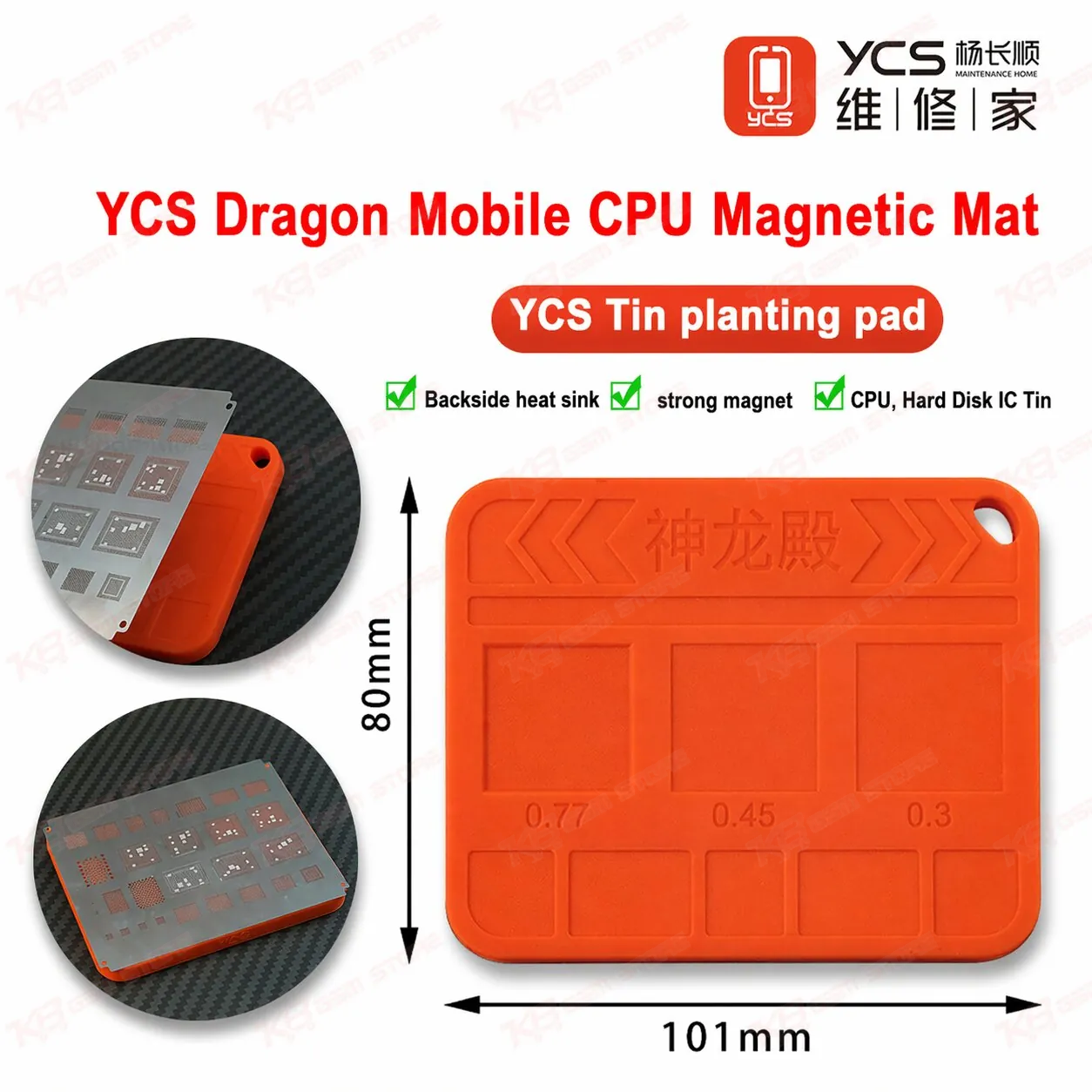
When you handle CPU or eMMC reballing on a busy repair bench, the biggest risk is not the tin itself but the steel mesh sliding out of position while you work. The YCS SLD01 Dragon Magnetic Silicone Mat solves this problem with a built-in magnetic base that locks the reballing stencil in place from the moment you set it down, so your tin balls land exactly where the chip pads need them. You get a heat-resistant silicone body that tolerates direct contact with your hot air station and soldering iron without warping, melting, or releasing fumes that could contaminate your workspace. This matters on a real bench where you switch between IC change, board cleaning, and reballing within the same session, and any surface that degrades under heat slows you down and costs you rework time. The mat carries multiple slot depths cut into its surface, so instead of buying a separate pad for every chip package thickness you find on Samsung, Oppo, Vivo, Infinix, or Tecno boards, you switch slots on the same mat and keep working. Hollow heat dissipation channels sit underneath the tin planting mesh area, and this design pulls heat away from the mesh during reflow so the steel does not bulge or warp mid-job, which keeps your ball grid array flat and your solder joints consistent across every chip you plant. For a technician dealing with a dead phone after flash, a hang on logo fault traced to a CPU or eMMC issue, or a board that needs a full IC change, this mat becomes the surface you reach for once diagnostics point to a hardware fault rather than a software issue. You place the board, position the mesh using the magnetic hold, apply flux, spread the solder balls, and reflow, all without babysitting the mesh position with your free hand. The soft silicone surface also protects your board and components from scratches during positioning, since you are not working directly against a hard metal or glass surface while you align chips for soldering or desoldering. Cleanup stays simple: flux residue and stray solder wipe off the silicone without soaking in, so the mat stays usable through hundreds of reballing cycles instead of degrading after a handful of jobs. Because the SLD01 works as a universal reballing accessory rather than a device-specific tool, you are not locked into one phone brand or chipset family. Any repair shop running CPU repair, eMMC repair, or UFS repair workflows across mixed brands gets consistent use from a single mat, which cuts down on bench clutter and the cost of stocking separate pads per device line. The magnetic adsorption strength stays reliable even with repeated heat cycling, so you are not replacing the mat every few months the way you might with a cheaper unbranded pad. If your workshop handles high volumes of board-level repair, having a mat that holds position under hot air without you having to weigh it down or clamp it saves real time across a full day of jobs. The compact footprint means it fits next to your microscope, hot air station, and PCB fixture without eating up bench space, and its lightweight build makes it easy to move between workstations if more than one technician shares reballing duties. For anyone running a professional repair shop or service center where reballing is a recurring task rather than an occasional fix, the YCS SLD01 gives you a dependable, reusable base that keeps your tin planting accuracy high and your rework rate low.