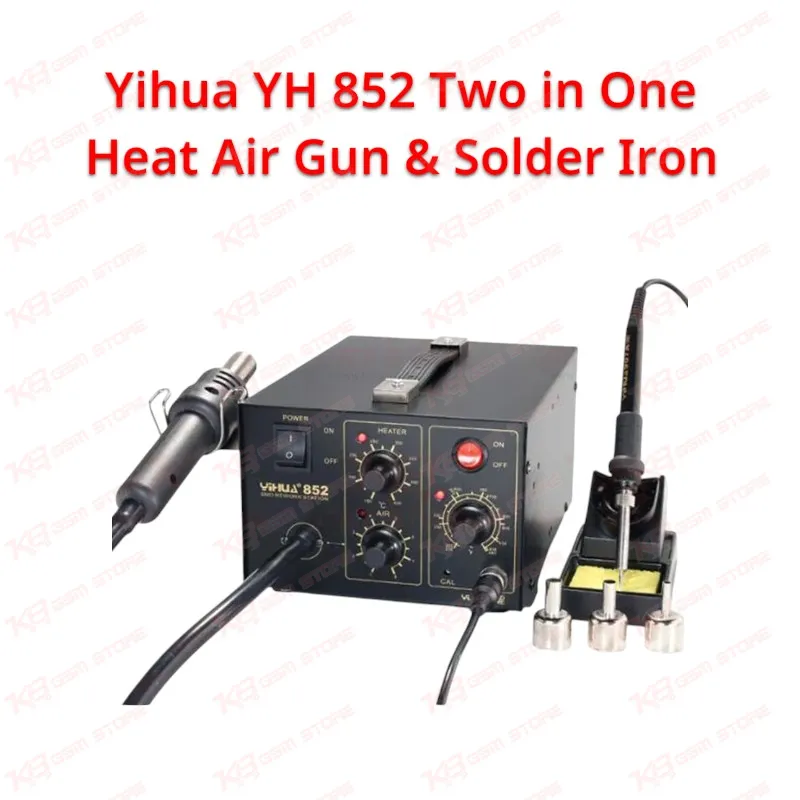
A GSM repair bench runs on two constant demands: controlled heat for lifting and reseating SMD components, and a precise iron tip for fine board-level joints, and the Yihua 852 combines both functions into one 700W platform so a technician does not need separate stations taking up bench space. The hot air gun side runs on a brushless fan design rated for a 20,000-hour service life, pushing airflow up to 120L/min through a ceramic heating core that resists warping under repeated heat cycles, and the temperature range spans 100°C to 480°C with a static stability of ±15°C, which covers everything from gentle flex cable reflow to full IC removal on multilayer boards. Compared to diaphragm pump type hot air guns that force air through smaller nozzles at 24-28L/min for sharper, more concentrated pressure, this brushless fan unit delivers a wider, softer airflow pattern that spreads heat more evenly across a component footprint, reducing the risk of scorching nearby parts when reworking dense boards packed with PMICs, charging ICs, and RF shielding cans. The included nozzle set of 13mm, 10mm, and 8mm sizes covers the common range of chip packages a technician handles daily, from power management ICs to CPU and baseband packages, and the IC puller in the box speeds up component extraction once the solder reflows. The soldering iron half of the unit runs on a separate 26V circuit rated at 50W, keeping tip temperature adjustable between 200°C and 480°C with a tighter ±10°C stability window, and the common metal heater warms up fast enough for quick jumper work, connector resoldering, and flex cable repair without a long wait between power-on and usable heat. Ground impedance on the tip stays below 2Ω with tip-to-ground voltage under 2mV, which matters directly on ESD-sensitive board work where a poorly grounded iron can damage a chipset before a fault is even diagnosed. On a typical repair bench in Lahore, Karachi, or Islamabad, this station handles the daily mix of dead phone diagnosis, charging port desoldering, board-level IC change on power and charging circuits, camera module rework, and connector replacement on boards affected by liquid damage or physical impact. A board that comes in dead after flash, showing no display or hang on logo behavior, often needs a PMIC or CPU reflow before any software step makes sense, and the hot air side of this station provides the even, wide-area heat needed to loosen BGA packages without lifting surrounding pads, while the soldering iron side finishes the job with jumper wires or component-level fixes once the board is back on the bench. The compact 25.5 x 18.8 x 12.5cm footprint and 4.5kg weight keep the unit stable during use without occupying excessive space, which suits repair shops running multiple stations side by side, and the enclosed housing tolerates a working environment of 0°C to 40°C with humidity under 80%, matching the conditions found in most repair shops without climate control. Technicians moving between soldering irons and hot air guns from separate brands often deal with mismatched temperature calibration between tools, and having both functions on one chassis with independently rated circuits removes that inconsistency, since both halves are calibrated against the same power supply and share a common ground reference. This station fits naturally into a board-level repair workflow that starts with visual inspection and continues through hot air-assisted component removal, cleaning of the pad area, reballing or direct placement of a replacement part, and final joint work with the soldering iron before the board goes back for functional testing. For a workshop handling FRP lock cases, pattern unlock jobs, or hardware fault diagnosis where a board needs a physical IC swap rather than a software fix, having a stable, dual-function heat source reduces the back-and-forth between separate tools and keeps turnaround time down on jobs where the customer is waiting. The anti-twist ceramic heater inside the hot air gun is built to resist the mechanical stress of repeated handle movement during long repair sessions, a common failure point on cheaper hot air guns where the internal heating element cracks after a few months of daily use. Charging issue repairs, where a board needs a new charging IC or a reflowed connector, and display problem cases that trace back to a loose or damaged display flex connector, both fall within the range this station is built for, since the soldering iron's fine tip control suits delicate flex and connector work while the hot air gun handles the surrounding component removal. Network issue boards that need an RF shield or PA module reflow also benefit from the wide, even heat spread of the brushless fan design, which lowers the chance of damaging adjacent RF components during the process. Built by Guangzhou Yihua Electronic Equipment, a manufacturer with a long production history in soldering and rework equipment, this 852 series unit represents the standard general-type configuration in the lineup, giving repair shops a dependable dual-function tool without the added cost of the digital display variants in the same series, while keeping the same core heating technology and temperature performance across the board. Repair shops running a shared bench for multiple technicians benefit from the straightforward analog temperature adjustment on this general-type unit, since new staff can pick up consistent settings for common jobs like connector rework or IC reflow without needing to interpret a digital menu, which shortens the training curve for entry-level technicians joining a busy workshop. The single power intake feeding both the hot air gun and the soldering iron simplifies bench wiring compared to running two separate stations from two outlets, and the compact footprint leaves room on a crowded workbench for a microscope, a multimeter, and a PCB holder without cable clutter getting in the way of hand movement during delicate work. For a technician moving through a stack of boards in a single shift, the combination of a fast-heating soldering iron and a stable hot air gun on one chassis cuts the downtime between switching tools, since both are always powered and ready rather than requiring a separate warm-up cycle each time the job shifts from component removal to fine joint work. Skill training institutes teaching board-level repair also find this configuration practical, since students can practice both hot air rework and iron soldering technique on a single unit without needing two pieces of equipment per training station, and the exposed parameter range across 100°C to 480°C on the air gun and 200°C to 480°C on the iron covers nearly every lead and lead-free soldering scenario a training curriculum would need to demonstrate. Component-level board repair on Android and iOS devices alike depends on consistent, repeatable heat application, since inconsistent temperature between repair attempts on the same board increases the risk of pad lift or damage to nearby components that have already been reflowed once, and the ceramic heater core in this unit is built specifically to hold a steady output across repeated on-off cycles through a full working day. For a shop weighing a first rework station purchase against a basic soldering iron alone, this 2-in-1 configuration removes the guesswork of matching a separate hot air gun to an existing iron, since both halves ship calibrated together under one duty-cycle rating.