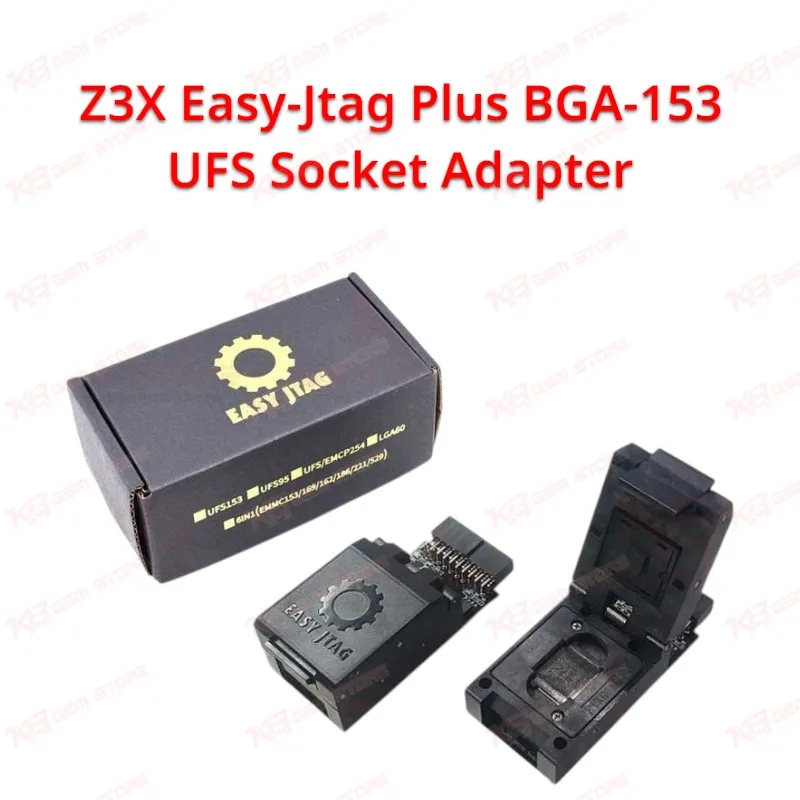
When a phone comes into your shop completely dead after a failed flash, stuck on logo, or with a UFS chip that software tools can no longer touch through the normal port, board-level chip-off repair becomes the only real option, and that is exactly where the Z3X Easy-Jtag Plus BGA-153 UFS Socket Adapter earns its place on the bench. This socket connects to your Easy-Jtag Plus box and gives you a direct hardware interface to a desoldered BGA-153 UFS memory chip, letting you read, write, and repair the chip's data without relying on the phone's own board or connector, which matters when the board itself is damaged or the ISP pads are burnt out. You open the socket, seat the reballed or as-removed BGA-153 chip into the cavity, close the lid, and the box picks up the chip through Direct Mode along with an ISP output signal carried on the adapter itself, so you get both direct-pin access and ISP-style operation from the same unit depending on how your workflow calls for it. The build quality is where this adapter separates itself from generic sockets you see flooding the market — the contact pins are positioned with high accuracy so the ball grid array lands correctly every time, which is critical because a misaligned BGA-153 chip in a loose socket gives you failed reads, checksum errors, or worse, physical damage to the chip's pads after repeated attempts. Pakistani technicians running high-volume UFS repair — dead phone recovery, hang on logo cases, IC change jobs where the UFS itself is suspect, or EFS and IMEI restoration after a bad flash — need a socket that survives constant insertion without the pins loosening or the alignment drifting, and this adapter is rated for a service life of 30,000-plus insertions, which for most single-technician workshops translates into years of daily use before you're looking at a replacement. Security is built into the hardware layer too: the adapter carries an ECDSA-protected serial number, a cryptographic anti-cloning measure that prevents unauthorized copies of the socket from being recognized by genuine Easy-Jtag Plus software, protecting both the tool manufacturer's IP and you as a buyer from getting stuck with a non-functional counterfeit. In terms of what the socket actually talks to, it's built around SK Hynix UFS memory ICs in the BGA-153 package — chips like the H28S7Q302BMR, H28S8Q302CMR, H28U62301AMR, H28U64222MMR, and H28U74301AMR — which cover a meaningful share of the UFS storage found in mid-range and flagship Android devices using this package size, and the supported chip list is maintained and updated by the manufacturer as new BGA-153 parts enter the market. Within a repair workflow, this adapter sits at the board-level end of the UFS repair process: after IC removal and reballing on your hot air station or preheater, the chip goes into this socket instead of back onto the board, letting you run data recovery, direct format, bad-block repair, or full backup and restore before deciding whether the original board or a donor board gets the chip back. It pairs naturally with the rest of an Easy-Jtag Plus setup — ISP pinout tools for board-level access when the chip stays in place, eMMC programmers and BGA-254 or BGA-95 sockets for other package sizes, and a decent hot air rework station for the desoldering and reballing side of the job — so if UFS chip-off work is becoming a regular part of your service menu, this socket is the piece that makes those repairs consistent and repeatable instead of a gamble on every insertion.