


Brand:
2UUL
2UUL BG02 Universal Reballing Stencil A&B (2pcs)
2UUL BG02 Universal Reballing Stencil A&B (2pcs)
Regular price
Rs.1,500.00 PKR
Regular price
Sale price
Rs.1,500.00 PKR
Shipping calculated at checkout.
Quantity
Couldn't load pickup availability
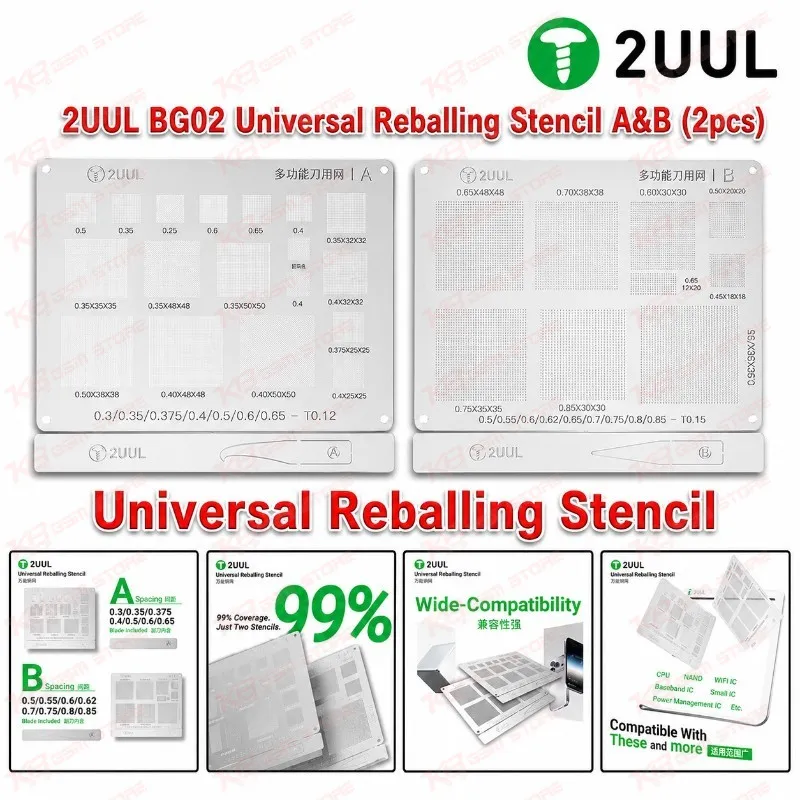
The 2UUL BG02 Universal Reballing Stencil A&B (2pcs) gives your repair bench two steel stencil sheets that cover BGA ball pitches from 0.3 mm to 0.85 mm. You use it to reball iPhone CPUs, NAND flash chips, WiFi ICs, baseband ICs, power management ICs and small support ICs after you lift them from the board. Each sheet measures 100 x 85 x 0.1 mm, so you work with a thin, flat template that sits close to the chip pads. Pick the hole pattern that matches your chip pitch, apply paste or solder balls, and finish a clean reball on dead phone, boot loop and hang on logo repairs.
SKU:MST-SOLDERING-TOOLS-1197
⚖️ Weight: 0.3 kg
- Safe & Secure Payment
- Fast Delivery
- WhatsApp Support


Description
FAQ
What is the product name?
The product name is 2UUL BG02 Universal Reballing Stencil A&B (2pcs).
What is the brand of this product?
The brand of this product is 2UUL.
What is the model of this product?
The model of this product is BG02.
What is this product used for?
This product is used for reballing BGA chips on mobile phone motherboards with a stencil.
Which devices are compatible with this product?
This product fits BGA chips with ball pitches between 0.3 mm and 0.85 mm, including iPhone CPU, NAND flash, WiFi, baseband and power management chips.
Who should use this product?
This product is suitable for mobile repair technicians, repair shops, service centers, and professional users.
Which ball pitch sizes do the A and B stencils cover?
Sheet A covers 0.3, 0.35, 0.375, 0.4, 0.5, 0.6 and 0.65 mm, and sheet B covers 0.5, 0.55, 0.6, 0.62, 0.7, 0.8 and 0.85 mm.
Can I use this stencil for iPhone CPU and NAND flash reballing?
Yes, iPhone CPU, NAND flash, WiFi IC, baseband IC and power management IC reballing all fall within its intended use. Check the ball pitch and array layout of your chip first, because the stencil matches by pitch.