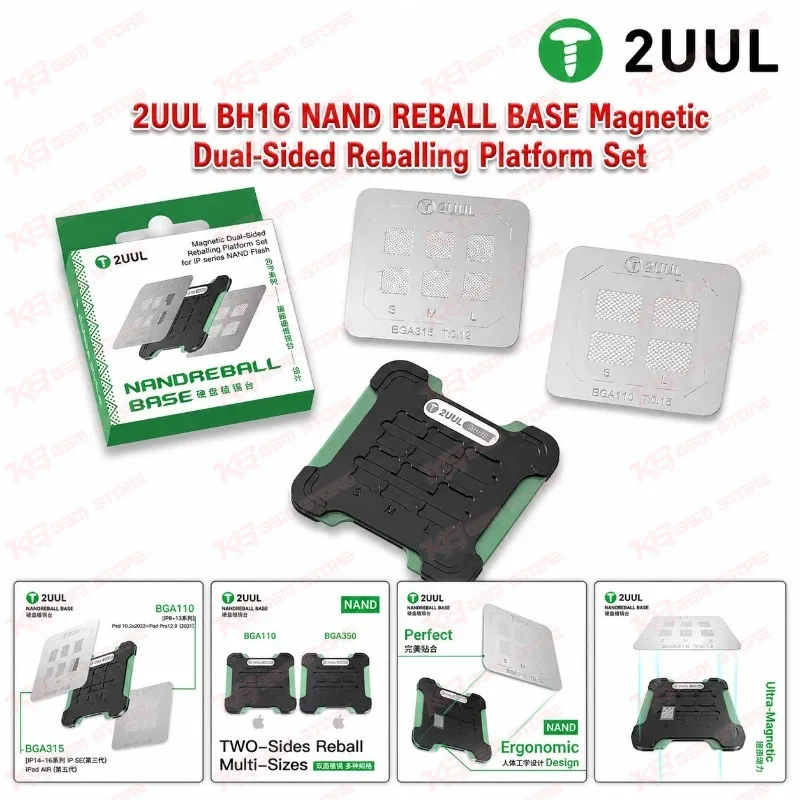
The 2UUL BH16 NAND REBALL BASE Magnetic Dual-Sided Reballing Platform Set gives your repair bench a fixed, repeatable way to reball NAND flash chips, and it solves the problem that slows most technicians down: a stencil that shifts while you spread solder paste. When a phone arrives with a dead phone complaint, a boot loop issue, hang on logo, or dead after flash, and your diagnosis points to the NAND chip, the reball step decides whether the chip goes back onto the board clean or returns to your bench a second time. This platform holds the chip and the stencil in a fixed position so your hands stay free for the paste and the squeegee. The built-in magnets grip the stencil firmly, which keeps the apertures centered over the pads and cuts down on solder bridges and misaligned balls during paste application and hot-air heating. You place the chip, set the stencil on the magnetic base, apply paste, heat, and lift the stencil without chasing a moving template across the platform. The base has two usable sides, so you handle different NAND layouts on one platform instead of swapping fixtures mid-job, which matters when your repair queue mixes different chip sizes in a single day. The set comes with BGA110 and BGA315 stencils, two NAND package layouts that cover iPhone series NAND, and it also suits BGA-type NAND in other smartphones and tablets that follow the same layouts. The platform body combines synthetic stone with steel, and that construction handles the heat of your hot air station without deforming, so the base stays flat job after job. A flat base gives you an even surface for the stencil, and an even stencil gives you consistent ball height across the whole chip. Pair it with a reliable Hot Air Station or a temperature-controlled Soldering Station, keep your airflow low so the wind does not blow paste off the stencil, and lift the stencil once the solder balls form. A Microscope over your bench lets you inspect every ball before you reflow the chip onto the board, and Multimeters help you confirm continuity and catch shorts once the NAND sits back on the PCB. Keep PCB Holders nearby to grip the motherboard steady while you work on the chip. If you already own Reballing Kits with solder paste, cleaning flux, and tweezers, the BH16 slots into that workflow without changing how you work. For technicians who also work with ISP Pinout Tools, eMMC Programmers, UFS Adapters, or Test Boxes, the BH16 handles the reballing side of NAND work while those tools cover the reading and programming side. It fits the way NAND work runs on a Pakistani repair bench, where one technician often handles chip removal, cleaning, reballing, and refitting personally instead of sending the board out. Shop owners and service centers benefit most, because a single platform that takes two chip layouts reduces the number of loose fixtures on the bench and shortens setup time between jobs. Beginners get a steadier starting point, since the magnetic hold removes the hardest part of reballing, which is keeping the stencil still, and experienced technicians get faster, more repeatable results across a full day of boards. 2UUL builds the BH16 as the NAND-specific base in its reballing range, while the BH17 covers CPU work, so you choose the base that matches the chip on your board instead of forcing one platform to do every job. Clean the stencil after each job, wipe residue off the magnetic surface, and store the platform flat so the magnets keep their grip. Add the 2UUL BH16 NAND REBALL BASE Magnetic Dual-Sided Reballing Platform Set to your NAND repair setup and cut down the reballing errors that cost you time and boards.