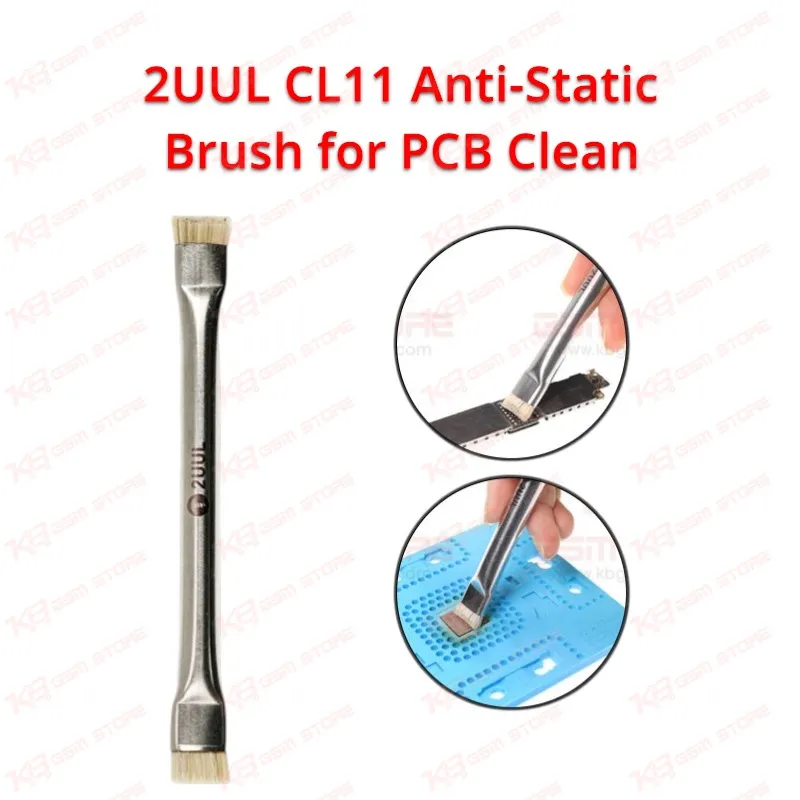
When you're working on a dead phone or a board that's giving you a hang on logo issue after months of dust buildup, the first real step on your repair bench is getting the board clean enough to actually see what you're dealing with, and that's exactly where the 2UUL CL11 earns its spot in your toolkit. This brush uses a dual-head design, giving you a tapered tip on one side for reaching into tight corners around connectors, ICs, and board edges, and a flat brush head on the other side for sweeping dust off larger motherboard surfaces in one pass, so you're not switching tools mid-job just to reach a cramped area near a charging port or camera connector. The bristles themselves are made from pig's mane, a material technicians favor because it stays firm enough to lift dried flux and stubborn debris without scratching solder mask or damaging fine pitch components underneath. What makes this brush hold up on a busy repair bench is how the bristles are mounted: instead of being glued into the handle, they're mechanically clamped in place, so you don't get shedding hairs stuck under a BGA chip or loose adhesive residue contaminating a board you just cleaned. That detail matters more than it sounds, because a single stray bristle hair caught under an IC during reballing can cause a cold joint that sends the phone right back to your bench. The bristles carry anti-static, ESD-safe properties, which means you can brush directly over a live or connected board without introducing static discharge that could damage sensitive PMICs, CPU ICs, or RF components sitting exposed during a repair. This is a real concern in Pakistan's repair shops where technicians handle boards on open workbenches without full ESD flooring or wrist straps, so having a brush that's inherently anti-static removes one more risk factor from your workflow. The handle is stainless steel, giving the brush a solid, balanced feel in hand instead of the flimsy plastic grips you get on cheaper cleaning brushes, and that rigidity helps when you're applying light pressure to scrub dried glue off a board without the handle flexing or slipping in your grip. You'll reach for this brush constantly across different jobs: sweeping dust off a board before diagnosing a charging issue, cleaning flux residue after hot air rework on a PMIC, prepping a pad for reballing an eMMC chip, or clearing old adhesive off a display flex connector before reattaching a new part. It's also useful during IC change karna work, where you need the board spotless before applying fresh solder paste, since any leftover debris under a reballed chip becomes a hardware fault waiting to happen. For software marna and box chalana sessions, a clean board also makes it easier to spot cracked traces, lifted pads, or corrosion that might explain why a phone won't boot past logo or keeps giving a boot loop issue. The compact size, roughly 14cm in length, means it fits easily in a tool tray or drawer without taking up bench space, and at around 60 grams it's light enough to use for extended periods without hand fatigue during long repair sessions. Whether you're running a solo repair counter or managing a full service center, this brush is one of those small tools that ends up in your hand on nearly every job that reaches your bench, which is why most GSM technicians keep more than one on hand.