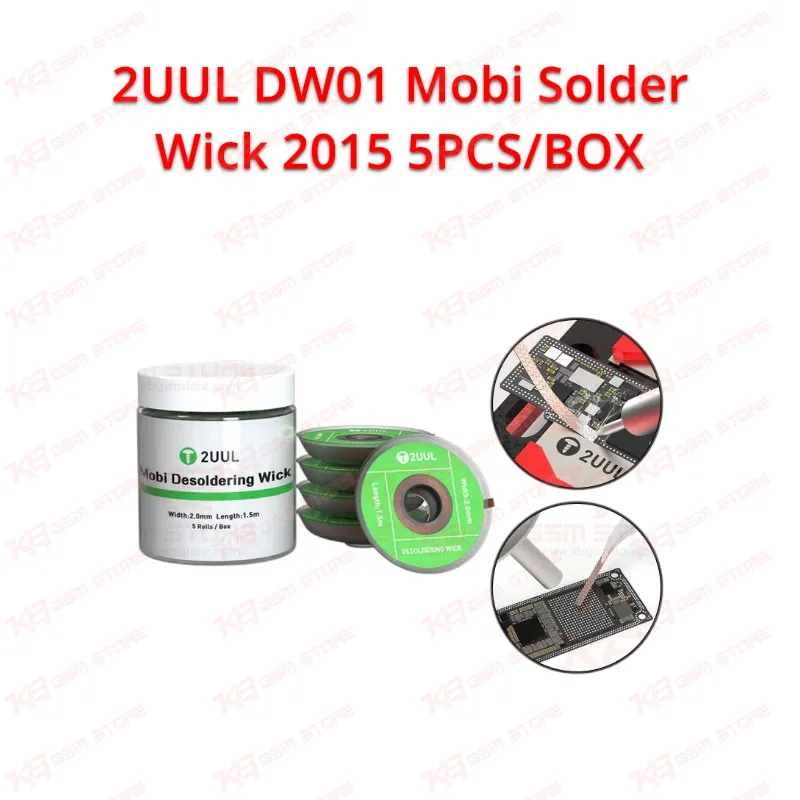
When you're doing IC change ya jumper lagana on a dead phone board, the quality of your desoldering wick decides how clean your pads come out afterward. The 2UUL DW01 Mobi Desoldering Wick 2015 is built around a plain-knitting braided copper structure that soaks up molten solder fast, so you spend less time reheating the same joint and more time moving through your repair queue. Each box gives you 5 rolls, and every roll runs approximately 1.5m long at a 2.0mm width — wide enough to lift solder from BGA pads, connector legs, and small SMD components without you constantly swapping wicks mid-job. On a typical repair bench handling charging port replacements, display connector rework, or IC removal before a reball, that kind of consistency matters because a wick that clumps or oxidizes early forces you to rework the same spot twice, which risks lifting pads on a board that's already fragile after a boot loop issue or hardware fault diagnosis. The braid on this wick is designed to stay flexible and absorbent through the length of the roll, so you're not fighting a stiff or brittle section halfway through a box. You touch your soldering iron tip to the wick over the solder joint, let capillary action pull the molten solder up into the braid, then trim and move to the next pad — a straightforward workflow that any technician working dead-after-flash boards, charging issue diagnostics, or display problem repairs will recognize immediately. Because the wick is copper-based rather than a cheaper alloy blend, it draws solder more evenly and reduces the chance of dragging flux residue across neighboring components, which keeps your board cleaner going into the next stage of repair, whether that's a fresh IC placement or a full reball job. For technicians working ISP-mode recovery, eMMC swaps, or general motherboard cleaning between diagnostic steps, having a wick that performs consistently roll after roll cuts down on rework and protects pad integrity on boards that have already been through multiple repair attempts. The 5-roll box format also means you're not restocking every few jobs, which matters if you're running a service center with several technicians pulling from the same tool tray. Handle the wick by the grip section only, since the working end heats up quickly against the iron tip — a basic safety habit that protects both your fingers and the quality of your work. Whether you're stripping old solder before installing a new PMIC, cleaning a board after a failed charging IC, or prepping pads for a fresh component during network issue troubleshooting, this wick gives you a dependable, repeatable result that fits directly into a professional GSM repair workflow.