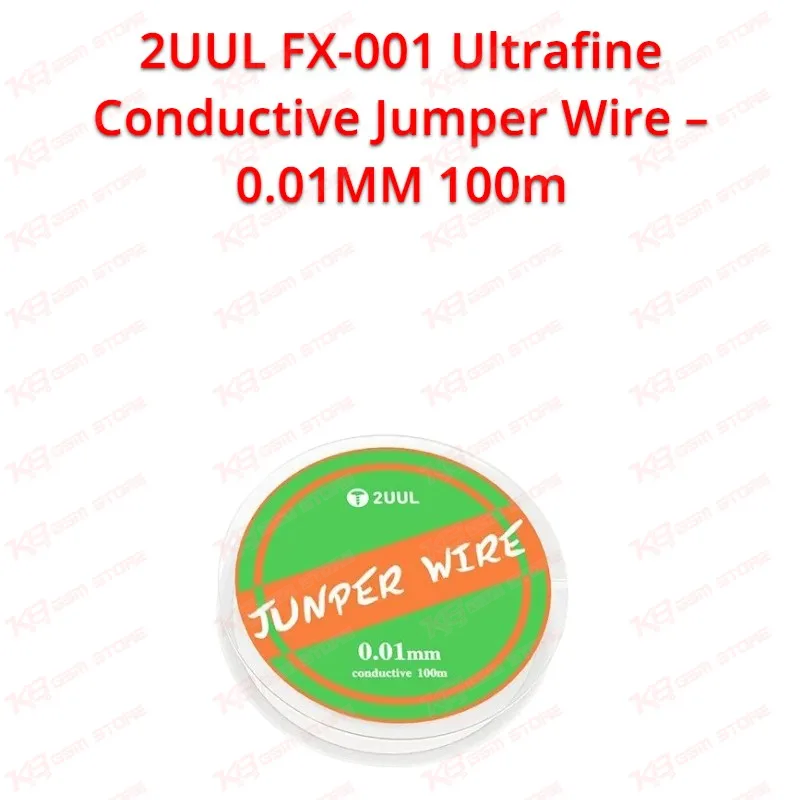
When you're staring at a hairline trace break on a densely packed motherboard, the gauge of your jumper wire decides whether the repair is even possible, and the 2UUL FX-001 exists for exactly that scenario. At 0.01mm in diameter, it slips between IC pins and BGA pads that standard 0.1mm or 0.2mm wire can't reach, letting you restore continuity on traces that would otherwise mean a scrapped board. You'll notice the difference immediately when tinning the tip: the conductive copper core takes solder fast, without the paint-scraping step that slows down thicker insulated wires, so you can jump straight from one pad to the next during a live repair instead of prepping each segment separately. This matters most on jobs like fingerprint sensor line restoration, network IC rework, and CPU jumper repair after a board has been damaged by a short or a bad reflow, where every extra second under heat risks lifting a neighboring component. The wire is built non-magnetic and holds its shape without kinking or snapping mid-pull, which keeps your workflow steady when you're stringing a jumper across several centimeters of board under a microscope. Low resistivity across the strand means the signal path you rebuild behaves like the original trace rather than introducing a weak point that causes intermittent faults down the line, something technicians notice quickly on boards that come back with charging issues or hang-on-logo symptoms traced to a bad ground or data line. Because it's non-insulated, the FX-001 is best suited to isolated jumper runs where the wire won't cross other exposed traces, so keep it in the toolkit alongside an insulated variant like the FX-002A for jobs where crossover risk is higher. On the bench, this wire earns its place in workflows spanning dead-after-flash recovery, boot loop diagnosis where a data line has separated from the CPU, and general PCB repair on iPhone, Samsung, and other smartphone or tablet motherboards where component density leaves no room for anything thicker. The 100-meter spool means a single roll covers hundreds of individual repairs before you need a replacement, which keeps your cost per jump low even on high-volume repair days. Technicians running eMMC or UFS-related rework, ISP mode jumper setups, or board-level diagnostics on service center benches will find the FX-001 pairs naturally with a soldering microscope and a fine-tip iron, since the wire's thinness only pays off when your hands and your optics can match its precision. Store the spool away from moisture and avoid excessive tension when pulling wire from the roll, since ultrafine gauges like this one are more prone to stretching or breaking under rough handling than standard hookup wire. For a repair shop juggling multiple board-level jobs a day, keeping the FX-001 stocked next to your reballing stencils, hot air station, and multimeter rounds out a workflow built for the kind of micro-repairs that separate a professional bench from a basic parts-swap operation.