


Brand:
2UUL
2UUL MS96 MicroScope Lamp for CPU Jump Wire
2UUL MS96 MicroScope Lamp for CPU Jump Wire
Regular price
Rs.3,500.00 PKR
Regular price
Sale price
Rs.3,500.00 PKR
Shipping calculated at checkout.
Quantity
Couldn't load pickup availability
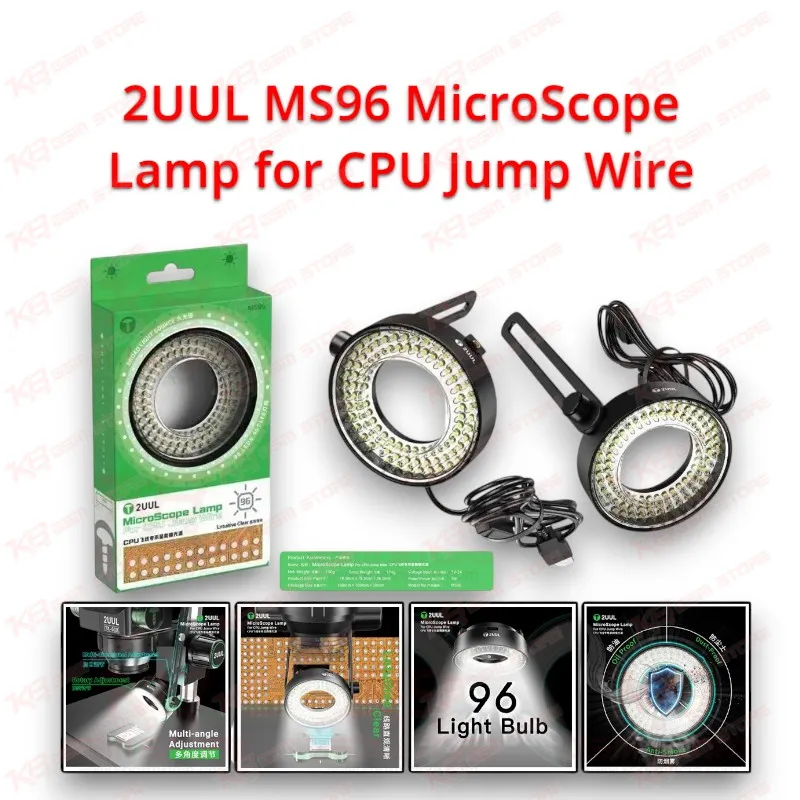
The 2UUL MS96 MicroScope Lamp for CPU Jump Wire lights up your microscope with 96 LED beads, giving you even, shadow-free illumination for CPU jump wire repair, trace restoration, and micro-soldering on phone motherboards. You rotate and tilt the ring lamp to any angle, adjust brightness to suit shiny or dark boards, and rely on the anti-glare, anti-reflection design to see true pad and wire detail. The oil-proof, dust-proof, and smoke-resistant build handles a busy repair bench, and the lamp works with 7X to 60X microscopes. Repair technicians, shop owners, and service centers in Pakistan use it to fix hardware faults with confidence.
⚖️ Weight: 0.35 kg
SKU:MST-MICROSCOPES-29
- Safe & Secure Payment
- Fast Delivery
- WhatsApp Support


Description
FAQ
What is the product name?
The product name is 2UUL MS96 MicroScope Lamp for CPU Jump Wire.
What is the brand of this product?
The brand of this product is 2UUL.
What is the model of this product?
The model of this product is MS96.
What is this product used for?
This product lights your microscope workspace for CPU jump wire repair, trace restoration, and micro-soldering.
Which devices are compatible with this product?
This product works with 7X–60X microscopes and is universal, not tied to specific phone models.
Who should use this product?
This product is suitable for mobile repair technicians, repair shops, service centers, and professional users.
How many LEDs does the MS96 ring light have, and can you adjust the angle?
The MS96 has 96 LED beads, and you can rotate and tilt the lamp to any angle.
Does the MS96 reduce glare on shiny boards and solder?
Yes. Its anti-glare, anti-reflection design minimizes bright spots so you see true pad and wire detail.