


Brand:
2UUL
2UUL PC11 Muit-Port Desktop Charging Station
2UUL PC11 Muit-Port Desktop Charging Station
Regular price
Rs.7,500.00 PKR
Regular price
Sale price
Rs.7,500.00 PKR
Shipping calculated at checkout.
Quantity
Couldn't load pickup availability
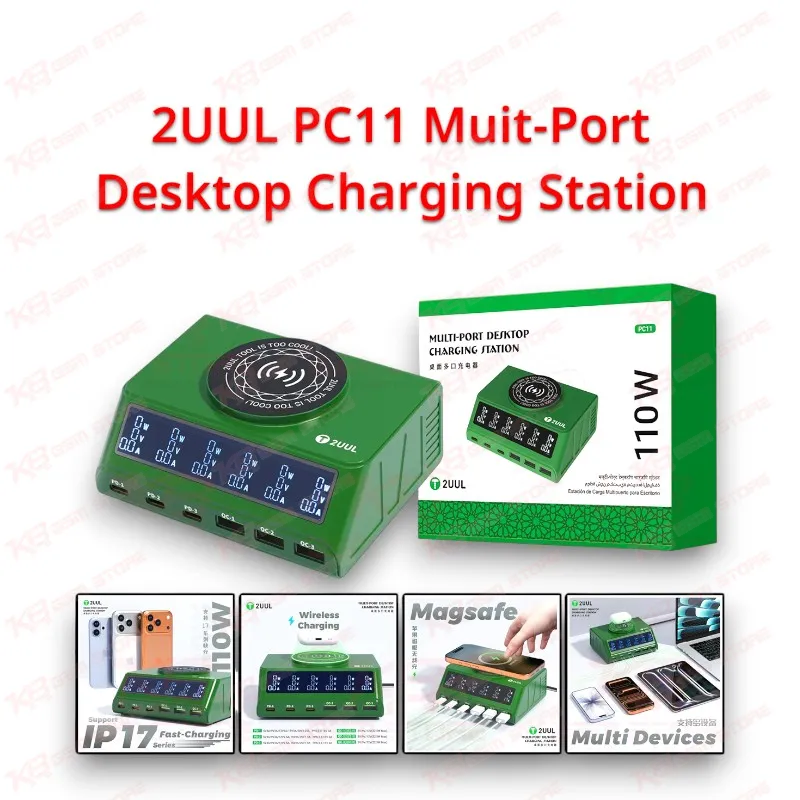
The 2UUL PC11 Muit-Port Desktop Charging Station puts six wired outputs and a magnetic wireless pad on one desktop base, giving your repair bench a single charging point for finished phones, tablets, and accessories. You get three Type-C ports with PD fast charging, three USB-A ports with QC fast charging, and 5W to 15W Apple magnetic wireless charging, all under a 110W maximum output. The 1.2m power cord lets you position the hub beside your soldering station or microscope. Repair shops, service centers, and technicians in Pakistan use it to run post-repair charging tests and keep customer devices powered without a pile of adapters.
SKU:MST-SOLDERING-TOOLS-1201
⚖️ Weight: 0.6 kg
- Safe & Secure Payment
- Fast Delivery
- WhatsApp Support


Description
FAQ
What is the product name?
The product name is 2UUL PC11 Muit-Port Desktop Charging Station.
What is the brand of this product?
The brand of this product is 2UUL.
What is the model of this product?
The model of this product is PC11.
What is this product used for?
This product charges multiple phones, tablets, and accessories at once from one desktop base, and it serves as a charging and testing point on a mobile repair bench.
Which devices are compatible with this product?
This product supports fast charging for iPhone X through iPhone 17 series, AirPods, Android phones, iPad, and other USB-powered electronics.
Who should use this product?
This product is suitable for mobile repair technicians, repair shops, service centers, and professional users.
How many ports does the 2UUL PC11 have, and which fast charging protocols do they support?
It has three Type-C ports and three USB-A ports. The Type-C ports support PD fast charging and the USB-A ports support QC fast charging, with a maximum combined output of 110W.
What wireless charging power does the 2UUL PC11 provide?
It provides Apple magnetic wireless charging from 5W to 15W.