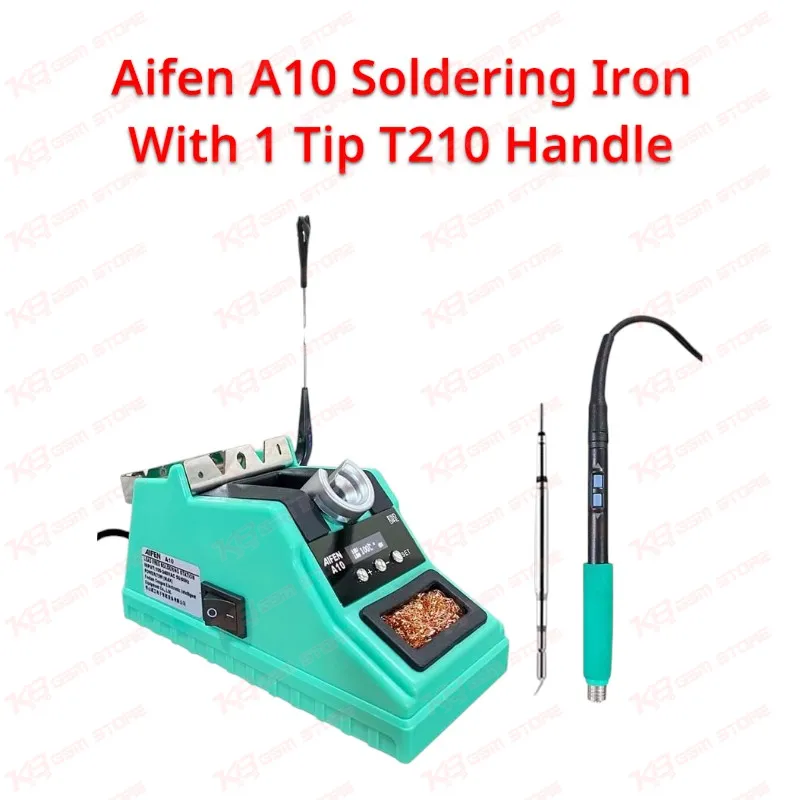
Mobile phone motherboard repair depends on a soldering iron that heats fast, holds temperature under load, and recovers instantly between joints, and the Aifen A10 Soldering Iron with T210 Handle delivers exactly that kind of control for technicians who work on BGA chips, CPU rework, and fine-pitch connectors every day. Instead of the older AC voltage temperature control found in basic soldering irons, the A10 runs on a program-chip control system that reads and adjusts iron tip temperature at high speed, so the difference between your set temperature and your actual tip temperature stays small even when you jump between quick tack joints and longer reflow work on a dense board. This matters directly on a busy repair bench in Pakistan, where a technician might move from a charging port resolder to a CPU reball to a display connector fix within the same hour, and a slow-recovering iron simply cannot keep up without cold joints or overheated pads. The A10 station ships with a T210 handle and a T210-K tip out of the box, and the handle itself works with T115, T210, and T245 handle types, plus JBC C210, C245, and C115 soldering iron tips, which means you are not locked into one tip family as your repair work grows into finer BGA pitch soldering or heavier ground-plane joints. Temperature compensation runs continuously while you solder, correcting the tip in real time so it holds the set point through sustained contact with large copper pours or multi-layer boards, a common pain point when reworking Android motherboards or iPhone logic boards that pull heat away from the tip quickly. The PID-based control program monitors tip temperature at high sampling speed and corrects deviations before they show up as a cold joint or a scorched pad, giving you the kind of consistency that matters when you are working under a microscope on 0.3mm pitch components. A dormant metal ring on the handle triggers automatic sleep mode the moment you set the iron back on the stand, cutting tip oxidation and extending tip life without you needing to manually power down between jobs, and the iron wakes and returns to working temperature within seconds once you lift it again. You get Celsius and Fahrenheit switching built into the control unit, so you can work to whatever temperature standard you are used to, whether that is matching a repair guide written in Fahrenheit or working from your own Celsius-based experience. The station covers a working temperature range of 100°C to 450°C, wide enough to handle low-melting-point solder pastes on delicate flex cables as well as higher-temperature joints on shielded RF components and board-mounted connectors. At 75W maximum output and universal AC 100-240V input, the A10 runs on standard mains power without needing a separate voltage converter, which keeps it practical for repair shops running mixed equipment on the same power strip. Inside a repair workflow, this soldering station typically sits at the IC and connector rework stage, right after diagnostics has identified a dead phone, a charging issue, or a hardware fault traced to a specific component on the board. A technician doing IC change karna on a PMIC or CPU will use the A10 to break the initial solder bond around the chip before moving to a hot air station for full chip removal, then come back to the A10 for cleaning pads and tacking new components or jumper wires. For jumper lagana work after a trace repair, or for reattaching small SMD components after a board clean, the fast heat-up and tight temperature control reduce the risk of lifting adjacent pads, which is a real concern on tightly packed modern motherboards. Technicians handling charging port replacement, battery connector resoldering, or display flex repair benefit from the same fast recovery, since these jobs often involve many small, quick solder points in a row rather than one long continuous joint. The A10 also fits naturally into training environments and service centers where multiple technicians share equipment, since the sleep function protects tip life across shifts and the digital temperature readout on the handle gives a clear, shared reference point for whatever temperature a specific repair procedure calls for. Because the unit accepts a range of JBC-compatible tips, a shop can stock different tip shapes for chip-level soldering, general SMD work, and larger ground pad joints, then switch between them on the same base station rather than buying separate irons for each task. For anyone stepping up from a basic non-temperature-controlled iron, the jump to program-chip control on the A10 shows up most clearly in reduced cold joints, fewer reworked connections, and less time spent waiting for the tip to recover heat between solder points, all of which add up across a full day of dead after flash repairs, board-level troubleshooting, and general motherboard servicing. The compact 225 x 155 x 55mm footprint keeps it manageable on a crowded repair bench next to a hot air station, microscope, and test box, and the 1.5kg station weight makes it easy to move between workstations if your shop rotates equipment. Whether your daily work involves network issue repairs tied to RF IC reflow, hang on logo faults traced back to CPU or eMMC joints, or straightforward board cleaning and connector resoldering, the Aifen A10 gives you the temperature stability and tip flexibility needed to handle chip-level and board-level repair work reliably on a professional repair bench.