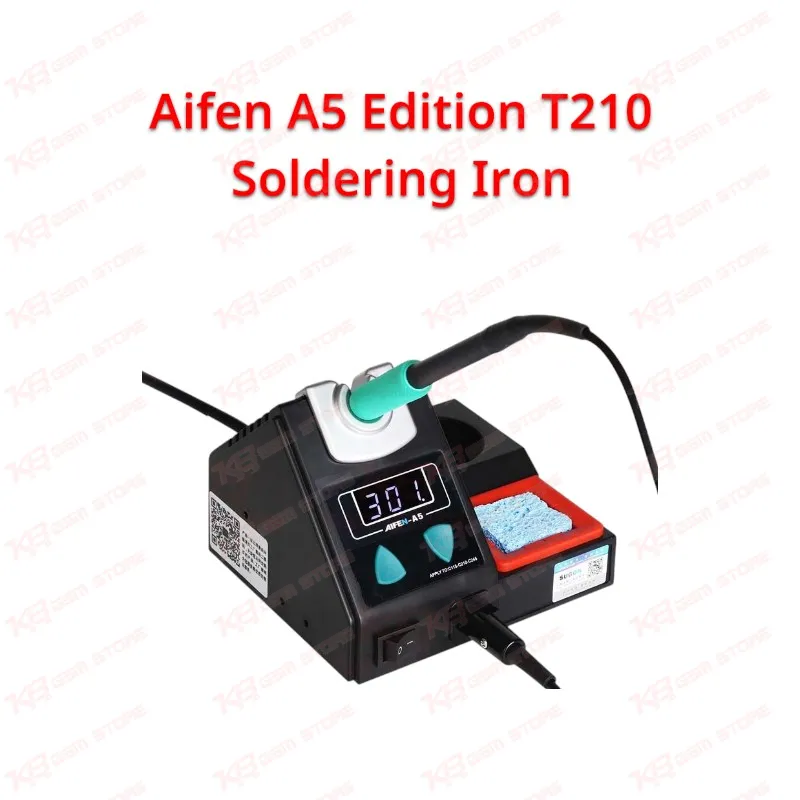
The Aifen A5 Edition T210 Soldering Iron brings chip-controlled precision to mobile phone motherboard repair, PCB rework, and general electronics soldering work. Unlike older soldering irons that rely on AC voltage swings to regulate heat, the A5 uses a programmable control chip inside the station to manage temperature, which means the tip reaches your set point faster and holds it more consistently while you work through IC removal, jumper wire soldering, or connector replacement on a busy repair bench. Technicians dealing with a dead phone after a bad flash, a board that needs an IC change, or a charging port that requires desoldering and rework will find the A5 handles the heat-sensitive parts of that workflow without the temperature drift that damages components or lifts pads. The T210 handle is the core of this station, and it accepts the same C210, C245, and C115 tip families used across popular JBC-style soldering irons, so a technician who already owns tips from a compatible ecosystem can bring that investment straight onto this station rather than rebuying a full tip set. That cross-compatibility matters for repair shops running multiple stations, since it keeps consumable costs down and simplifies tip stock management across the workshop. Power output tops out at 120W, which gives the iron enough thermal mass to recover quickly after contact with larger solder joints, ground planes, or shielded components that pull heat away fast, a common frustration when working on multilayer mobile phone PCBs where a weak iron struggles to keep up. The adjustable temperature range runs from 100°C to 450°C (212°F to 842°F), wide enough to cover low-temperature work on sensitive components as well as higher-heat tasks like reflow touch-up or removing components soldered with older, higher-melting-point alloys. Four programmable standby temperature presets, set at 0, 150, 180, and 200 degrees, let a technician switch quickly between idle, warm-up, and active soldering states depending on the job in front of them, and the "0" setting effectively powers the tip down for standby without a full shutdown cycle. Lifting the handle from the stand brings the iron back to working temperature immediately, so there is no waiting period between picking up the iron and starting work on the next joint. The stand itself includes a sleep-detection ring, and placing the handle back down automatically drops the station into sleep mode, which extends tip lifespan by reducing the amount of time the tip sits at full temperature with no solder contact, a common cause of premature tip oxidation and shortened tip life on stations that lack this feature. A digital display on the station shows real-time temperature and working status, giving the technician a clear read on where the iron sits relative to the target setting rather than guessing based on solder flow alone. Temperature compensation functionality helps the station maintain a stable tip temperature even as heat is drawn away during continuous contact with larger joints, which matters most during rework tasks like reballing preparation, connector desoldering, or board-level cleaning where the iron stays in contact with the board for extended periods. This kind of consistency directly affects repair quality on jobs like hang-on-logo boards, network issue troubleshooting that requires IC reflow, or hardware fault diagnosis where a technician needs to isolate and resolder specific components without disturbing neighboring parts. For a repair shop or service center running multiple repair stations side by side, the A5's dual voltage input covering both 220V and 110V AC at 50-60Hz makes it usable across different regional power setups without needing a separate converter, which is a practical advantage for shops that source equipment from different suppliers or operate across varying electrical standards. The station fits naturally into a PCB repair workflow that also includes hot air rework, ISP or UFS programming tools, and multimeters for diagnostics, functioning as the hands-on soldering component of that broader toolkit rather than a standalone gadget. Whether the task is IC change on a motherboard, jumper wire placement after a trace repair, or general SMD component replacement during board-level diagnostics, the combination of program-chip temperature control, wide tip compatibility, and standby management makes the Aifen A5 Edition T210 a practical daily-use soldering station for mobile repair technicians who need consistent results across a wide range of repair jobs.