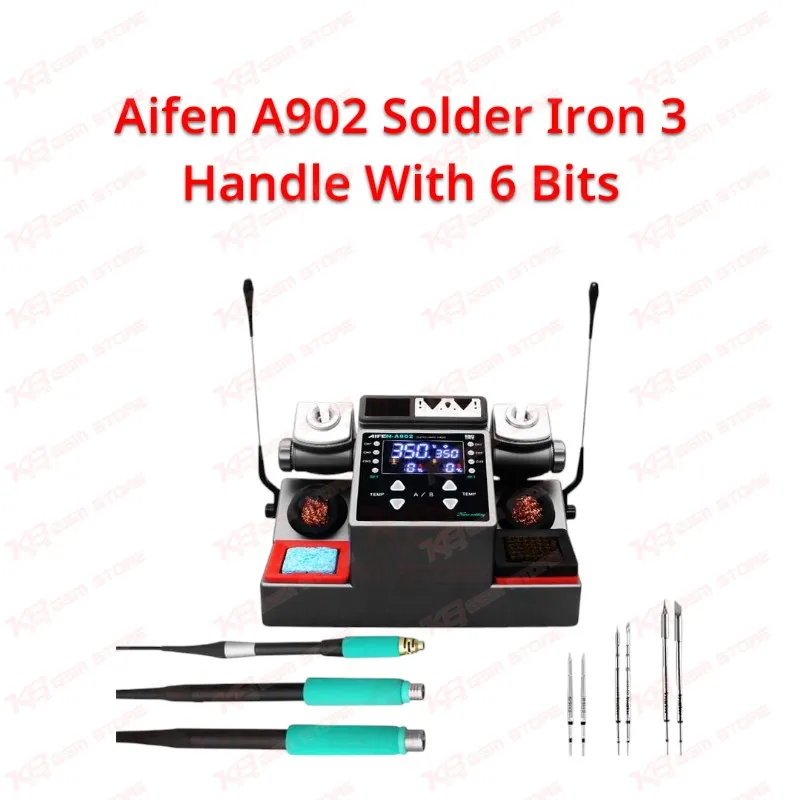
The Aifen A902 dual station soldering iron gives your repair bench genuine BGA-level rework capability, backed by a 350W heating element that reaches working temperature fast and holds it steady even during long charging port or IC replacement sessions on a dead phone board. This station runs on AC 220V/110V input at 50-60Hz and covers a temperature window of 100°C-450°C (212°F-842°F), so you move between low-heat flex cable work and high-heat ground-plane joints without swapping equipment. The package puts three handles in your hand: the T115 handle for tight-pitch SMD work like camera connectors and small ICs, the T210 handle for everyday motherboard soldering such as charging ports, battery connectors, and display flex repair, and the T245 handle for heavier joints, shield removal, and larger tin volumes. Six soldering tips from the C115, C210, and C245 series ship with the station, and the T245 handle also accepts C470 heating cores, so a single unit covers precision micro-soldering and heavier rework without forcing you to own three separate irons. Two independent channels let two technicians work at the same bench simultaneously, or let you keep two different tip sizes hot at once so you switch from a fine C115 tip to a heavier C245 tip mid-repair instead of waiting for a single iron to cool and reheat. Each channel stores three memory temperature settings, so you press once for a second to recall your saved setting or hold the button for three seconds to save a new one, which matters on a busy bench where you jump between iPhone board work, Android charging IC replacement, and general PCB repair all day. Six standby temperature presets (0°C, 150°C, 180°C, 200°C, 250°C, 280°C) keep the tip warm without oxidizing it during pauses between jobs, and temperature compensation automatically corrects heat loss as the tip touches cold solder joints, so your set temperature stays accurate joint after joint instead of drifting low on bigger pads. Key lock stops accidental temperature changes mid-repair, Celsius and Fahrenheit conversion lets you work in whichever unit you trained on, and a buzzer confirms button presses so you do not lose track of settings while focused under the microscope. Built-in short-circuit protection shuts the station down automatically if it detects a fault in your setup or in the board you are repairing, which protects both the tool and the client's board from further hardware fault damage during a repair attempt. For Pakistani repair shops handling daily walk-in traffic, this kind of dual-channel setup pays for itself quickly: one station handles IC change karna on a dead phone, jumper lagana on a damaged trace, charging issue repairs, and display problem flex resoldering, all without switching irons between jobs. The T115 handle suits micro-component work under a microscope, including 01005 and 0201 passive components, small ICs, and Wi-Fi or Bluetooth module pads where too much heat lifts the pad instantly. The T210 handle covers the bulk of daily bench work on modern smartphones, from charging port replacement to Taptic Engine connectors, network IC pads, and general board-level soldering where you need reliable, repeatable heat. The T245 handle, paired with the C470 core option, takes on shield can removal, larger ground pours, and joints that pull heat away faster than a lighter tip can supply, so you are not fighting the iron on bigger jobs. Because the station separates the heating element from the handle and keeps the whole unit lightweight, you get steady hand control during multi-hour repair sessions instead of the fatigue that comes with older integrated iron designs, and that control matters most when you are aligning a fine-pitch IC or reworking a board under magnification. The dual-station layout also fits naturally into a training environment or a two-technician bench, where one channel runs a fine tip for diagnostic rework while the second stays set at a heavier tip temperature for board-level repairs, cutting the downtime that comes from constantly resetting a single-channel iron. Whether your workflow centers on iPhone logic board repair, Android motherboard-level fault-finding, laptop PCB rework, or general PCB repair across mixed brands, the Aifen A902 gives you the tip range, power headroom, and independent dual-channel control to keep the bench moving without compromising on temperature accuracy or joint quality. Tip maintenance stays simple on this station: keep each tip tinned with fresh solder before you set it back in the holder, and avoid parking a tip at high temperature for long idle stretches, since that shortens tip life through oxidation faster than actual soldering work does. The plug-in tip design means you swap between C115, C210, and C245 tips directly at the handle without extra tools, so moving from a hang on logo motherboard diagnosis that needs a fine tip to a network issue repair that needs a heavier one takes seconds rather than a full handle change. On a Pakistani repair bench that sees everything from a pattern unlock job needing board access to a boot loop issue traced back to a cracked solder joint, having 350W of heating power on tap means the iron recovers heat instantly after touching a large ground plane, instead of sagging in temperature the way lower-power irons do on bigger boards. This station fits directly into the standard PCB repair workflow ahead of diagnostics: technicians typically run a short box or diagnostic tool first to isolate a hardware fault, then bring the A902 in for the physical rework step, whether that means IC removal ahead of reballing, jumper wire installation across a cut trace, or connector replacement after a charging issue diagnosis. It pairs naturally with a hot air rework station for full BGA workflows, since hot air handles chip removal and reflow while the A902's fine tips manage fine-pitch touch-up, trace repair, and connector-level soldering that hot air alone cannot control precisely. For technicians building out a complete bench, this soldering station sits alongside your hot air station, microscope, DC power supply, and BGA reballing kit as one of the core tools in any serious PCB repair or IC repair setup, and the memory temperature function means a shared bench can switch between technicians without anyone losing their preferred settings. The short-circuit protection also matters on boards already flagged as dead phone cases, where a hidden short is often the reason the board failed in the first place, since the station shuts down automatically instead of pushing current into an already-damaged trace or pushing heat into an area where a downstream short could cause further hardware fault. Because the A902 supports both C115/C210/C245 tips and C470 heating cores through the T245 handle, repair shops that take on laptop and PC-level PCB work alongside phone repair get a single station that scales from delicate mobile IC pads up to laptop-grade solder joints, which reduces the number of separate irons a busy shop needs to stock, maintain, and train staff on. Overall, this dual-channel 350W setup gives professional repair technicians, hardware engineers, and service center teams a dependable core soldering tool for daily SMD and BGA-level repair work across phones, tablets, and laptop boards.