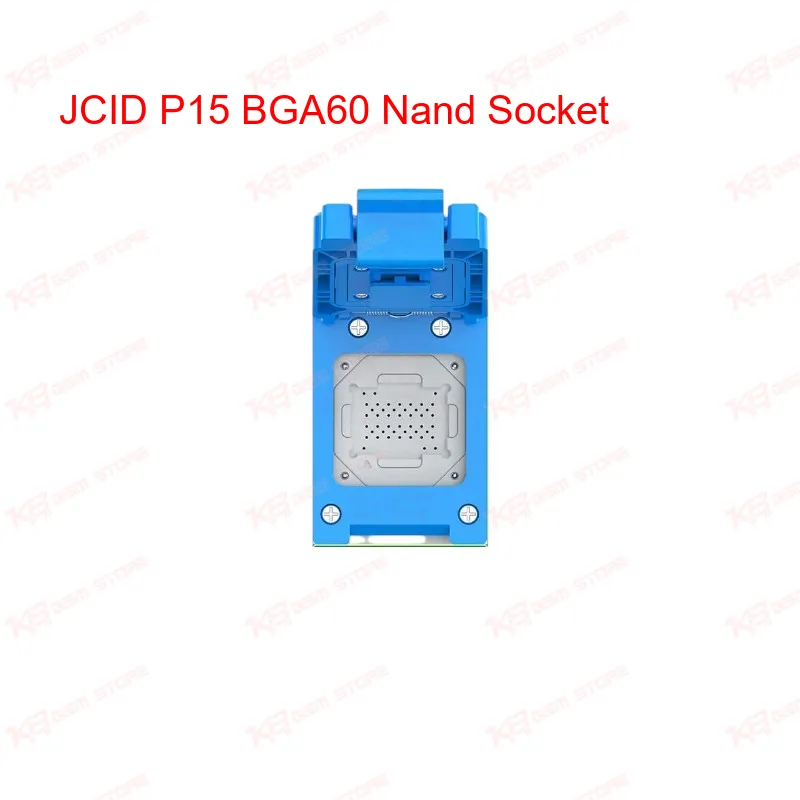
The JCID P15 BGA60 Nand Socket is a purpose-built module that plugs into the JCID P15 Nand programmer, giving your repair bench the ability to work directly with BGA60 package Nand flash chips. If you already run a P15 base unit for iPhone Nand repair, this socket extends your toolkit into another Nand package size without buying a second programmer. BGA60 Nand chips show up in several iPhone generations, and technicians dealing with dead-after-flash boards, storage corruption, or Nand-related boot loop issues need a socket that makes clean, reliable contact with the chip pads. This module handles that job. You place the board or the removed Nand chip into the socket, connect it to your P15 base unit, and run read, write, or format operations through the JCID software interface. The socket itself carries no onboard processing — all the programming logic runs through the P15 programmer, and this module simply provides the correct pinout and contact geometry for BGA60 chips. On the repair bench, this socket handles several real workflows. When a phone comes in dead after a failed flash or firmware corruption, you can pull the Nand, read the syscfg data, and either repair or rewrite it before reinstalling the chip. Storage capacity expansion jobs also run through this socket — technicians upgrading a device's internal storage need accurate Nand programming, and the BGA60 socket delivers the pin alignment that expansion work depends on. Factory code query is another common use: verifying serial number, IMEI-linked data, and syscfg integrity before returning a unit to a customer. Purple screen recovery is one of the more frequent jobs this module supports. When an iPhone boots into a purple screen loop due to Nand data corruption, technicians use the P15 with the correct BGA60 socket to read and rewrite the affected data without full disassembly in many cases, cutting repair time considerably. WiFi unbind operations, which resolve pairing errors after board-level repairs or part swaps, also route through this same socket when the Nand package is BGA60. Reliability at the socket level matters more than most technicians expect. A worn or poorly aligned socket introduces read/write errors that show up as failed operations, corrupted syscfg writes, or intermittent connection drops mid-programming — problems that waste time and put customer devices at risk. The BGA60 socket is built to hold consistent pressure across the pin array, which keeps programming sessions stable across repeated use. This module fits into a technician's broader Nand repair workflow alongside the BGA70, BGA110, and BGA315 sockets, since different iPhone generations use different Nand package sizes. Keeping the full socket set on hand means you're never stuck turning away a job because you only have one package size covered. It also pairs naturally with ISP pinout tools and UFS test boxes on a well-equipped bench, since Nand-level work often follows the same diagnostic path as board-level ISP recovery. For a Pakistani repair shop handling daily iPhone software and hardware faults — dead phone recovery, hang on logo, storage expansion requests, or hardware fault diagnosis tied to Nand corruption — this socket is a direct extension of your existing P15 setup rather than a standalone purchase decision. It's a focused accessory that does one job precisely: give your P15 programmer accurate, repeatable contact with BGA60 Nand chips.