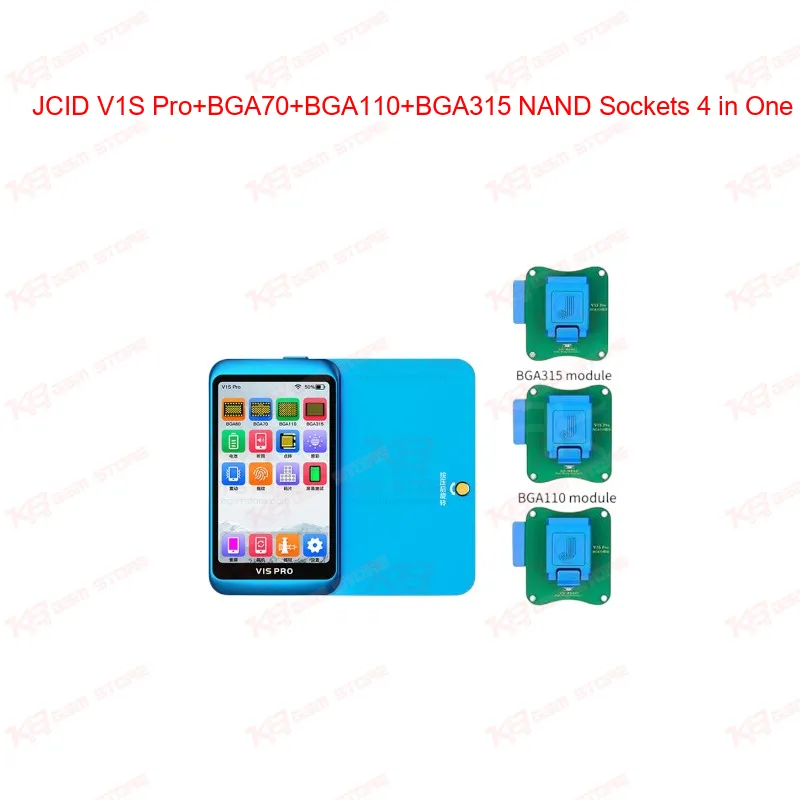
Every mobile repair shop that services iPhones eventually runs into a board that needs direct NAND-level intervention — a dead phone after a failed flash, a boot loop that software alone cannot clear, or a Face ID module that refuses to bind. The JCID V1S Pro Programmer, bundled here with the BGA70, BGA110, and BGA315 NAND sockets, gives your workshop the hardware to handle these cases from iPhone 6S all the way to iPhone 14 Pro Max without switching between multiple standalone boxes. At the center of the set is the JCID V1S Pro main unit, a programmer built to replace older JC Pro1000S fixtures while staying backward compatible with them. If your bench already has Pro1000S modules or V1S/V1SE boards from previous purchases, they still plug into the V1S Pro, so upgrading does not mean writing off your existing module collection. The V1S Pro test fixture folds the functions of JC V1SE, P13, and P7S into one machine, cutting down the number of separate tools a technician needs to keep on the bench for iPhone 6 through 14 Pro Max repairs. The three NAND sockets included in this 4-in-1 bundle each target a specific generation of iPhone NAND flash chips. The BGA70 module handles NAND flash on iPhone 6S through 7 Plus boards, covering the generation where dead-after-flash and hang-on-logo issues are common after failed firmware updates. The BGA110 module steps up to iPhone 8 through 13 Pro Max NAND flash, the widest device range in the set and the one most technicians will use most often given how many of these models still come through Pakistani repair shops for board-level work. The BGA315 module rounds out the set with iPhone 14 series NAND flash support, keeping your setup current for the newer boards now reaching independent repair workshops. With these sockets connected to the V1S Pro, a technician can read, write, and format NAND flash directly from the chip, which becomes essential when a board is stuck in a state that normal iTunes or Finder restores cannot fix. This is the same operation GSM technicians describe as going straight to "IC change" or working around a "dead after flash" board — instead of guessing at a software fix, you pull data at the chip level and rewrite it cleanly. NAND work is only part of what this programmer covers. The DFU purple screen repair function lets you recover an iPhone 6 through X, iPad, or iPod stuck in a purple-screen DFU loop without opening the device — a fast fix for a problem that otherwise eats significant bench time. WiFi unbinding without a full restore is built in as well, useful when a board swap leaves WiFi function locked to the original logic board. The syscfg data modification tool addresses the calibration data that controls sensor and hardware IDs, which often needs correcting after a board or component swap. Screen-related repairs get direct support too. The true tone read/write function lets you pull true tone calibration data from an original screen and write it during a screen replacement, solving the "display problem" complaint that shows up when a swapped screen loses color calibration. Battery repair functions read and write battery health data, letting you calibrate a replacement battery and clear the battery health warning pop-up that otherwise appears after a battery swap — a common complaint among customers after aftermarket battery replacements. For biometric and camera-related repairs, the fingerprint serial number read/write function restores home button fingerprint function on supported older iPhone models after a board or button swap, while the dot projector data read/write function addresses Face ID failures tied to the TrueDepth camera system, a repair category that has grown as more customers bring in iPhone X-generation and later devices with "Face ID not working" complaints. This bundle suits any technician who wants one machine handling NAND-level board repair, DFU recovery, WiFi unbinding, true tone, battery calibration, and Face ID data work across seven iPhone generations, rather than juggling separate single-purpose tools. Whether you run a small mobile repair counter or a full-service center handling volume board work, the V1S Pro with these three NAND sockets covers the chip-level operations that keep dead and boot-looping iPhones off your bench and back in customers' hands.