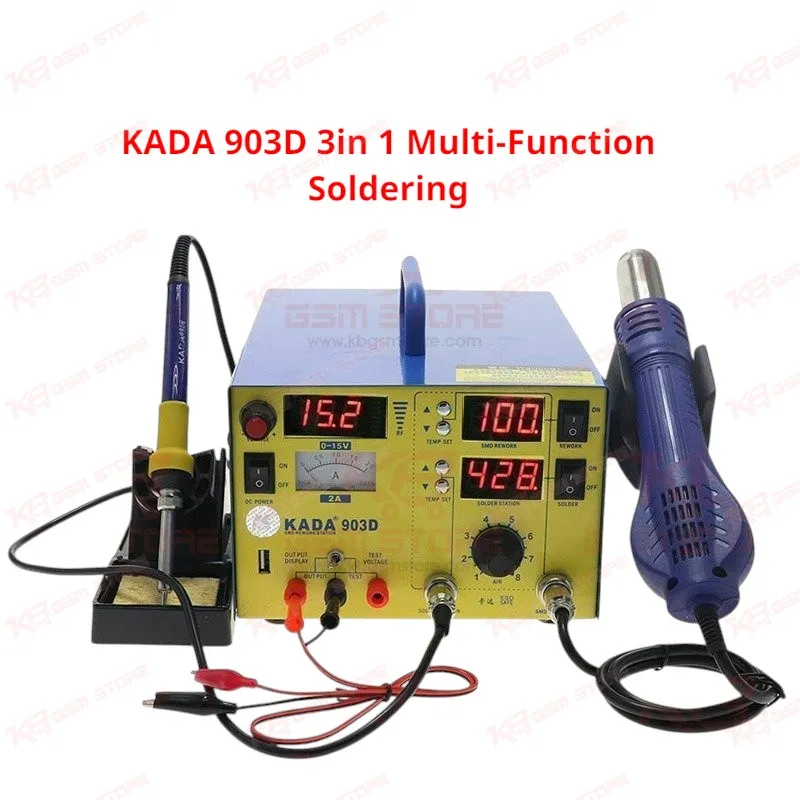
Every mobile repair bench eventually needs three things within arm's reach: a hot air source for component removal, a soldering iron for precision rework, and a regulated power supply for board testing. The KADA 903D puts all three into a single 3.85kg unit measuring 250 x 185 x 175mm, cutting down bench clutter without cutting corners on any of the three functions.
Hot air gun performance
The hot air side runs on a brushless fan delivering soft, controlled airflow up to 120L/min, paired with a temperature range of 100°C to 480°C and stability rated at ±1°C. That stability matters when you're lifting a BGA chip or reflowing a charging port connector — swings in airflow temperature are what crack nearby components or lift adjacent pads. The digital display shows your working temperature in real time, and the unit remembers your last-used temperature setting, so you're not resetting values every time you power on for a routine job like removing a dead phone's shield can or desoldering a battery connector.
Because the fan is brushless, it holds up better under continuous daily use than older station designs that rely on carbon-brush motors, which wear down and lose airflow consistency over time. For a shop running through several boards a day, that translates into a longer service life before the airflow assembly needs attention.
Soldering iron performance
The soldering iron portion covers 200°C to 480°C with ±2°C temperature stability, ground voltage under 2mV, and grounding resistance under 2 ohms. Low ground voltage and resistance are not spec-sheet filler — they directly protect sensitive ICs and CPUs from static discharge damage while you're working on a board that's already powered or connected to test equipment. This is the same concern that matters when jumper lagana on a motherboard trace or reballing a PMIC: any static leakage through the iron tip can silently damage the very chip you're trying to save.
Integrated DC power supply
The third function is a regulated 0V–15V DC power supply built directly into the chassis, with load stability rated at under 0.01±2mV, a temperature coefficient below 300ppm/°C, ripple noise under 1mrms, and adjustable protection current between 1A and 3A. In daily repair work, this power supply covers a wide range of diagnostic tasks: powering a dead phone that won't boot to check current draw patterns, running voltage checks across a circuit board to isolate a short, or testing RF signal strength during a network issue diagnosis. The adjustable current protection is particularly useful when working on a board with a suspected short — you can cap the current before it damages traces or components further, rather than guessing and risking more harm to an already-faulty board.
Built for a busy workshop
KADA built in an intelligent alarm and automatic fault detection system, so the unit flags abnormal conditions instead of failing silently mid-job. The hot air handle is designed for comfortable extended handheld use, and airflow rotation automatically stops once temperature drops below 70°C, reducing wasted heat cycling between jobs. The unit is rated for a working environment of 0°C to 50°C and storage between -20°C and 80°C with 35%-45% storage humidity, which covers standard workshop conditions across Pakistan without special climate handling.
Where it fits in the repair workflow
The 903D sits at the center of board-level repair work: hot air handles component removal and reflow, the soldering iron handles fine rework and jumper wire placement, and the power supply handles pre- and post-repair diagnostics. For a technician troubleshooting a dead phone or a board that's hang on logo, the typical flow is power-supply diagnosis first to check for shorts or abnormal current draw, hot air removal of the suspect IC or connector next, then soldering iron work to install jumper wires or reattach components, followed by a final power-supply test to confirm the fix before reassembly. Having all three stages on one unit removes the back-and-forth between separate tools that slows down a repair bench.
This station suits mobile phone repair technicians, GSM software and hardware technicians, repair shop owners, and service centers handling SOIC, QFP, PLCC, BGA, and general SMD-level board work, particularly where flex cable and connector desoldering is a frequent task.