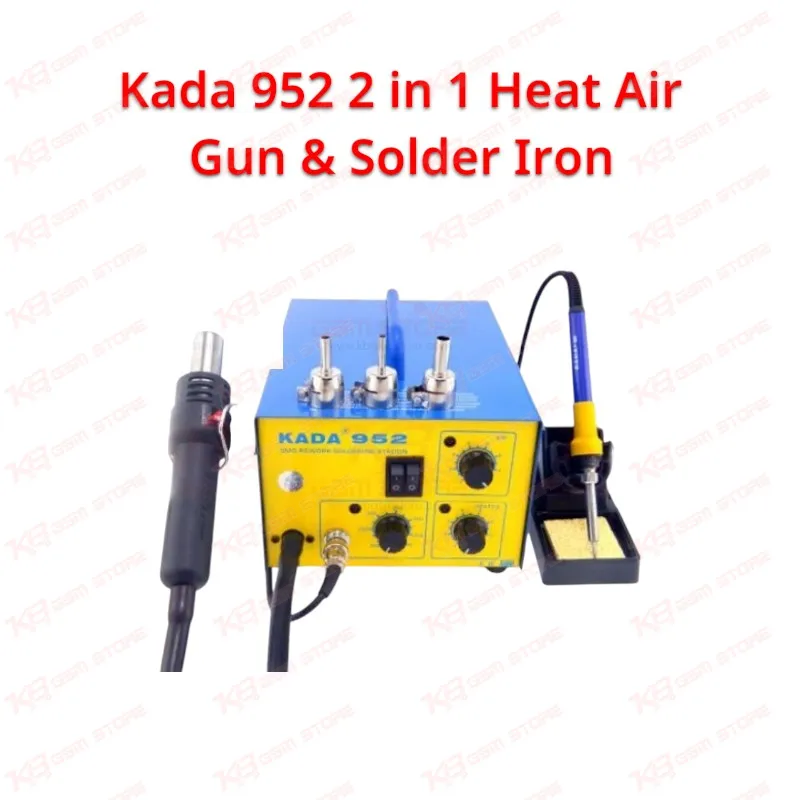
Every mobile repair bench that handles board-level work eventually needs a rework station that does more than heat air, and the KADA 952 fills that role by pairing a hot air gun with a soldering iron in a single 2-in-1 chassis, letting a technician move between IC reballing, SMD desoldering, and standard iron work without switching equipment or losing bench space. The hot air side runs on an independent temperature control from 100°C to 480°C, giving you enough range to lift a charging IC off a board without disturbing surrounding components, remove a CPU IC ahead of a reballing job, or gently rework a PMIC on a dead-after-flash board where excess heat risks damaging nearby traces. The soldering iron side runs separately from 200°C to 480°C, so a technician doing a quick jumper lagana repair or a connector resolder does not need to fire up the air gun at all, which keeps the workspace cooler and cuts unnecessary power draw during long shifts. Independent control between the two heating elements is the real workflow advantage here: a shop running dozens of board repairs a day is not always doing hot air work, and having a separate iron circuit means the soldering side heats up fast without waiting on the air pump or blower to stabilize. The 24V DC output on both sides keeps the working voltage low at the tool tip, which matters on ESD-sensitive boards where a technician is working close to exposed ICs and connectors, and it reduces the risk of static discharge damaging a chip mid-repair. A brushless fan drives the internal cooling and the air pump feed, and this design choice matters over the long run because brushless motors run quieter and last longer under the kind of continuous daily use a busy GSM repair shop puts on a rework station, compared to the brushed motors found in older or budget hot air units that wear out within a year of heavy use. An automatic cooling function activates after the hot air gun is powered off, running the fan for a short period to bring the heating element and nozzle down to a safe handling temperature before full shutdown, which protects both the internal heating coil and the technician handling the gun immediately after a repair. This kind of thermal protection extends the working life of the heating element considerably compared to units that cut power immediately, since sudden shutdown under full heat tends to stress the coil and shorten its lifespan. The KADA 952 handles the repair scenarios that come up constantly on a Pakistani service center bench: boot loop issue boards that need a PMIC reflow, network issue repairs that trace back to a baseband IC needing reseating, charging issue jobs where the charging IC needs full removal and replacement, and display problem cases where a display connector needs careful desoldering without lifting the pad. Because the hot air side covers up to 480°C, it also handles the heavier lifting jobs like CPU IC removal ahead of a reballing session, where the technician needs sustained heat across a wider area without the temperature dropping mid-job, a common complaint with lower-powered or single-mode hot air guns. The package includes the main rework station unit, two interchangeable nozzles for different component sizes, a soldering iron with its own holder stand, a power cable, and an instruction manual, giving a shop everything needed to get the station running on day one without sourcing separate accessories. Two digital displays, one for the hot air side and one for the soldering iron, let the technician read and set the exact working temperature for each tool independently, removing the guesswork that comes with analog dial-based rework stations where hitting a precise temperature for sensitive IC work is difficult. For a repair shop that handles a high volume of iPhone and Android board work, the ability to set and hold a stable temperature matters more than raw wattage numbers, because inconsistent heat is what causes lifted pads, damaged traces, and IC change karna jobs that go wrong halfway through. The KADA 952 sits well within a standard PCB repair workflow: diagnostics first to confirm the fault is IC-level rather than software marna territory, hot air removal of the suspect IC, cleaning of the pad with flux and braid, reballing or direct replacement of the component, and a final reflow pass with the same hot air gun to seat the new IC. Because the soldering iron shares the same 24V low-voltage system, technicians moving between hot air rework and iron-based connector or jumper work stay within one consistent safety profile for the whole repair, rather than switching between a low-voltage air gun and a separate mains-voltage iron. This 2-in-1 design also saves physical bench space, which matters in smaller Pakistani repair shops where multiple technicians often share a single workbench and every extra standalone tool eats into limited working room. For technical training institutes teaching board-level repair, the KADA 952 gives students a single station to practice both hot air IC handling and iron-based soldering fundamentals, covering the two core skills that make up most entry-level mobile repair work. Overall, the KADA 952 is built for the technician who needs a dependable, dual-function rework station rather than two separate tools, with enough temperature range and independent control to handle everyday SMD IC work alongside standard soldering iron tasks on the same bench.