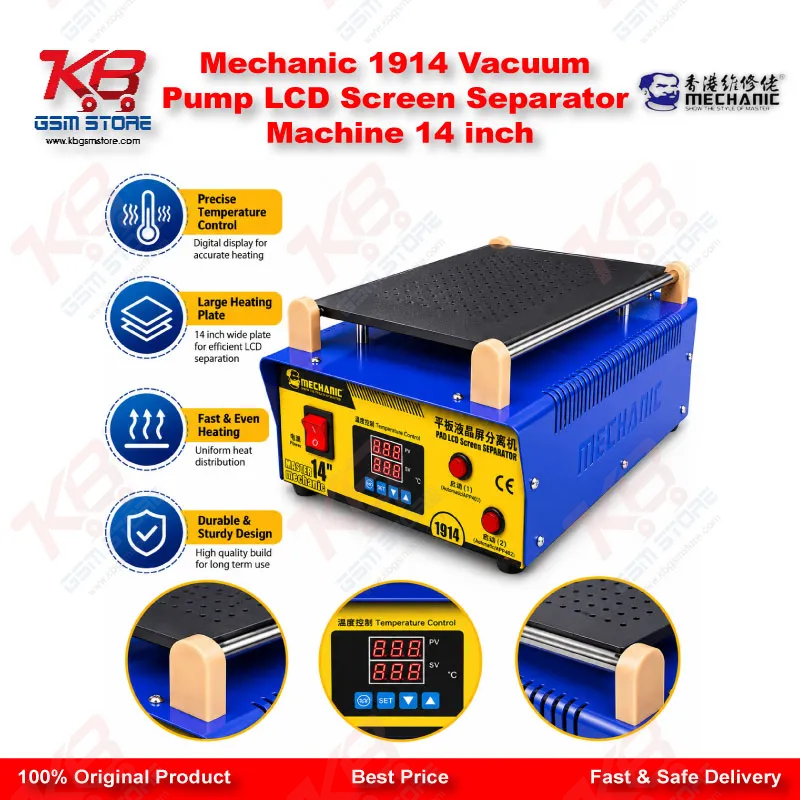
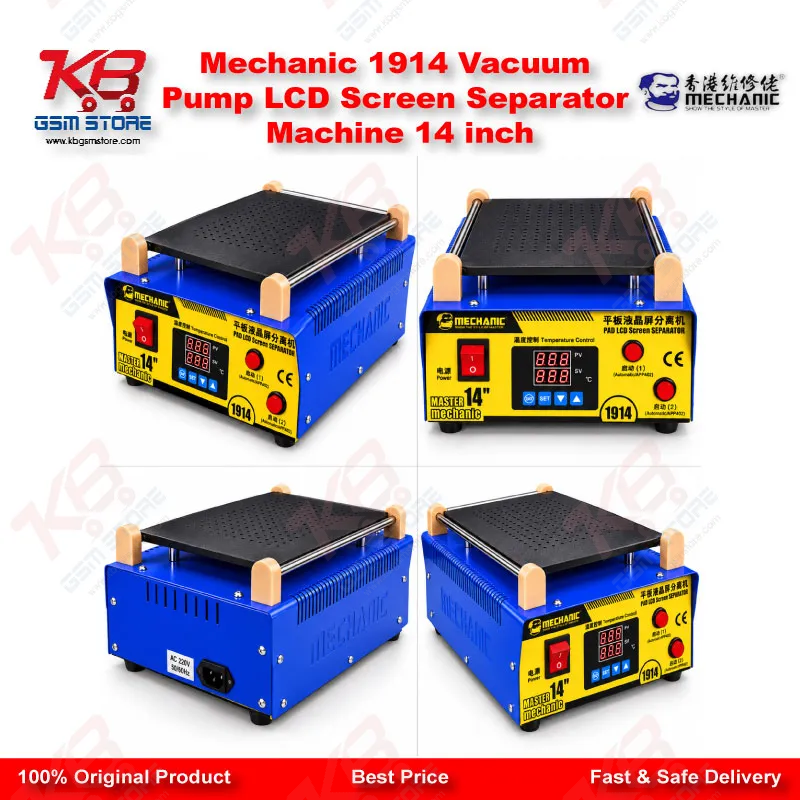
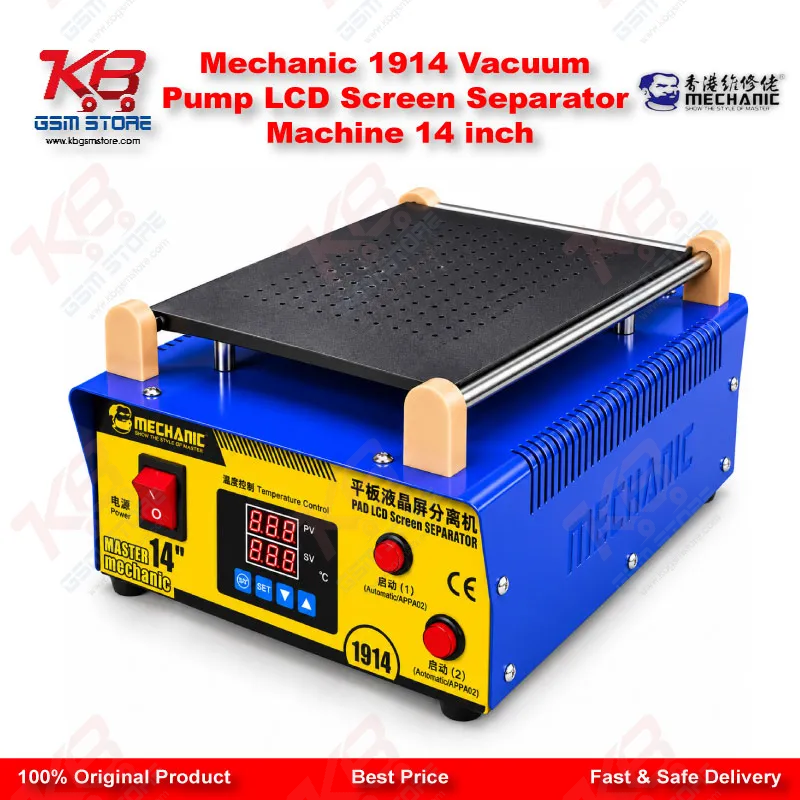
Every repair shop in Pakistan knows the scene: a customer walks in with a cracked screen, the display still lights up, touch still responds in the corners, and the full original combo costs more than the customer wants to pay, so the smart move is a glass-only change, and that job lives or dies on how well your separator holds and heats the panel, which is exactly where the Mechanic 1914 Vacuum Pump LCD Screen Separator Machine 14 inch earns its place on your repair bench. Mechanic builds this unit around a 14-inch all-aluminum heating plate made from aviation-grade aluminum, and that plate spreads heat evenly across the whole working surface, so the OCA glue under the broken glass softens at the same rate from edge to centre instead of leaving cold spots that fight your cutting wire and crack the LCD underneath. Uneven heat ranks among the top reasons technicians end up with a dead display, black patches, or lines on the panel after a glass change, and a large uniform plate removes much of that risk before you even pick up the wire. The real advantage over older flat heaters comes from the built-in double vacuum pump, since the Mechanic 1914 carries two air pumps inside the body and you choose to run one pump or both at the same time from the front panel, which means a small Infinix or Tecno phone screen gets enough suction from a single pump while a 10-inch or larger tablet panel gets the full grip of both pumps working together. In older setups you needed a separate heavy vacuum pump with pipes running across the counter, or you clamped the screen with screws and fixtures that put uneven pressure on the panel, and this machine replaces both approaches with one compact unit that plugs in and works, freeing bench space for your hot air station, soldering station, and microscope. The top surface uses a special silicone pad with a lip-style sealing ring and a porous hole pattern, so the suction spreads across the area under the screen and holds panels of different sizes without air leakage, and Mechanic specifically points to the aviation aluminum construction as the reason the platform stays sealed during long sessions, which matters when you work through a stack of glass jobs on a Saturday rush. Temperature control sits on the front panel with an LED digital display and preset temperature settings, so you see the working temperature in real time and change it without guessing, and that visibility helps you match heat to the job, with a gentler setting for OLED panels that you want to protect and a stronger setting for stubborn adhesive on tablet glass. Shop owners who train new staff appreciate this point because a junior technician follows a clear number on the display instead of judging heat by touch, and fewer mistakes mean fewer customers coming back with a display problem the next day. Static damage counts as a quiet killer in display repair, since a flex cable or display driver can fail from a discharge you never noticed, and the Mechanic 1914 body uses anti-static material to protect the LCD and its flex cable while the panel sits on the plate, which pairs well with an anti-static mat and grounded tweezers on the rest of your workbench. The unit also includes an internal safety power system that guards against electric leakage, an important detail in shops where the machine runs for hours next to other equipment on shared extension boards. Operation stays manual and straightforward: you set the temperature, switch on one or both vacuum pumps, place the screen assembly face up on the silicone pad, let the heat soften the adhesive, and then run your cutting wire between the glass and the LCD while the suction keeps the panel from moving, and once the old glass comes off you clean the remaining glue, laminate the new glass with OCA, and send the assembly through your autoclave or bubble removal process if your workflow includes one. The 14-inch working capacity covers almost everything that comes across a Pakistani repair counter, from compact smartphones from Samsung, Oppo, Vivo, Infinix, Tecno, and iPhone series to iPads and Android tablets, and the machine handles both LCD and LED screen assemblies, so one unit covers your phone glass jobs and your tablet glass jobs without a second separator taking up space. The machine also helps when you need to separate a touch digitizer from a display on older models where the touch layer sits as a separate part, saving the working panel when only the touch has failed, and for shops that do bulk refurbishing work for dealers this flexibility cuts per-job cost noticeably because you stop paying for full combos when the display itself still works. Inside a complete repair workflow, the screen separator sits on the display side of your bench, and the board side needs its own set of tools when a phone comes in with more than a broken screen, so a customer with a dead phone or hang-on-logo issue after a drop may need diagnosis with a multimeter and a test box, board work with a hot air station, soldering station, PCB holder, and reballing kit, and inspection under a microscope before the job ends, while software-side recovery may call for ISP pinout tools, eMMC programmers, or UFS adapters when storage needs attention, and KB GSM Store stocks these tools so you can build a complete bench from one supplier. If you currently use a small 7-inch heating plate, the Mechanic 1914 works as a natural upgrade path, because you gain tablet capacity, dual-pump suction, and a cleaner bench in one step, and if you already run a big separator with an external pump, this machine removes the noisy pump and the hose clutter while keeping full holding power. For shops just starting out with display repair, it gives a professional base that grows with your work, since you can begin with phone glass changes and move into tablet and iPad glass jobs without buying new equipment, letting your investment pay itself back across more job types as your customer base grows. KB GSM Store supplies the Mechanic 1914 to technicians across Pakistan with delivery to Lahore, Karachi, Islamabad, and other cities, so you get a dependable separator at a competitive price in Pakistan and keep your display repair work moving without long waits.