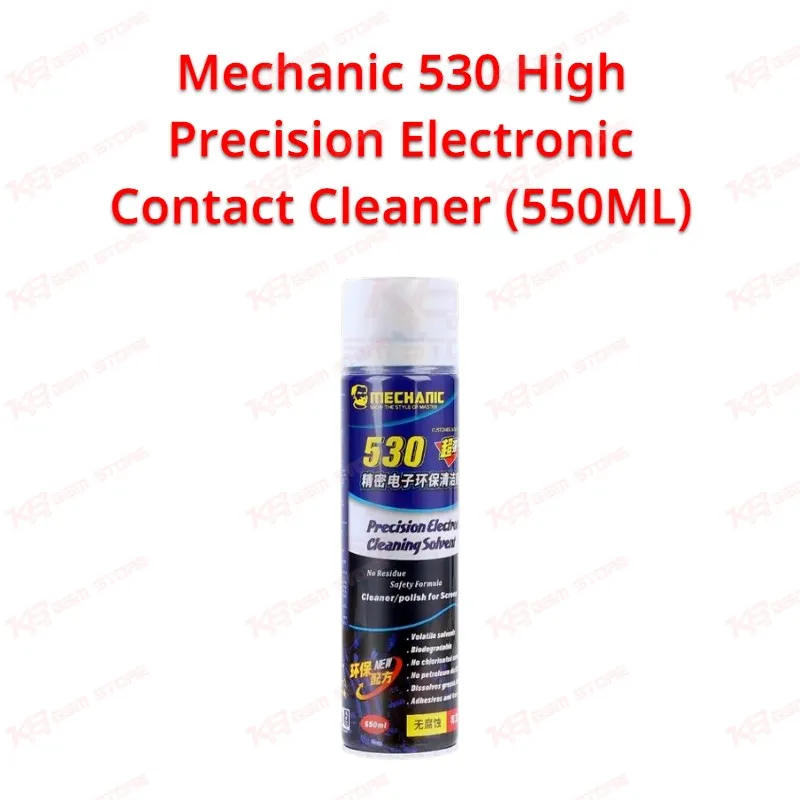
Every repair bench eventually hits the same problem: flux residue clinging to a board after IC change, oil smudges under a screen before glass fitting, or corrosion buildup on connector pins after a charging port swap. Mechanic 530 High Precision Electronic Contact Cleaner is formulated to handle exactly this kind of daily cleanup, giving technicians a fast, non-conductive solvent that clears contaminants without damaging sensitive components underneath.The formula is built from high-quality hydrocarbon solvent and surfactant, which gives it strong decontamination power against grease, oil pollution, toner powder, salt deposits, moisture, and metal powder. On a repair bench, that translates into practical use cases: wiping down a motherboard after reballing, clearing flux marks left behind after soldering work, or prepping a glass panel before a screen protector goes on. The liquid evaporates quickly and leaves no residue, so there is no need to wipe the board dry afterward or worry about leftover film interfering with connections.A key detail for board-level work is the insulation resistance rating of 14×10¹³ Ω, which confirms the liquid is non-conductive and safe to use around live circuits and delicate electronic components without risking a short. The cleaner is also non-corrosive on the materials technicians actually work with daily: metal, insulating paint, plastic, rubber, organic glass, and veneer surfaces all stay unaffected. This matters when cleaning near ICs, connectors, or plastic housing where a harsh solvent could eat through coatings or degrade plastic components over repeated use.The 550ml can uses a 360-degree press spray mechanism with an ABS plastic bottle cap, letting technicians angle the spray to reach connector housings, IC edges, and tight spaces around the motherboard without needing to reposition the board constantly. This is useful during dead phone diagnosis, where multiple areas of the board need cleaning in sequence — connector pins, test points, and component legs — before probing with a multimeter or continuity tester.Beyond board-level repair, Mechanic 530 handles general device cleaning: shell surfaces, plastic housings, camera lenses, and glass screens on phones, tablets, and laptops. It is commonly used to clean the display glass before fitting a new screen protector or replacing a cracked glass panel, since any leftover oil or dust under the glass shows up as visible smudges or air bubbles after installation. The cleaner also generates an antistatic film after application, which helps reduce dust attraction on sensitive surfaces like camera lenses and screen glass after cleaning.For repair shops running high volumes of screen replacements, charging port repairs, and IC-level board work, this cleaner earns its place as a consumable that gets used daily rather than occasionally. It pairs naturally with other bench tools like brushes, microfiber cloths, and precision tweezers during the cleaning stage of any repair job — before soldering, before reballing, and before final reassembly. Technicians dealing with hardware fault diagnosis on boards with corrosion or liquid damage also rely on this type of cleaner to clear oxidation from pins and pads before testing continuity or attempting a repair.Storage and handling on the bench are simple: shake the can before use, spray a light coat on the target area, and let it evaporate fully before powering the device back on. For heavily soiled boards or connectors, a second light pass clears remaining residue without oversaturating the component.