Skip to product information
1 of 4
Brand: MECHANIC

MECHANIC Aac-14 Tweezers Non-Magnetic Precision Tweezers

MECHANIC Aac-14 Tweezers Non-Magnetic Precision Tweezers

Regular price Rs.300.00 PKR
Regular price Sale price Rs.300.00 PKR
Sale Sold out
Shipping calculated at checkout.
Quantity

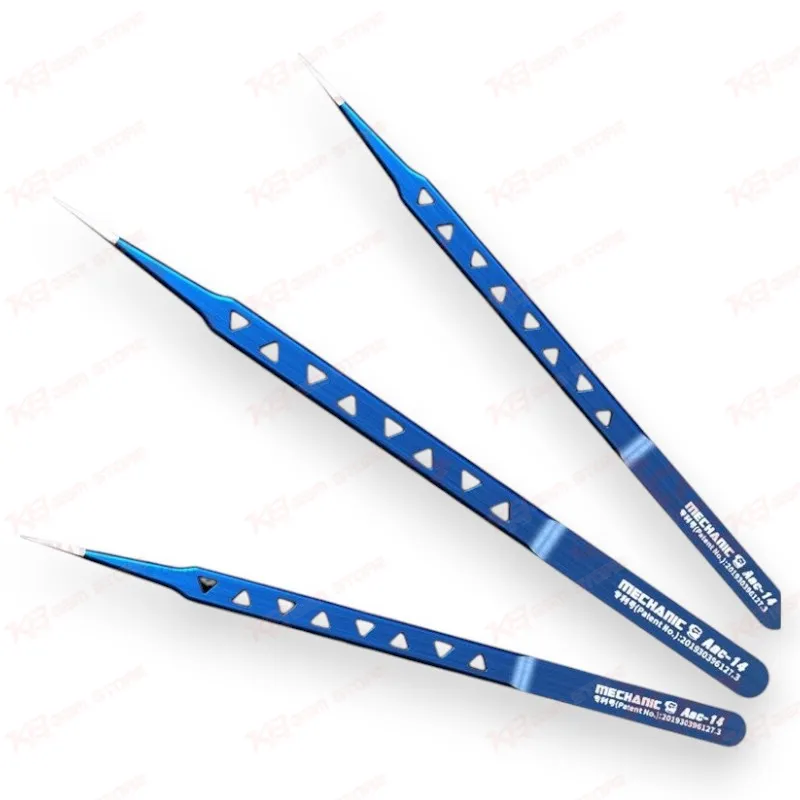
The MECHANIC Aac-14 Tweezers Non-Magnetic Precision Tweezers give Pakistani repair technicians a long, stiff, heat-resistant tool for board-level work. The 160mm body has 8 hollow heat-dissipation holes that keep your fingers cool under the hot air nozzle. The straight pointed tips taper to 0.25mm, which gives you control for jumper wire routing, SMD placement, and IC alignment. HRC50 non-magnetic stainless steel keeps the tips aligned and stops tiny screws and shields from sticking to the tool. At 22.5g, it stays light and steady in your hand, so it suits daily use on any mobile repair bench in Lahore, Karachi, or Islamabad.

SKU:MST-SOLDERING-TOOLS-84

⚖️ Weight: 0.5 kg

  • Safe & Secure Payment
  • Fast Delivery
  • WhatsApp Support
View full details

Description

Every repair bench has one pair of tweezers that gets picked up a hundred times a day, and the MECHANIC Aac-14 Tweezers Non-Magnetic Precision Tweezers earn that spot because they fix the two problems that ruin cheap tweezers: heat creep and tip flex. On a dead phone with a short on the main rail, you spend long minutes under the hot air nozzle lifting capacitors, moving filters, and checking pads under the microscope. A solid steel tweezer absorbs that heat until it burns your fingers or warms the component you want to place. MECHANIC handles this with a patented 8-hole hollow body. Eight cut-outs along the arms reduce the metal mass and let heat escape before it reaches your grip, and triangular anti-slip openings give your fingertips a firm hold through a long session. The body is 160mm long, which is longer and thicker than a standard ESD tweezer. Your hand stays further from the hot air stream, and the arms resist bending when you press on a stubborn shield clip or lift a small part off the board. The straight pointed tips taper to 0.25mm. That gives you the control to route a thin jumper wire between two broken traces, line up the pins of a charging IC before you tack it, or pick up a single tiny SMD capacitor without knocking its neighbours off their pads. The steel has a hardness rating of HRC50, so the tips keep their alignment after months of daily work instead of crossing over or splaying open, which is the usual reason technicians in Pakistan replace low-grade tweezers every few weeks. Non-magnetic stainless steel matters more than most buyers realise. A magnetised tweezer pulls tiny screws, shields, and ferrite parts toward it, makes speaker and earpiece work frustrating, and can throw small components off the board at the worst moment. The AAC-14 lets you handle these parts cleanly. At 22.5g, the tool is light enough for fine placement and solid enough to give you feedback through your fingers when a tip touches a pad. A typical workshop workflow goes like this: you clamp the board in your PCB holder, inspect the fault under the microscope, heat the area with your hot air station or soldering station, and use the AAC-14 to lift, position, and hold parts while the solder sets. During IC change jobs on charging issue or network issue phones, the long straight tips help you nudge the chip into alignment on its pads before reflow. During reballing work with your reballing kit, the fine points let you correct a misplaced ball or clear stencil residue. On boot loop and hang on logo cases, after you trace a broken line with a multimeter, the 0.25mm tip holds enamel jumper wire steady without crushing it. The AAC-14 is a hardware-side tool, but it also supports software-side jobs. When a dead after flash device needs an ISP connection, you rely on precise tweezers to place fine wires on the ISP pinout points before you connect your eMMC programmer, UFS adapter, or test box. Beyond phones, the same tweezers serve watch repair, eyeglass hinge work, and any precision task involving small accessories or integrated circuit pins. Repair shop owners usually buy this tool in multiples: one for the hot air area, one for jumper work under the microscope, and one for the trainee's station, so everyone works with the same reliable grip. The blue finish makes it easy to spot on a crowded mat, and the engraved MECHANIC branding shows that you are holding the genuine tool. If you already own basic tweezers and keep dealing with bent tips and hot fingers, the AAC-14 is a direct upgrade for daily board repair. Pair it with a curved-tip tweezer for angled access and you cover nearly every handling task on a mobile repair bench. Order the MECHANIC AAC-14 from KB GSM Store and put it to work on your repair bench.

Key Features

  • Patented 8-hole hollow body that releases heat away from your fingers during hot air and soldering work
  • Ultra-fine 0.25mm straight pointed tips for jumper wires, small SMD parts, and IC pin alignment
  • HRC50 high-hardness stainless steel that keeps the tips aligned through heavy daily use
  • Non-magnetic construction that stops screws, shields, and small ferrite parts from sticking to the tool
  • Lengthened 160mm body that keeps your hand clear of the hot air stream
  • Thickened arms that resist bending under pressure on clips and tight components
  • Triangular anti-slip openings for a secure grip during long repair sessions
  • Lightweight 22.5g build with a blue finish that is easy to find on a crowded repair mat

Specifications

Brand Entity MECHANIC
Product Entity MECHANIC AAC-14 Non-Magnetic Precision Tweezers
Technology Entity 8-hole hollow heat-dissipation design, HRC50 non-magnetic stainless steel
Compatible Device Entities Smartphone logic boards (all brands), integrated circuit pins, SMD components, watches, eyeglasses
Repair Process Entity Jumper wire repair, SMD rework, IC alignment, BGA reballing, hot air rework
Industry Entity Mobile phone repair, PCB repair, electronics repair

Compatible Devices

  • Universal — not device-specific
  • Smartphone logic boards from any brand (Samsung, Oppo, Vivo, Infinix, Tecno, iPhone, and others) for component handling
  • Integrated circuit pins and small SMD components
  • Watches, eyeglasses, and other small precision devices

Common Repair Uses

  • Routing and holding jumper wires on broken PCB traces
  • Lifting and placing SMD capacitors, resistors, and filters during hot air rework
  • Aligning charging ICs, PMICs, and other chips on their pads before reflow
  • Correcting misplaced solder balls and positioning parts during BGA reballing
  • Placing fine wires on ISP pinout points for dead phone software recovery
  • Handling tiny screws, shields, and small accessories during phone disassembly
  • Precision work on watches and eyeglass parts

FAQ

What is the product name?
The product name is MECHANIC Aac-14 Tweezers Non-Magnetic Precision Tweezers.
What is the brand of this product?
The brand of this product is MECHANIC.
What is the model of this product?
The model of this product is AAC-14.
What is this product used for?
This product is used for precise component handling in mobile phone board repair, including jumper wire work, SMD placement, IC alignment, and reballing.
Which devices are compatible with this product?
This product is compatible with all smartphone logic boards, IC pins, SMD components, and small precision devices such as watches and eyeglasses, as it is a universal hand tool.
Who should use this product?
This product is suitable for mobile repair technicians, repair shops, service centers, and professional users.
How fine are the tips on the MECHANIC AAC-14, and can they handle jumper wire work?
The tips taper to 0.25mm, which gives you enough control to hold and route thin jumper wire between broken traces under a microscope.
Do the 8 holes on the AAC-14 actually reduce heat during hot air rework?
Yes. The hollow cut-outs reduce the metal mass of the arms, so heat escapes along the body instead of travelling to your fingers during hot air and soldering work.

Ask any Query