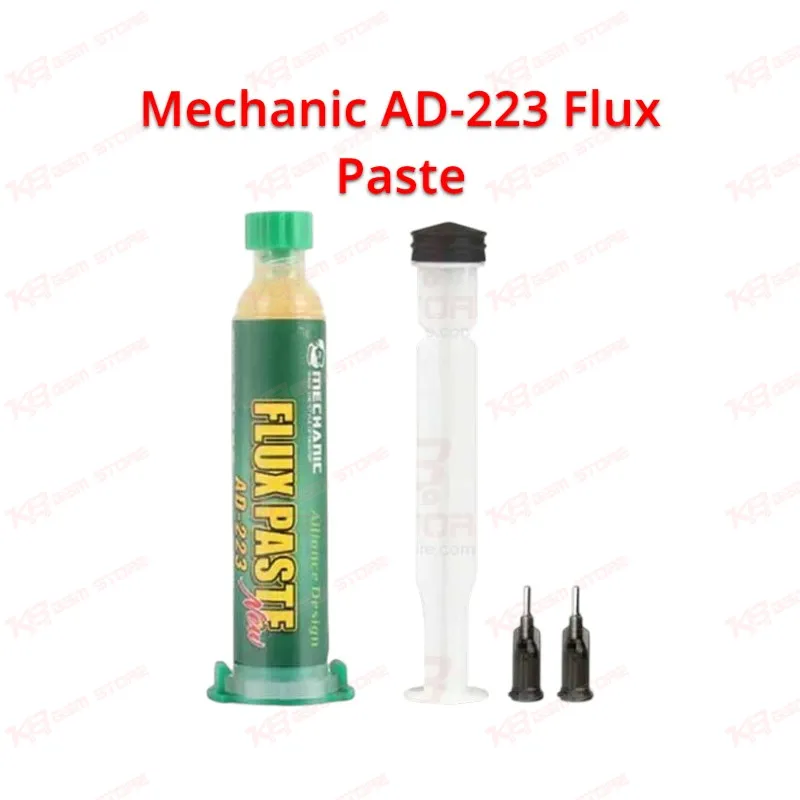
When a phone comes in dead after a drop or a failed flash and the board needs an IC change, the flux you use under the hot air station decides whether the joint holds or lifts again in a week, and Mechanic AD-223 is built around that exact pressure point. The paste combines alloyed powder with a resinic pasty base, so it wets the pad evenly and pulls solder balls into place during BGA reballing instead of letting them scatter under heat, which matters when you're reworking a CPU, PMIC, or NAND package on a crowded board where neighboring components can't take extra thermal stress. It carries the RMA-223/559 classification, a no-clean flux type that Pakistani technicians already trust for reballing and chip-level repair, and because it's no-clean, you don't need to follow up with isopropyl alcohol scrubbing before you close the board back up — the residue stays pale yellow and doesn't interfere with continuity testing afterward. The 10cc tube comes with a fine needle tip, so instead of dipping a brush and guessing how much flux lands on the pads, you push a controlled bead exactly where the stencil sits, which keeps neighboring pads clean and cuts down bridging risk when you're working under a microscope on tight BGA pitches. This kind of precision matters most on jobs like a charging IC change or a PMIC reflow, where a single bad connection means the phone stays in a boot loop or the charging issue comes right back after the repair. On the workshop floor, this flux fits naturally into a few repair scenarios: reballing a CPU or PMIC that's shown a hang on logo fault, prepping pads before you jumper lagana on a board with a lifted trace, cleaning oxidation off contact points before a cold solder joint, or supporting SMD rework when you're replacing a network IC after a persistent network issue. The alloyed powder in the mix also helps with wettability on older, slightly oxidized boards — a common situation with used phones coming in for a dead after flash repair — so the solder flows instead of beading up and refusing to tin properly. Because the formula avoids strong acids, it's gentler on nearby components and traces compared to aggressive fluxes, which lowers the chance of damaging a board that's already fragile from a previous failed repair attempt. Technicians running eMMC or UFS chip swaps also use it during the reballing stage before mounting the chip back with a BGA rework station, since consistent wetting reduces the odds of a bridge or a cold joint under the ball grid. The paste stores well in the squeeze tube without drying out between jobs, so it holds up through regular bench use rather than needing frequent replacement. For a service center handling volume repairs — screen problems, charging issues, and board-level faults side by side — having a reliable no-clean flux on the bench removes one more variable from the soldering process, letting you focus the actual skill on heat control and placement rather than fighting a flux that leaves gummy residue or fails to wet properly. Mechanic AD-223 fits into that workflow as a straightforward, dependable input for BGA, PGA, CSP, and general SMD soldering across both mobile phone and computer motherboard repair.