


Brand:
MECHANIC
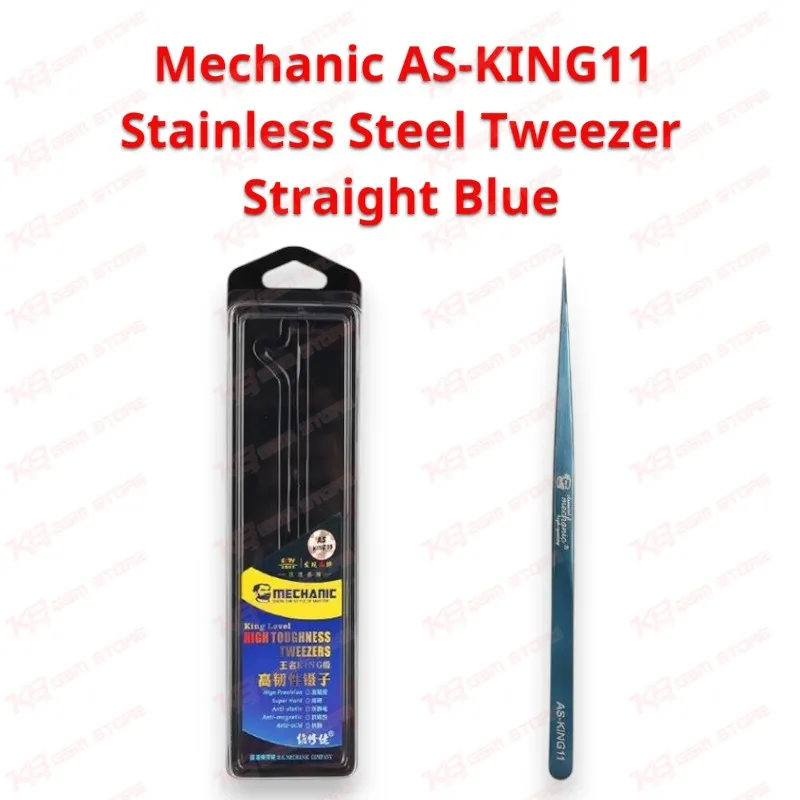
Mechanic AS-KING11 Stainless Steel Tweezer Straight Blue
Mechanic AS-KING11 Stainless Steel Tweezer Straight Blue
Regular price
Rs.1.00 PKR
Regular price
Sale price
Rs.1.00 PKR
Shipping calculated at checkout.
Quantity
Couldn't load pickup availability
The Mechanic AS-KING11 Stainless Steel Tweezer Straight Blue gives you a fine, pointed straight tip for the smallest jobs on your repair bench. Part of Mechanic's THE KING series, it uses high-tenacity stainless steel that stays non-magnetic and resists acid and corrosion, so flux and cleaning chemicals do not eat into the tips. Use it to pick and place SMD capacitors, resistors, and small ICs, lift flex connectors, and hold parts steady under the microscope during IC replacement and jumper work. A dependable everyday straight SMD tweezer for Pakistani repair shops, service centers, and board-level technicians.
SKU:MST-SOLDERING-TOOLS-180
⚖️ Weight: 0.15 kg
- Safe & Secure Payment
- Fast Delivery
- WhatsApp Support


Description
FAQ
What is the product name?
The product name is Mechanic AS-KING11 Stainless Steel Tweezer Straight Blue.
What is the brand of this product?
The brand of this product is Mechanic.
What is the model of this product?
The model of this product is AS-KING11.
What is this product used for?
This product is used for precise handling and placement of SMD components, ICs, and jumper wires during mobile phone and electronics board repair.
Which devices are compatible with this product?
This product is compatible with mobile phone PCBs of any brand, computer boards, watches, and other small electronics, as it is a universal hand tool.
Who should use this product?
This product is suitable for mobile repair technicians, repair shops, service centers, and professional users.
Is the Mechanic AS-KING11 tweezer non-magnetic?
Yes. Mechanic builds THE KING series from non-magnetic stainless steel, so small screws, shields, and SMD parts do not stick to the tips during placement.
Will flux and cleaning chemicals damage the tips?
No. The stainless steel resists acid and corrosion, so regular contact with flux residue and board-cleaning liquids does not corrode the tips.
What is the difference between the KING11 and KING15 tweezers?
The KING11 models carry a straight tip, while the KING15 models carry a bent tip for angled access around tall components and under shields.