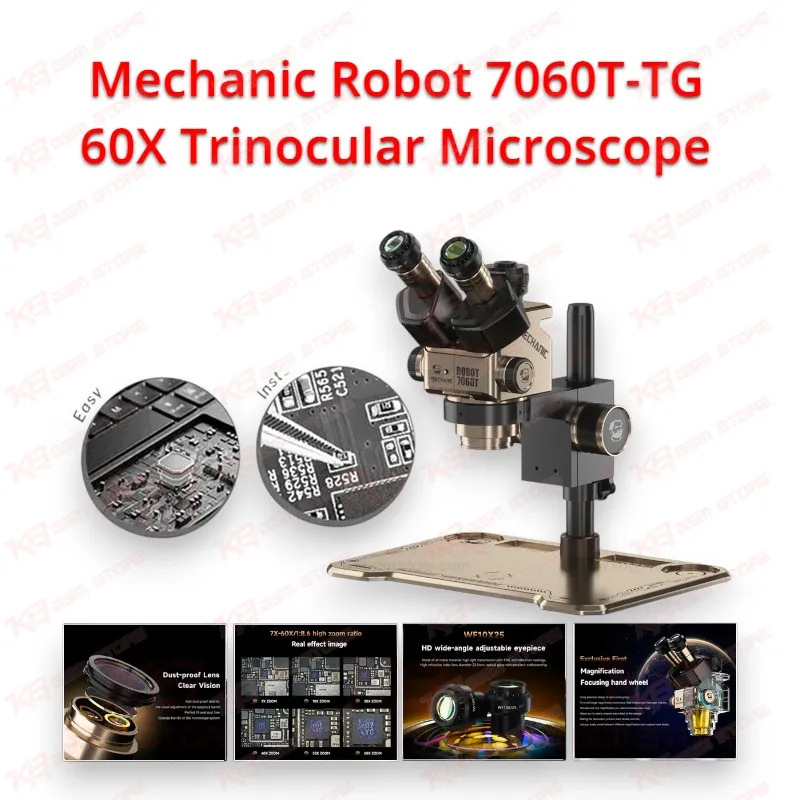
The Mechanic Robot 7060T-TG 60X Trinocular Microscope gives your repair bench the optical depth that dead phone work demands. When a board arrives dead after flash, with a charging issue or stuck hang on logo, the real fault usually hides under a tiny capacitor, a lifted pad, or a cracked ball beneath a chip, and your naked eye cannot confirm any of it. This stereo microscope shows the board in true depth, so you judge solder joint quality, flux residue, micro-cracks, and trace damage before you pick up the iron or the hot air gun. You work from evidence instead of guesses, and that saves you from replacing a good IC or burning a pad you could have saved. The continuous zoom runs from 7X to 60X, so you start wide to scan the whole motherboard, then zoom in on the exact corner of a CPU, eMMC, or power IC that needs attention. The fixed gear function lets you lock the magnification you need, which keeps your view consistent when you move between inspection, soldering, and cleaning on the same board. Many technicians in Pakistan lose time re-adjusting focus every few minutes on cheaper scopes, and this locking design removes that interruption from your workflow. The WF10X25 HD wide-angle adjustable eyepieces give you a generous field of view, and the all-metal build holds up to daily workshop handling. A dust-proof lens on the eyepiece barrel keeps dust off the optical path, which protects image clarity and extends the life of the system in a busy repair environment. The pupil adjustment scale marks let you set and remember your own eye distance anywhere between 55mm and 75mm, so you and your co-technicians can share one microscope without hunting for the right setting every shift. The head tilts and rotates, so you can angle your view around tall components and keep a comfortable posture through long BGA and reballing sessions. The aluminum alloy base adds weight and stability, so the image stays steady while you work with tweezers, solder wick, and flux under magnification. The trinocular design is where this model earns its place beyond plain inspection. The third port accepts a camera through the 0.45X adapter, so you can show a customer the damaged pad before the repair, record the process for your shop's training, or send a clear photo of a tricky board to a senior technician. A camera adapter at 0.45X also gives a wider field of view than many basic adapters, which suits capturing a full chip footprint in a single frame. The package includes a ring lamp, so you get shadow-reduced lighting over the board right away, which matters when you read tiny component markings or trace the edge of a burnt track. On a real repair bench, you place this microscope at the center of your whole PCB repair process. You inspect the board first and find the lifted pad, the corroded connector, or the cold joint. You then use it to guide your hot air station while you remove an IC, and you check pad condition afterward with the zoom at a higher level. During reballing, you align the stencil and confirm ball placement under magnification before you reheat the chip. After the repair, you inspect your work again for bridges, leftover flux, and misaligned components before you power the board. For software-side jobs such as FRP lock, pattern unlock, or boot loop issue, you often need hardware access to ISP pinout points, test points, and tiny jumpers on the board. This microscope helps you place a jumper lagana job with confidence, because you see exactly where the test point sits and whether your wire touches only that pad. When you connect an ISP pinout tool or an eMMC programmer to a dead phone, you confirm each fine wire sits on the correct pad before you power up, which prevents shorts that could damage a board further. This microscope pairs naturally with the rest of your repair setup. You will get the best results when you combine it with a quality hot air station, a temperature-controlled soldering station, a PCB holder, a good multimeter for continuity and short checks, and a reballing kit for BGA work. If you also work with test boxes, ISP pinout tools, eMMC programmers, and UFS adapters, the microscope becomes the tool that verifies every physical connection those devices rely on. For shop owners, a microscope with a camera port also lowers your training cost, because new technicians watch the live feed on a monitor and learn correct soldering and rework technique faster. If you handle Samsung, Oppo, Vivo, Infinix, Tecno, Xiaomi, or iPhone boards, the microscope works with any of them, because the optics depend on the board in front of you rather than on one phone brand. The Mechanic Robot 7060T-TG 60X Trinocular Microscope also suits fine electronic soldering, small component inspection, and general electronics work outside phones, so a workshop that handles laptops or other small boards gets more use from the same investment. Pakistani repair shops often move from a basic single-lens magnifier to a stereo microscope as soon as they start doing IC and CPU level work, and this model fits that step up without forcing you into a laboratory-grade price class. If you plan to grow into BGA rework, CPU welding, and photo-documented repairs, the 7X-60X range and trinocular port give you room to grow. You buy it once and use it every day, on every board that crosses your bench. Order the Mechanic Robot 7060T-TG 60X Trinocular Microscope from KB GSM Store and bring clearer inspection, steadier rework, and better documented repairs to your workshop.