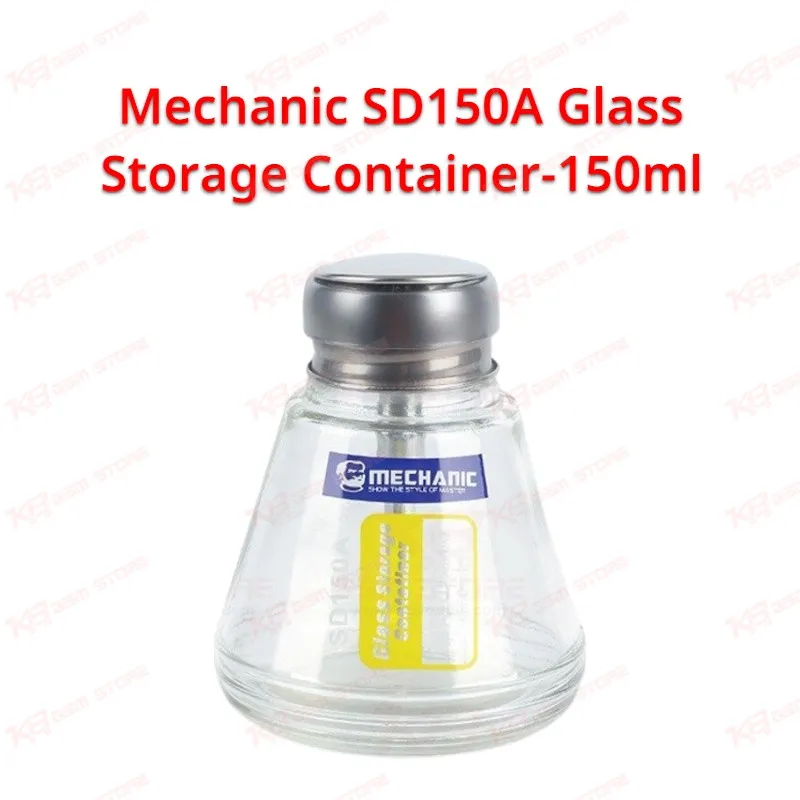
Every repair shop goes through cleaning solvents fast, and how you store them affects both your workflow speed and your board safety. The Mechanic SD150A solves a problem technicians run into daily: leaky containers, evaporating alcohol, and static buildup near open PCBs. This 150ml glass bottle uses a press-type pump system, so you push down once and the liquid comes straight up to the dispensing tip. You don't tilt the bottle, you don't risk spilling thinner across a partially disassembled board, and you keep both hands free for the actual repair work.
The body is glass, not plastic, which matters more than it sounds. Alcohol, flux remover, and other solvents degrade many plastics over repeated use, changing the container's chemical resistance and sometimes contaminating the liquid inside. Glass stays neutral. It doesn't react with corrosive cleaning agents, so what you pour in stays consistent every time you use it. The SD150A carries an aluminum core inside the pump mechanism, built specifically to handle repeated exposure to solvents without breaking down.
Static electricity is a real threat on a repair bench, especially when you're working close to exposed IC pins or a board still connected to a battery. The SD150A's anti-static design reduces the chance of static discharge while you dispense liquid near sensitive components. This isn't a marketing add-on — it's a practical safety feature for anyone doing board-level work where a stray static spark can damage a chip that costs more than the whole toolkit.
The valve seals shut after each press, which does two things for your workshop. First, it stops backflow, so liquid doesn't creep back into the reservoir and cause pressure buildup or leaks. Second, it slows down volatilization. Alcohol and thinner evaporate quickly when left in loosely sealed containers, and technicians who go through several bottles a week know how much product gets wasted this way. A tighter seal means your solvent stays usable longer, and you're not refilling as often mid-shift.
Light transmittance through the glass is another detail that saves time on the bench. You can see the liquid level without unscrewing the cap or holding the bottle up to a lamp. When you're in the middle of cleaning a board after a reflow job, that small visibility advantage keeps your hands moving instead of stopping to check how much solvent is left.
In terms of where this fits into your daily repair workflow, the SD150A works during board cleaning after hot air rework, flux removal following IC reballing, connector and charging port cleaning, and general PCB sanitization before diagnostics. It's not tied to any specific phone brand, chipset, or repair category — it's a support tool that sits on the bench alongside your hot air station, microscope, and soldering iron. Whether you're doing a dead phone diagnosis, prepping a board for a jumper, or cleaning residue after IC change, this bottle handles the solvent side of the job.
For Pakistani repair shops running high daily turnover — multiple boards, multiple technicians, constant solvent use — a dispenser like this cuts down on wasted product and reduces exposure risk near live boards. It's a low-cost addition, but the kind of tool that ends up on every station in a serious workshop once technicians get used to how much faster press-type dispensing is compared to open bottles or dropper bottles.