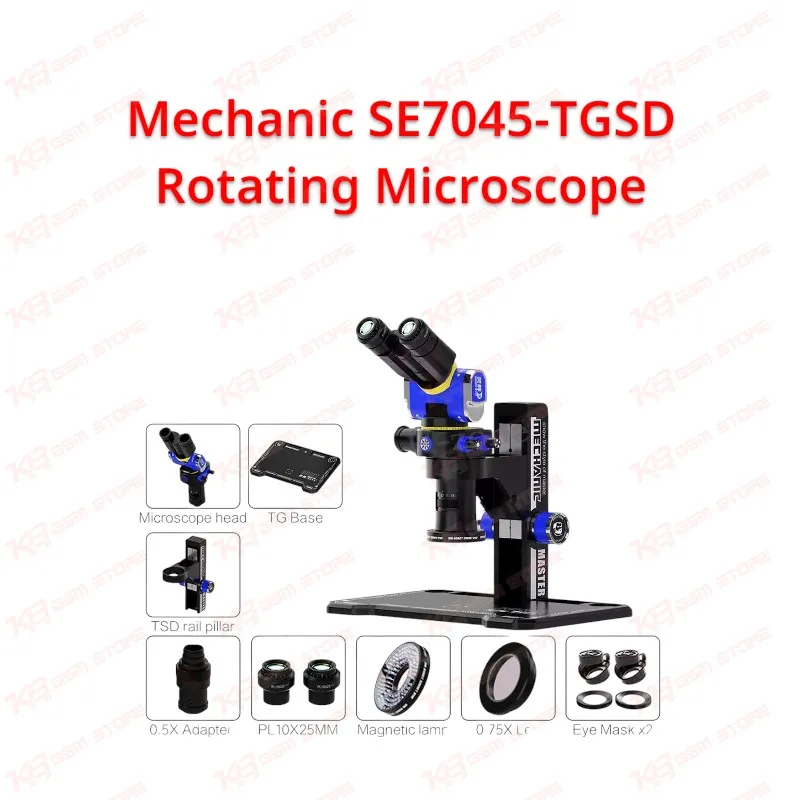
Every motherboard-level repair starts with what you can actually see, and the Mechanic SE7045-TGSD Rotating Microscope gives you a clear, steady view of the board before you touch it with a hot air gun or a soldering iron. When a dead phone lands on your bench, the fault often hides in a lifted pad, a cracked capacitor, a bridged IC leg, or a corroded connector that your bare eyes miss completely. This trinocular stereo microscope magnifies those details with a continuous 7X-45X zoom, built from 0.7X-4.5X zoom optics and WF10X eyepieces, so you move smoothly from a full board overview to a single solder ball without changing lenses. You start wide to locate the damaged area, then zoom in to confirm the exact fault before you commit to the repair. The stereo design gives you real depth perception, which matters when you place tweezers, lay jumper wire, or position a tiny component on a crowded charging section. A flat, uniformly sharp image across the field helps you follow a trace or a row of pads from the centre to the edge without refocusing. The parallel light path optical system supports that clarity and reduces the eye strain you feel after a full day at the bench. The head tilts at 45° and rotates 360°, so you reposition it around your board instead of twisting your neck or your wrist. That freedom helps when you work on long boards, flip the board for the other side, or hand the bench to a colleague who sits at a different angle. The foldable, integrated structure also lets you move the microscope aside when you need open space for a hot air station or a PCB holder, then bring it back over the work in seconds. For Pakistani repair shops where bench space runs tight, that flexibility saves real time during busy shifts. The interpupillary adjustment covers 54mm to 76mm, so technicians with different eye spacing in the same workshop can all set up a comfortable view quickly. Training institutes get a practical advantage too, because the trinocular head lets you attach a compatible camera and show students exactly what you see through the eyepieces. Recording your micro soldering process also helps you document a repair for a customer who asks why an IC change karna cost what it did. You use the Mechanic SE7045-TGSD Rotating Microscope across the full repair workflow, not only for inspection. During diagnostics, you inspect the board for liquid damage, burnt components, and broken connectors after you measure with a multimeter and find a short. During rework, you watch the solder melt, check the alignment of an IC on its pads, and confirm every leg sits correctly before you move on. During reballing, you examine the pads, check the stencil alignment, and verify the new solder balls form evenly across the BGA area. After the repair, you inspect your own joints for bridges, cold solder, and flux residue before you close the phone. This habit cuts comebacks and protects your reputation with customers who expect a clean, lasting fix. The microscope suits the faults Pakistani technicians face every day: charging issues, no power, boot loop issue, hang on logo, network issue, display problem, and dead after flash cases where hardware damage hides behind a software symptom. When you flash a phone and it stays dead, you open the board and look for the real problem under magnification, including damaged eMMC or UFS pads, broken ISP test points, and lifted connector pins. If you work with ISP pinout tools, eMMC programmers, or UFS adapters, this microscope helps you solder fine wires to tiny test points accurately and check each connection before you power the board. Paired with a quality soldering station, a hot air station, and a reballing kit, it completes a serious micro soldering setup. Many technicians buy a programmer or a box first, then discover that their results depend on how well they can see the work. A good microscope upgrades every other tool on your bench, because steadier, more accurate soldering leads to fewer damaged pads and fewer ruined boards. If your current setup uses a basic magnifier lamp or a small handheld loupe, the Mechanic SE7045-TGSD Rotating Microscope marks a clear step up in magnification, depth perception, and comfort. You see finer detail, you hold your posture longer without fatigue, and you work faster on delicate jobs such as small capacitors, power ICs, and CPU area repairs. The metal build keeps the stand steady on a workbench, which prevents image shake when you place a component or press down with tweezers. Shop owners and service centers also value the trinocular head as a long-term investment, because they can add a camera later and turn the microscope into a training and quality-control station without buying a second unit. When you compare options at the same budget level, focus on what matters at the bench: zoom range, image clarity across the field, head movement, eyepiece comfort, and camera readiness. The SE7045-TGSD covers each of these points in one package aimed at mobile and electronics repair. Check your bench layout before you order, because the stand needs space for its base and for the rotating head to swing freely over your work area. Place your PCB holder, soldering station, and hot air station within easy reach of the microscope so you keep your eyes on the eyepieces while your hands do the work. Technicians across Pakistan who handle high volumes of motherboard repair choose this class of microscope because it turns guesswork into confirmed diagnosis, and confirmed diagnosis turns into faster, cleaner repairs and happier customers. KB GSM Store supplies the Mechanic SE7045-TGSD Rotating Microscope for technicians who want a dependable inspection tool, and you can build out the rest of your bench from our microscopes, soldering stations, hot air stations, PCB holders, and reballing kits categories.