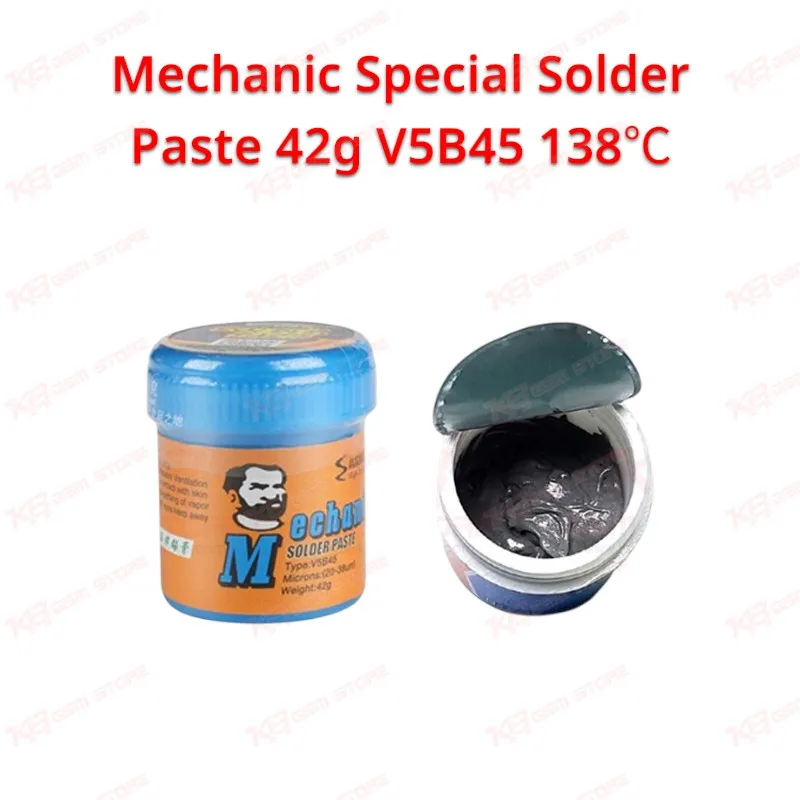
When you're doing chip-level repair on a mobile board, heat control decides whether the job succeeds or the board gets damaged further. Mechanic V5B45 solder paste solves this by melting at just 138°C, well below the 183°C–217°C range of standard paste. That lower threshold means you can reflow or reball a BGA chip without pushing excess heat into nearby ICs, connectors, or plastic components that sit close to the repair area.The paste uses a Sn42Bi58 alloy, a tin-bismuth composition known for forming clean, bright joints without the grainy or dull finish that shows up when solder cools too fast or the flux mix is off. At 20–38 microns, the particle size is fine enough for stencil printing and fine-pitch SMT pads, so you get even paste distribution across small BGA balls or QFN pads without clumping or dragging.On a repair bench, this paste earns its place in a few recurring jobs. Technicians reach for V5B45 when reballing NAND, power management ICs, or CPU packages where the board has already been through one or two reflow cycles and the pads can't take another high-temp pass. It also comes up in dead phone recovery, where a board has hardware fault symptoms tied to a lifted IC or a cracked BGA joint, and a low-temp reflow gives a second chance without frying the board further. For hang on logo issues traced back to a loose CPU or eMMC connection, a controlled 138°C reflow with this paste often resolves the fault without a full chip change.Applying it is straightforward once you've set your hot air station or reflow tool to a matching profile. Print a thin, even layer through a stencil, or apply with a syringe tip directly on the pads, then bring the board up gradually rather than blasting it with high heat from the start. Because the melting point sits low, overheating happens fast if your station runs hotter than needed, so dial in your temperature rather than guessing. Store the syringe in a cool spot, ideally refrigerated between 0–10°C if you're not using it daily, since paste that sits warm for long stretches loses consistency and gets harder to spread evenly.This paste fits into the SMT and BGA rework side of the repair workflow, sitting alongside your hot air station, stencils, and reballing kit. It pairs naturally with ISP tools and eMMC programmers on jobs where a chip needs reflow before it can be re-read or reprogrammed, and it complements microscope work where you're inspecting joints after reflow to confirm there's no bridging or cold soldering.For a repair shop handling volume work, having a low-temp paste on the bench cuts down on board damage from repeated high-heat passes, which matters when margins depend on first-time-fix rates. Whether you're running a BGA station, doing manual reballing with a stencil, or fixing a board with a stubborn charging issue tied to a loose IC, V5B45 gives you a controlled, repeatable way to get clean joints without gambling with board integrity.