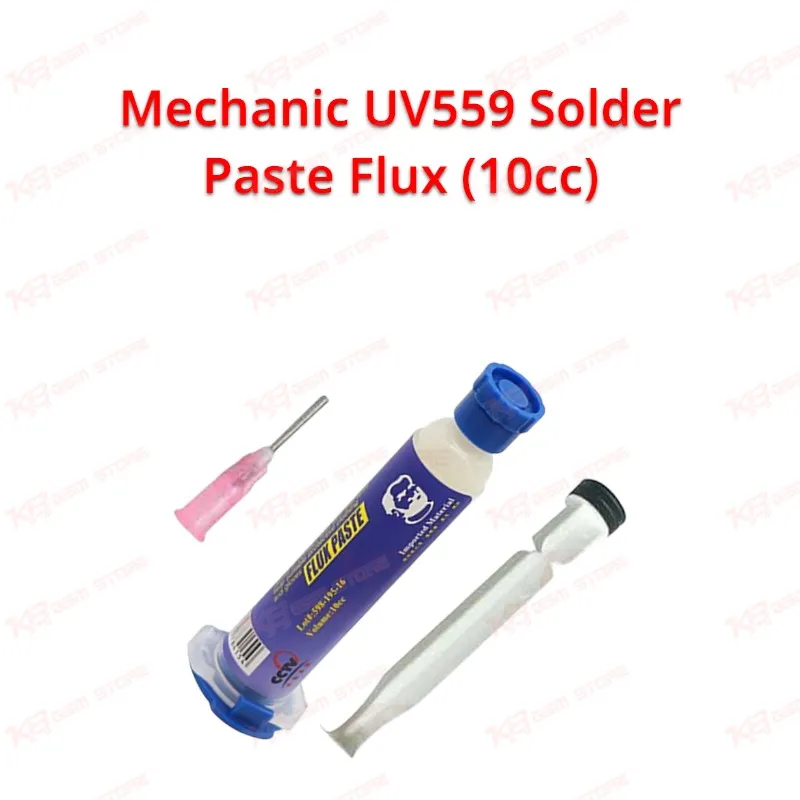
When you're doing IC change karna on a phone motherboard or reballing a BGA chip, the flux you use decides whether the joint holds or fails after a few days. Mechanic UV-559 is a weakly acidic, no-clean solder paste flux made from a blend of high-quality alloyed powder and resinic paste, formulated to give you strong immersion and high-strength joints without leaving the thick, sticky residue that slows down your workflow. You apply it directly from the 10CC syringe using the included needle tip, so you control exactly how much flux goes onto the pad instead of wasting paste or flooding nearby components. The paste sits with a toothpaste-like consistency, which means it stays where you place it on the board instead of spreading into surrounding traces, a real problem when you're working close to tiny SMD parts under a microscope. On your repair bench, this flux earns its place in BGA reballing, CSP ball array repair, IC resoldering, and general PCB rework where you need dependable heat transfer and clean tinning. The weakly acidic formulation cuts through oxidation on gold, copper, phosphorus, and bronze contact points quickly, so your solder flows evenly across the pad on the first pass instead of requiring repeated reheating that stresses the board. Repeated reheating is exactly what damages surrounding ICs and pads, so a flux that works fast reduces your risk of causing a new hardware fault while fixing the original one. Because it's a no-clean formula, you're not stuck scrubbing yellow residue off the board after every job — the residue that does remain stays light in color and peels away cleanly with your fingers or tweezers, protecting the insulation resistance of the board instead of leaving conductive gunk behind that can cause a short circuit later. That insulation property matters more than most technicians realize: a board that looks clean after repair but still has active flux residue underneath a shield can come back with a mysterious charging issue or hang on logo weeks later, and this formula is built to avoid that outcome. UV-559 is lead-free and non-corrosive, so it's safe to use around sensitive components on modern phone boards without eating into pads or nearby solder mask over time. Whether you're on a dead phone with a suspected IC fault, doing a board-level repair after liquid damage, or handling routine SMD rework for a service center, this flux gives you consistent behavior job after job instead of the inconsistent results you get from unbranded, uncontrolled flux pastes. It's become a staple across GSM repair shops and mobile service centers in Pakistan precisely because it performs the same way every time — predictable flux behavior is what lets you standardize your reballing and resoldering process instead of adjusting technique for every new batch. Store it capped and at room temperature, and a single 10CC tube covers a meaningful volume of board-level repair work before you need a refill, making it a cost-efficient addition to your soldering station alongside your hot air rework tool and microscope.