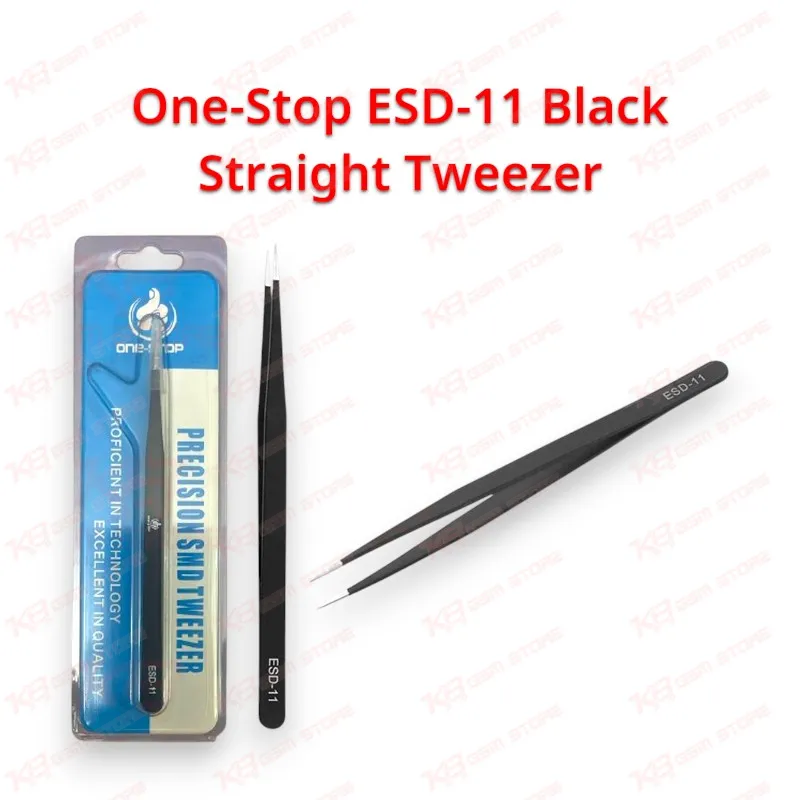
When you're working on a dead phone board with resistors and ICs packed millimeters apart, the tweezer you reach for decides whether the job goes smoothly or turns into a fight with tiny parts under a microscope. The One Stop ESD-11 Black Straight Tweezer is built for exactly that kind of narrow-space precision work. Its slender profile and fine straight tip let you pick up, position, and remove small SMD components — resistors, capacitors, diodes, small ICs — in areas where wider tweezers simply won't fit, which is why the ESD-11 pattern is one of the most common picks on a GSM repair bench for delicate component-level tasks. The tweezer body is machined from stainless steel, giving it corrosion resistance and enough spring tension to hold small parts firmly without crushing them, and the finish stays non-magnetic so it won't interfere with sensitive board components or pick up stray metal shavings while you're cleaning a board. An anti-static (ESD) coating runs across the tool, which matters more than it sounds like it should: static discharge from an ungrounded tool is a real way to kill a PMIC or CPU mid-repair, and this coating helps dissipate that risk while you handle static-sensitive parts. On a typical workshop day, this tweezer earns its place doing jumper lagana on a board after a trace repair, holding small ICs steady during reflow, lifting flex cable connectors off a logic board, and picking foreign debris out of charging ports and connector housings. It's equally useful during diagnostics work, where you might need to lift a shorted component temporarily to isolate a hardware fault, or hold a jumper wire in position while you tack it down with a soldering iron. Technicians dealing with hang on logo issues or board-level shorts often need to isolate components one at a time, and a tweezer with a fine, accurate tip makes that process faster and reduces the chance of damaging neighboring parts on a crowded board. The straight pointed design also helps during screen and display problem diagnostics, where small connectors and ribbon cables need careful handling without scratching or bending pins. Because the tip stays fine and straight instead of splaying out after repeated use, this tool holds its accuracy over time, which matters when you're doing IC change karna work on a daily basis and can't afford tools that lose precision after a few weeks. The black ESD coating also cuts down on glare under bench lighting or a microscope, which helps when you're doing close visual work on fine-pitch components. This tweezer fits naturally into a technician's core toolkit alongside a hot air station, soldering iron, and PCB fixture — it's the tool you pick up dozens of times a day for the small, repetitive tasks that make up most board-level repair work, from component placement during reballing prep to general cleanup and part removal. For repair shops handling a mix of Samsung, Oppo, Vivo, Infinix, Tecno, and iPhone boards, a dependable straight ESD tweezer like this one is a basic requirement rather than an optional extra, since board layouts across brands still rely on the same small SMD footprints that this tool is designed to handle. Add it to your kit as a dedicated component-handling tool, and keep the protective cap on when it's not in use to preserve the tip's accuracy for the next job.