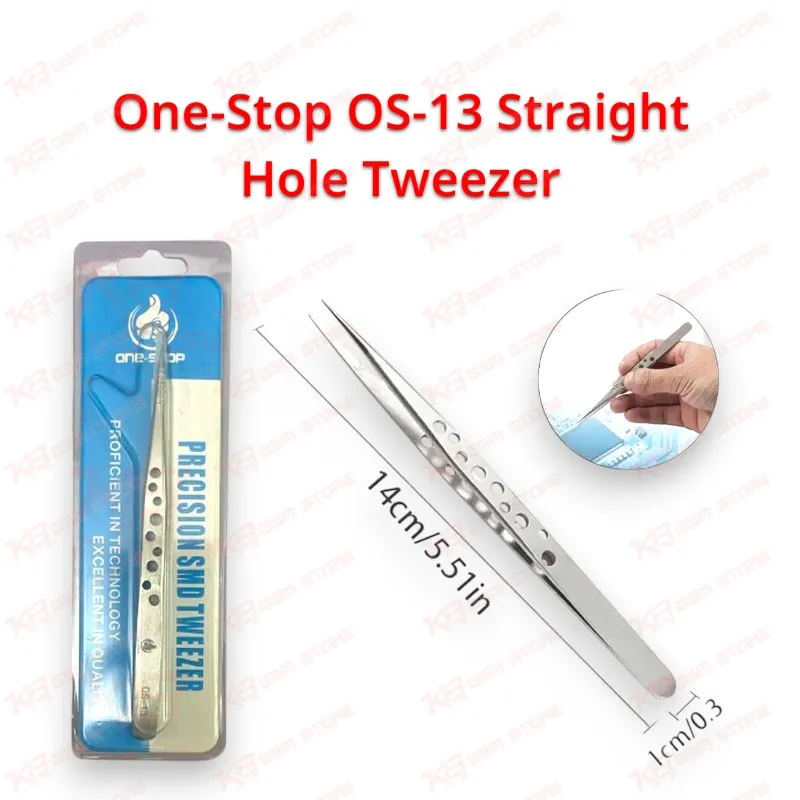
Every board-level technician reaches a point where a normal tweezer just cannot hold a wire steady long enough to get a clean solder joint, and that gap is exactly what the One-Stop OS-13 straight hole soldering tweezer is built to close. The defining feature is the hole positioned near the tip, sized to slot a wire through and clamp it under spring tension so it stays put while you apply solder, instead of slipping or springing back the moment you let go. This turns a two-hand soldering task into a one-hand task, which matters when you are also holding a soldering iron, a flux pen, or steadying a board on your repair mat. The OS-13 uses a cross-lock, reverse-action mechanism, meaning the jaws sit closed by default and only open when you squeeze the handle, so once you release pressure the wire stays gripped without you having to maintain a constant hold. On a busy repair bench this reduces hand fatigue during long soldering sessions and gives you a more consistent grip than standard spring-open tweezers, where the jaws want to snap shut the instant your fingers relax. The straight profile keeps the tool predictable in tight spaces around a PCB, letting you approach a solder point from a direct angle rather than working around a curved or angled tip that can obstruct your view of the joint. Technicians handling jumper wire repairs, dead-after-flash boards that need bridge wires, or reworked charging port and connector pins will find the wire-holding hole particularly useful, since it keeps thin wire aligned exactly where the solder needs to land instead of drifting during the heat cycle. The OS-13 can be used purely handheld for quick jobs, or mounted onto a third-hand soldering base for hands-free wire holding when you need both hands on the iron and solder wire at the same time — a common setup on GSM repair benches working through board-level faults, dead phone diagnostics, or hardware fault tracing. Because it is a straight-with-hole design rather than a curved or angled tip, it pairs naturally with other bench tools already in a technician's kit: fine-point tweezers for SMD placement, curved tweezers for board cleaning, and the OS-13 specifically for the moments where a wire needs to be held firmly under tension. This makes it less of a standalone gadget and more of a workflow piece that slots into an existing soldering and PCB repair routine, alongside hot air rework, IC reballing, and general board-level troubleshooting. For a repair shop or service center outfitting a soldering station, the OS-13 is the kind of low-cost, high-utility addition that removes one of the recurring friction points in daily bench work — holding a wire steady without needing an extra pair of hands. It is not device-specific and carries no chipset or firmware dependency, so its value sits entirely in the mechanical task it performs: gripping and positioning wire during soldering and rework across whatever board or device is on the bench that day.