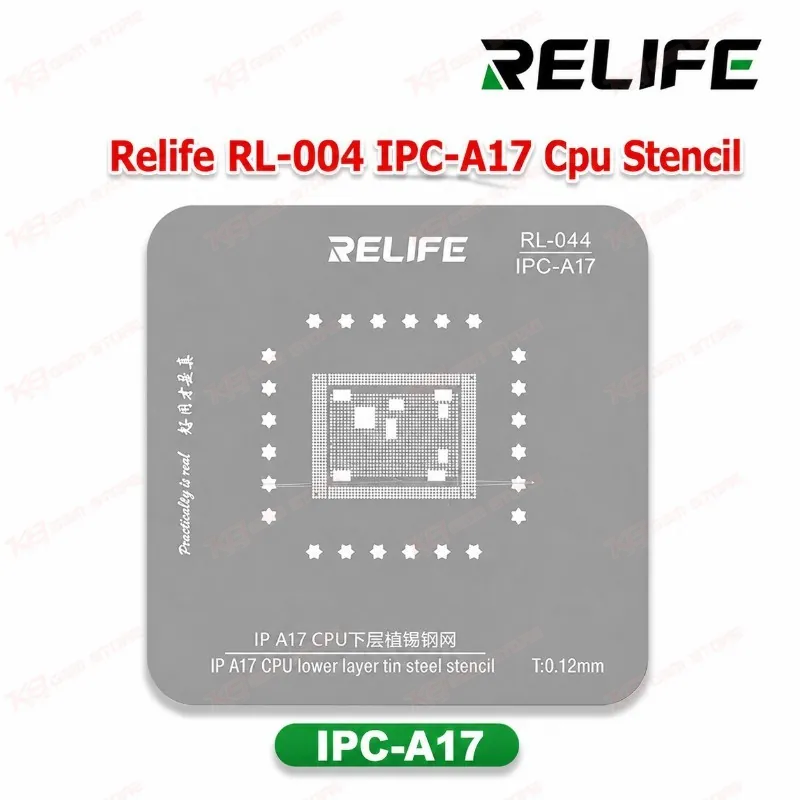
When a technician pulls a faulty Apple A17 CPU off an iPhone 15 Pro or 15 Pro Max board, the real challenge starts after the IC change — getting fresh solder balls planted evenly enough that the chip reflows without bridging, tombstoning, or cold joints, and that is exactly where the Relife RL-004 IPC-A17 Cpu Stencil earns its place on your bench. Cut from special high-grade steel at just 0.12mm thickness, this stencil is engineered specifically as a lower-layer tin planting mesh for the A17 CPU footprint, meaning you are not forcing a generic universal template onto a chip pad layout it was never designed for. Every round and square hole on the mesh sits at a precisely calculated pitch, so when you spread solder paste or drop tin balls across the surface, each pad receives a uniform, fully rounded deposit instead of uneven blobs that cause shorts or open joints once the board goes back under the hot air station. You get a stencil measuring 80mm by 100mm, light enough at around 5 grams that it never adds bulk to your tool tray, yet rigid enough to withstand repeated flexing across dozens of reballing jobs without warping or cracking along the fine hole edges. The steel composition matters more than most technicians realize during CPU work — this grade resists high-temperature exposure during hot air rework and pushes back against metal fatigue, so the stencil keeps its shape and hole accuracy through daily workshop use instead of degrading after a handful of sessions like cheaper aluminum templates do. For a Pakistani repair shop handling dead phone boards, boot loop cases traced back to a faulty CPU, or hang on logo faults that only get resolved through a full IC change and reball, having a stencil matched exactly to the A17 lower layer removes the guesswork that leads to a second reflow attempt and wasted board time. You place the stencil directly over the cleaned CPU footprint on the board or platform, apply your solder paste or tin balls across the mesh, and lift it away to leave behind a clean grid of evenly sized solder deposits ready for reflow — no manual dot placement, no eyeballing pad spacing under the microscope. Technicians moving from basic universal reballing kits to model-specific stencils typically notice fewer rework passes and cleaner joints on the first reflow, which directly cuts the time a board sits on your bench and reduces the callback rate on CPU-related repairs. The Relife RL-004 IPC-A17 Cpu Stencil sits naturally within a broader reballing workflow that includes a BGA rework platform or fixture, hot air station, flux, solder paste or preformed balls, and a microscope for final inspection, so shops already running ISP or eMMC tools on the same bench can slot this stencil straight into their CPU reballing stage without changing their existing setup. Because it targets the A17 CPU specifically, this tool sees the most use in service centers and technical training institutes working on current-generation iPhone 15 Pro series boards, where CPU-related dead phone faults and charging or network issues traced back to a damaged chip package are common enough that a dedicated, accurate stencil pays for itself within the first few repairs. Store it flat, keep it away from unnecessary bending or heavy items stacked on top of it, and the fine hole geometry stays intact for a long service life on your repair bench.