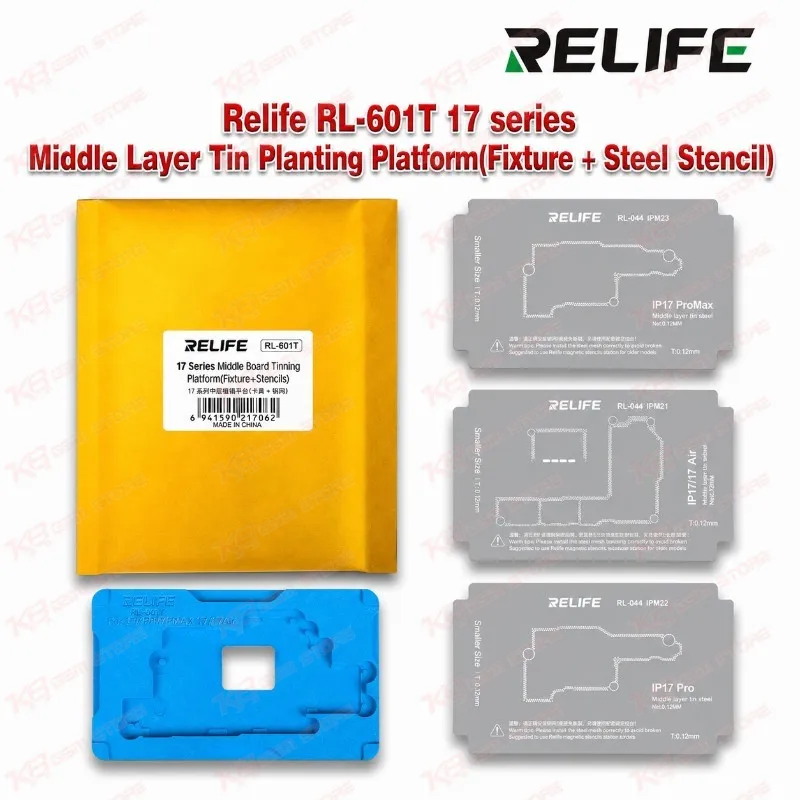
The RL-601T from Relife solves a problem every GSM technician working on iPhone middle-layer motherboards knows well: keeping a separate reballing stencil for every iPhone generation clutters the bench and slows down the job, especially when a shop handles everything from an old iPhone X board to a fresh iPhone 17 Pro Max unit. This system replaces that scattered setup with one magnetic base and a matched stencil kit covering iPhone X through iPhone 17 Pro Max middle-layer boards, so when a customer brings in a dead phone after liquid damage, a boot loop issue, or a board that needs IC change and reballing, you reach for a single tool instead of digging through a drawer of mismatched stencils. The core of the design is its automatic magnetic positioning, built using strong neodymium magnets that pull the stencil into millimetric alignment over the CPU, NAND, or baseband pads the moment you place it on the board. This matters on middle-layer sandwich boards because even a slightly off-center stencil wastes solder paste and risks bridging between pads, and on newer iPhone boards where component spacing is tighter than ever, that margin for error keeps shrinking. With the RL-601T's magnetic lock, you get repeatable, centered placement every time without hand-holding the stencil in position while you apply paste, which speeds up multi-board days and reduces rework. The stencil holes themselves use a laser-cut tapered geometry, wider on top and narrowing toward the board contact point, so solder paste releases cleanly instead of sticking inside straight-walled holes. That tapered design is what gives you uniform solder ball height and shape across the whole chip footprint on the first pass, cutting down the "reflow and redo" cycle that eats into workshop time when balls come out uneven or bridged. Underneath the stencil sits a thermally insulated base, built from synthetic stone combined with a steel structure, engineered to absorb and dissipate heat generated during the reflow and reballing process rather than letting that heat transfer straight into the motherboard substrate. On a middle-layer board, uncontrolled heat spread is one of the fastest ways to damage neighboring components or delaminate PCB layers, so this insulation layer is a practical safeguard, not just a spec sheet line. The base itself locks down with steel positioning pins, keeping the whole setup rigid on the bench so the board doesn't shift mid-reflow, which is especially important when you're working under a microscope with a hot air station running close to the surface. In terms of where this tool sits in your repair workflow, the RL-601T comes into play right after board-level diagnostics confirm a chip-off repair is needed, whether that's a CPU that needs reballing after a "hardware fault" diagnosis, a NAND swap on a board with storage corruption, or baseband IC reballing on a phone showing persistent network issue symptoms. It's a hardware-side tool, so it pairs naturally with your existing hot air rework station, BGA reballing kit, and microscope, and it fits directly into any ISP, eMMC, or CPU repair workflow that already runs through your bench. For a shop handling volume repair work across multiple iPhone generations, consolidating stencils into one magnetic system also means less inventory to manage and fewer chances of grabbing the wrong stencil size mid-job. The RL-601T is built for professional and semi-professional repair environments, not casual hobby use, and it rewards technicians who already understand reballing fundamentals rather than replacing that skill. Used correctly, with clean pad prep and proper reflow temperature control, it gives Pakistani repair shops and mobile service centers a way to handle iPhone motherboard reballing jobs, from an older X series board to the latest 17 Pro Max, without constantly re-tooling the bench between customers.